
Your website works. It loads, it looks professional, it explains what you do, and it has been converting a reasonable proportion of its visitors into enquiries for years. The design isn’t embarrassing. The copy is clear enough.
The problem is that it was built for a search landscape that has changed substantially, and it is not being read the way AI search engines need to read it to recommend your business. This is not a redesign problem. It is a layer problem.
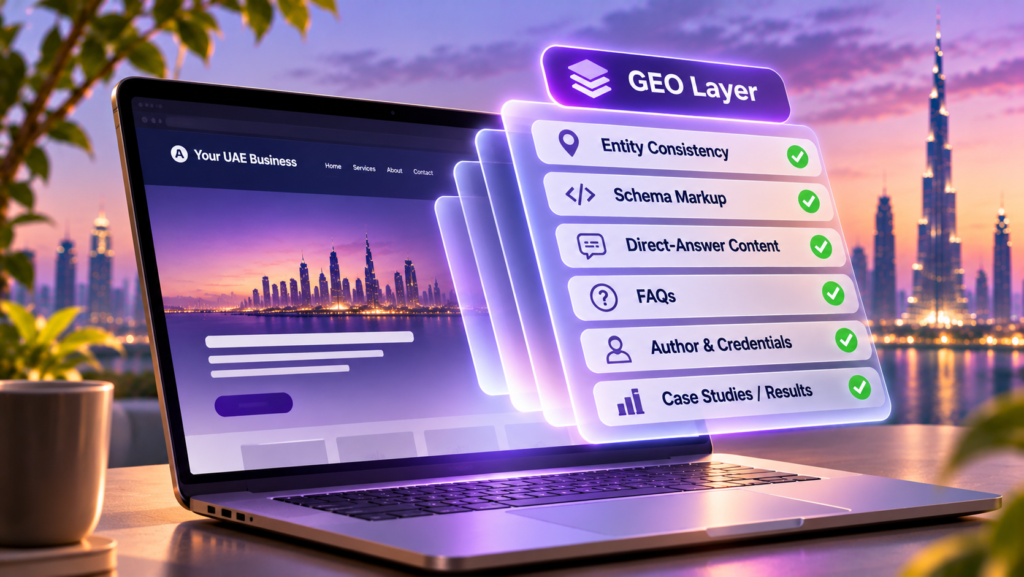
A GEO layer is what closes the gap between a functional UAE business website and one that performs in AI search. Adding it doesn’t require rebuilding what works. It requires adding what’s missing.
What is a GEO layer?
GEO stands for Generative Engine Optimization. It’s the practice of structuring your website and digital presence so that AI search engines, including ChatGPT Search, Perplexity, Google AI Overviews, and Gemini, can accurately read, understand, and cite your business in their responses.
A GEO layer is the specific set of changes added to an existing website to achieve this. It is not a new design, a new domain, or a new content strategy from scratch. It works on top of what’s already there.
Most UAE businesses that need a GEO layer fall into a recognisable pattern: they rank adequately on Google, they have a reasonable digital presence, and they are nearly or completely invisible when potential clients search for their type of service using AI tools. The gap between their Google visibility and their AI search visibility is the GEO problem. The layer is the solution.
What does a GEO layer actually include?
The specific elements of a GEO layer vary by website, but most UAE service business websites need a version of the following:
Entity information consolidation. Before changing anything on the website, the GEO layer starts with ensuring that your business name, address, phone, and primary service description are consistent across your website, Google Business Profile, LinkedIn, and key directories. Inconsistencies across these sources are active negative signals for AI engines. Resolving them doesn’t require touching your website design at all.
Schema markup implementation. Schema is structured data code added to your website pages that tells AI engines and search platforms exactly what type of business you are, where you operate, what services you offer, and how to contact you. Most established UAE websites either have no schema or have outdated schema that no longer reflects the current business. Adding current, accurate schema is typically a few hours of developer time and produces meaningful AI visibility improvements.
Direct-answer content blocks added to existing service pages. Rather than rewriting your service pages, a GEO layer adds specific question-and-answer content to them. These blocks directly answer the questions UAE buyers ask about your service: who it’s for, what the process involves, how long it takes, and what outcomes clients typically see. The existing marketing copy stays. The GEO layer adds information above, below, or alongside it.
FAQ sections on key pages. AI engines extract question-and-answer content with high reliability. A FAQ section on each main service page is one of the highest-leverage GEO additions, because each answered question becomes a potential AI citation. The questions should be written as buyers actually ask them, not as the business wishes they were asked.
Author bios with specific credentials. If your website has any written content such as blog posts, guides, or case studies, adding author bios that state genuine qualifications and experience adds a trust layer that AI engines use when evaluating whether content is citable. “Written by [Name], a licensed architect with 12 years of commercial project experience in the UAE” contributes differently than anonymous content.
Glossary or definition pages for key terms. For businesses in technical or specialised industries, short pages that define key terms in your industry serve two purposes: they answer informational queries from potential clients, and they signal to AI engines that your website is an authoritative source in your category.
A client results or case study page with text-based outcomes. AI engines cite specific, factual outcomes. A case study page that describes client challenges, approaches, and measurable results in plain readable text gives AI engines exactly the type of content they look for when forming recommendations.
How long does it take to add a GEO layer to an existing UAE website?
For most UAE service businesses with websites of five to fifteen pages, a comprehensive GEO layer takes three to six weeks to implement. The timeline breaks down roughly as:
Entity audit and information consolidation across platforms: one to two weeks, depending on how many inconsistencies exist and how many platforms require updates.
Schema markup implementation: two to three days of developer time, plus review.
Content additions, FAQ sections, direct-answer blocks, author bios, and case study page: two to four weeks, depending on how much information needs to be gathered from the business.
Most of this work is content development and information management, not code. For most UAE websites, the developer involvement is limited to schema implementation and any structural changes needed to support the new content sections.
Why doesn’t existing SEO work cover this?
Traditional SEO and GEO optimisation target different things, and a website can be well-optimised for one while being inadequately prepared for the other.
Traditional SEO is primarily about keyword relevance and domain authority. A well-SEO’d page is one that ranks well for target keywords through a combination of content relevance, internal linking, and inbound backlinks. The goal is page ranking.
GEO optimisation is about entity recognition and answer extraction. A well-GEO’d page is one that AI engines can read accurately, understand in the context of a specific business entity, and extract specific, citable information from. The goal is AI recommendation.
A page optimised for keyword ranking often uses phrases and density patterns that don’t serve AI extraction. A page optimised for AI extraction often prioritises directness and specificity over keyword placement. The best UAE business websites are optimised for both, but this requires intentional work on both dimensions.
Working with an SEO and GEO agency Dubai that understands both dimensions will produce a GEO layer that doesn’t compromise your existing Google rankings while adding the AI visibility your current setup is missing.
Signs your UAE website needs a GEO layer
Several clear signals indicate that an existing website is missing its GEO layer:
You appear on the first page of Google for your main service keywords but don’t appear when potential clients ask ChatGPT or Perplexity for recommendations in your category.
Your service pages have strong keyword optimisation but no FAQ sections and no direct-answer content blocks.
Running a schema validator against your website pages shows no structured data, or data that no longer matches your current business.
Your Google Business Profile description, your LinkedIn bio, and your website homepage describe your business in noticeably different terms.
Your best case studies are in PDF format or embedded in slide decks rather than as text-based web pages.
Your business has been operating for three or more years but has never done a systematic entity audit.
Practical approach to adding a GEO layer to an existing website
If you’re managing this process yourself rather than working with a specialist, the practical sequence is:
Start with the entity audit. Fix every inconsistency in how your business appears across the web before changing anything on the website itself. This is the foundation.
Then add schema markup. Even without any content changes, accurate, current schema markup produces AI visibility improvements for most UAE websites.
Then add FAQ sections to your two most important service pages. Write ten to twelve questions for each, answered in plain language, and add them before the footer of each page.
Then work outward from there: adding direct-answer content blocks, building case study pages, adding author bios.
A digital marketing agencies in Dubai that manages GEO alongside your broader digital strategy will sequence these changes for maximum impact at each stage, rather than attempting everything simultaneously.
The technical implementation is typically handled by a website design company in UAE working from a content brief prepared by the GEO specialist. The designer or developer doesn’t need to understand GEO theory; they need a precise brief telling them what schema to add, what content sections to build, and where to place new content blocks.
Content that feeds into the GEO layer also benefits from a social media management Dubai strategy, because social content that drives traffic back to optimised GEO pages creates engagement signals that strengthen the overall digital footprint.
For the detailed checklist of what AI crawlers need from your UAE business website, what AI crawlers and human visitors both need from your UAE business website covers the specific technical and content requirements in a format you can apply directly.
For a look at what GEO looks like from the ground up for a new website, how to build a website that works for both Google and AI search provides the structural framework.
Frequently Asked Questions
Will adding a GEO layer affect our existing Google rankings? In most cases, no. GEO layer additions, primarily FAQ sections, schema markup, and direct-answer content, are additions to existing pages rather than changes to existing content. They typically improve or maintain existing Google rankings while adding AI search visibility.
Does the GEO layer need to be redone as AI search evolves? The foundational elements, entity consistency, schema markup, specific content, are durable. The specific questions and answers in FAQ sections benefit from periodic review as buyer questions evolve. Treat the GEO layer as living content that gets reviewed quarterly rather than as a one-time implementation.
Can we add a GEO layer to any website platform? Yes. Schema markup can be added to any website platform including WordPress, Webflow, Squarespace, and custom-built sites. Content additions work on any CMS. The technical approach varies by platform, but the GEO layer itself is platform-agnostic.
What’s the cost of adding a GEO layer to an existing UAE website? It varies significantly by website size and the depth of changes needed. For a typical UAE service business website with five to ten pages, a comprehensive GEO layer implementation, including entity audit, schema, FAQ sections, and case study page development, typically represents a fraction of the cost of a full website redesign, while producing measurable AI search visibility improvements within two to four months.