For most of the last decade, building a website that performed well online meant one thing: optimizing for Google. Keywords, backlinks, page speed, meta descriptions. The rules were well understood, and the goal was clear.
That is still true. But it is no longer the whole picture.
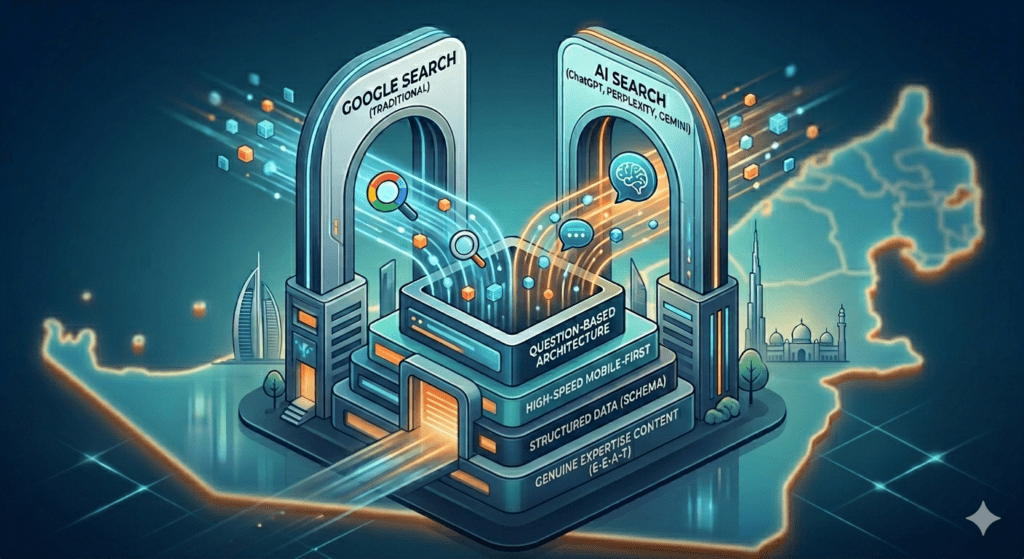
In 2026, your website needs to do something it was never originally designed to do: speak clearly to AI engines. ChatGPT, Google’s AI Overviews, Perplexity, Gemini, and a growing list of other AI-powered tools are now answering questions and making recommendations that used to require a Google search. And the websites they pull from, reference, and recommend are not always the ones with the highest traditional SEO rankings.
For UAE businesses, this shift is both a challenge and an opportunity. The challenge is that optimizing for AI search requires understanding a different set of principles. The opportunity is that most of your competitors have not started yet.
Here is how to build or rebuild a website in 2026 that performs strongly in both worlds.
What Is the Difference Between Optimizing for Google and Optimizing for AI Search?
Traditional SEO is fundamentally about signals. You are trying to convince Google’s algorithm that your page is the most relevant and authoritative result for a specific query. Keywords, technical structure, backlink profiles, and user engagement metrics all feed into that judgment.
AI search works differently. When someone asks ChatGPT or Perplexity a question, the AI is not ranking pages in order of authority. It is synthesizing an answer from everything it knows, and it is most likely to reference or recommend sources that it has learned are clear, credible, and genuinely useful.
The websites that perform well in AI search tend to share a set of characteristics: they answer questions directly and completely, they use clear and natural language rather than keyword-stuffed copy, they demonstrate genuine expertise on their topic, and they are structured in a way that makes it easy for both humans and machines to extract meaning.
The good news is that these characteristics also produce better traditional SEO performance. Building for AI search and building for Google are not opposing strategies. They are increasingly the same strategy, with slightly different emphases.
How Should a UAE Business Structure Its Website Content for AI Engines?
The most important structural shift for AI search is moving from a product-first to a question-first content architecture.
Most business websites are organized around the business. There is a page for each service, a page about the company, and a contact page. This structure makes sense from an internal perspective but tells AI engines very little about what problems the business actually solves for real people.
A question-first architecture organizes content around what your potential customers are actually asking. Instead of a generic “digital marketing services” page, a UAE marketing agency might have individual pages or blog articles that answer questions like “how much does social media management cost for a small business in Dubai” or “what is the difference between SEO and GEO for UAE businesses.” These are the questions people are asking AI tools, and a website that answers them clearly is one that AI engines learn to reference.
This does not mean your service pages disappear. It means they are supported by a layer of content that connects your expertise to real questions, and that layer is what AI engines actually use when deciding what to recommend.
Does Page Speed and Technical SEO Still Matter for AI Search in 2026?
Yes, and arguably more than before.
Google’s AI Overviews, which appear at the top of search results and synthesize answers from multiple sources, still pull from pages that Google can crawl and index efficiently. A website that loads slowly, has broken internal links, or is poorly structured technically is harder for search engines and AI crawlers to process, which limits how well its content gets represented in AI-generated answers.
For UAE businesses, a few technical priorities stand out as particularly important heading into 2026.
Core Web Vitals, Google’s set of page experience metrics, continue to influence both traditional rankings and AI Overview inclusion. A website that loads in under two seconds on mobile, does not have jarring layout shifts, and responds quickly to user interaction is giving itself a technical advantage that slower competitors do not have.
HTTPS is non-negotiable. Any UAE business website still running on HTTP is sending a trust signal that harms both SEO and AI credibility.
Mobile performance is critical. The majority of web browsing in the UAE happens on mobile devices, and Google’s mobile-first indexing means your mobile experience is effectively your primary website in the eyes of both search engines and AI tools that pull from indexed content.
Structured data markup, which adds a layer of machine-readable information to your website’s code, has become significantly more valuable in the AI search era. Marking up your content with appropriate schema helps AI engines understand exactly what your page is about, what type of business you are, where you are located, and what questions your content answers.
What Kind of Content Does a Website Need to Perform in Both Google and AI Search?
The content that performs best in both traditional and AI search in 2026 shares a set of qualities that are worth understanding in detail.
It answers a specific question completely. AI engines, like good search engines, reward completeness. A page that gives a partial answer and then pushes the reader to contact you for the full picture is not going to be cited by ChatGPT. A page that thoroughly addresses a question, including nuances, exceptions, and context, is far more likely to be used as a reference.
It demonstrates expertise in ways that are verifiable. Author information, credentials, specific case examples, and data references all contribute to what Google calls E-E-A-T (Experience, Expertise, Authoritativeness, and Trustworthiness). AI engines have learned to recognize similar signals. A page written by someone with named, verifiable expertise on a topic is treated differently than anonymous generic content.
It uses natural language structured around questions. The way people speak to AI tools is conversational and question-based. Website content that naturally incorporates question-based headings, as this article does, mirrors the structure of the queries AI engines are trying to match. This is not a trick. It is an alignment between how questions are asked and how answers are structured.
It is updated regularly. Stale content is a liability in both traditional SEO and AI search. Google’s systems deprioritize outdated pages, and AI engines trained on recent data are more likely to reference current sources. For UAE businesses, adding a publication date and updating key pages at least quarterly makes a meaningful difference.
How Do You Make a Website That AI Engines Recognize as Authoritative?
Authority in AI search is built through a combination of on-site and off-site signals, and both need attention.
On your website, authority comes from depth and specificity. A ten-page website with shallow content across all ten pages is not an authority site. A website with four genuinely excellent pages that comprehensively address specific topics within your industry carries more weight with AI engines than a site with fifty thin pages.
For UAE businesses, local authority signals matter significantly. Your website should clearly reference your location, the specific markets you serve, and any local credentials, memberships, or recognitions that connect you to the UAE business community. Being recognized by the Dubai Chamber, listed with a UAE industry association, or featured in a UAE publication are all authority signals that feed into how AI engines perceive your business.
Off your website, authority is built through citations. When other credible websites, publications, and directories reference your business, link to your content, or mention your expertise, AI engines learn to associate your name with your field. For UAE SMBs, a practical starting point is ensuring consistent and complete listings across the major UAE business directories, maintaining an active and credible LinkedIn company page, and looking for opportunities to contribute expertise to industry publications or business media.
What Role Does Your Website’s FAQ Section Play in AI Search?
This is one of the most underused tools available to UAE businesses for AI search optimization.
A well-constructed FAQ section does two things simultaneously. It directly answers the specific questions your customers are asking, in exactly the kind of clear and concise format that AI engines prefer to pull from. And it adds structured, question-based content to your site without requiring the full depth of a dedicated article for every topic.
AI tools like ChatGPT frequently pull short, direct answers from FAQ sections because they are formatted as questions and answers, which is precisely the structure the AI is trying to replicate when it generates a response.
For UAE businesses, FAQ content should include questions with local specificity wherever it fits naturally. “How long does a website build typically take for a UAE startup?” or “What are the most important digital marketing channels for an SMB in Dubai in 2026?” are both more useful to AI engines trying to serve UAE users than generic versions of the same questions.
Mark up your FAQ section with FAQ schema. This structured data markup tells search engines and AI crawlers explicitly that this section is formatted as questions and answers, which increases the likelihood of it being selected as a reference in AI-generated responses.
How Do You Balance SEO Keyword Strategy With the Natural Language AI Engines Prefer?
This is where many website owners get stuck, trying to reconcile the keyword-focused approach they learned for traditional SEO with the more conversational content style that performs better in AI search.
The resolution is simpler than it might seem. Keywords remain important, but they work best when they are embedded in content that is genuinely written for humans. Keyword stuffing, awkward keyword placement, and content that reads like it was written to rank rather than to inform all perform poorly in 2026 across both traditional and AI search.
The approach that works is writing content that thoroughly addresses a topic, and then ensuring the language you naturally use when discussing that topic includes the terms and phrases your potential customers would use when searching for it. This is not a compromise. It is what good content looks like when the primary goal is genuine usefulness.
For UAE businesses, this means using the terminology your customers actually use. If your customers call it a “trade license” rather than a “commercial license,” use the language they use. If they search for “affordable website design Dubai” rather than “cost-effective web development solutions UAE,” write for the way they actually search. Natural alignment between your content language and your audience’s search language is the approach that serves both traditional SEO and AI search simultaneously.
Conclusion
Building a website that works for both Google and AI search in 2026 is not about choosing one approach over the other. It is about recognizing that the underlying principles are converging: clear answers, genuine expertise, natural language, strong technical foundations, and a credible off-site presence.
For UAE businesses, the opportunity right now is that most websites in the local market were built for a 2019 version of search. They are optimized for a set of rules that is increasingly incomplete. A website rebuilt with both traditional and AI search principles in mind does not just perform better today. It is positioned for a search landscape that is only going to become more AI-driven over the coming years.
The businesses that invest in getting this right now are building a digital asset that compounds in value. The ones that wait are not just missing opportunity. They are letting competitors build the authority that will be very difficult to catch up to later.
FAQ
Is traditional SEO still worth investing in for a UAE business in 2026? Absolutely. Traditional Google search still drives significant traffic and leads for UAE businesses. The most effective approach in 2026 is building a strategy that serves both traditional SEO and AI search simultaneously, since the core principles of both are increasingly aligned.
How often should a UAE business update its website content for AI search? Key pages should be reviewed and updated at least quarterly. Blog and article content should be added consistently, with at least two to four new pieces per month for businesses actively pursuing AI search visibility. Freshness is a positive signal for both Google and AI engines.
Does having a multilingual website help with AI search visibility in the UAE? It can, particularly for businesses serving Arabic-speaking customers. Arabic-language content reaches a significant portion of the UAE market and creates additional citation and indexing opportunities. Businesses serving specific expat communities may also benefit from content in relevant languages.
What is structured data markup and is it worth implementing for a small UAE business? Structured data is code added to your website that explicitly tells search engines and AI crawlers what your content means, what type of business you are, and what questions your content answers. It is worth implementing, particularly for local business schema and FAQ schema, and most web platforms support it through plugins or built-in tools.
How does a UAE business know if its website is being referenced by AI engines? Search for your business name and key service terms in ChatGPT, Perplexity, and Google’s AI Overviews. Note whether your website is cited or referenced. Track this over time to see whether your optimization efforts are producing improved AI visibility. This informal audit is a useful starting point before investing in more sophisticated monitoring tools.