
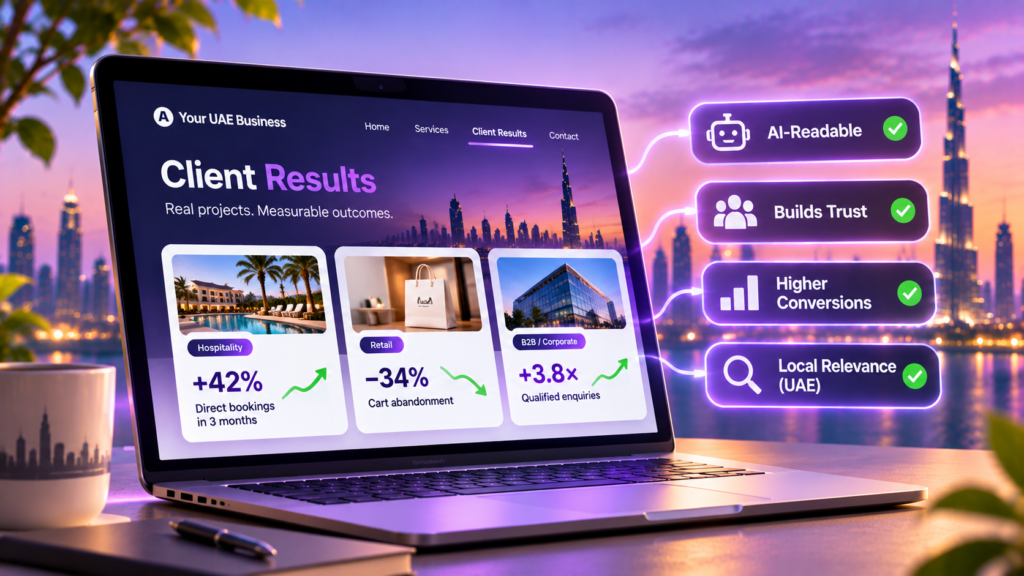
The evidence exists. Client feedback, documented project outcomes, before-and-after comparisons, measurable results: most established UAE service businesses have accumulated a meaningful body of proof over the years. The problem isn’t a shortage of social proof. It’s where that proof lives.
Screenshots in a folder nobody visits. Instagram posts from 2022. PDF case studies that require download. Testimonials embedded in WhatsApp threads. Google reviews that don’t mention specific outcomes. LinkedIn posts that the algorithm served to eight hundred people in 2023 and has been invisible to everyone since.
This scattered social proof does almost nothing for the people who most need to find it: potential clients researching your business, and the AI search engines increasingly doing that research on their behalf.
A dedicated client results page consolidates that proof into a single, permanently accessible, AI-readable location that serves both purposes at once.
Why scattered social proof underperforms
UAE service buyers, particularly in B2B contexts across financial services, consulting, technology, and professional services, tend to research thoroughly before engaging. The research pattern has shifted. A buyer in DIFC looking for a new legal translation service doesn’t just check Google. They check Perplexity, they search in ChatGPT, and some check Gemini. They are looking for evidence from multiple directions before making contact.
Scattered social proof fails this research pattern in several specific ways.
Social media posts are largely inaccessible to AI search engines. ChatGPT Search and Perplexity don’t reliably read Instagram content or LinkedIn posts, and their ability to access this content is limited even where it technically exists. A strong client success story shared as a Reel in January reaches zero of the AI search engines conducting research on your category in October.
PDFs create barriers at multiple levels. Buyers often won’t download an unfamiliar file. AI search engines don’t reliably extract content from PDF case studies. Search engines index them inconsistently. The content is effectively trapped.
Google reviews contain useful testimonials but rarely contain specific outcomes. “Great service, highly recommend” is not the kind of specific, factual claim that an AI search engine can extract and use in a recommendation response. “Reduced our turnaround time from five days to same-day” is.
What a client results page includes
A results page works differently from a testimonials section because it is structured around outcomes rather than sentiment.
The most effective UAE service business results pages share a specific structure. Each entry covers a client type (not always a named client, given common UAE confidentiality norms), a clear description of the problem or situation, the approach taken, and the specific outcome achieved with measurable figures wherever possible. This structure gives AI engines exactly what they look for when forming a recommendation: specific, factual, verifiable claims from a real business about real work.
The outcome figures matter more than almost anything else on the page. “Our client’s website now ranks on the first page of Google” is weak. “Our client’s website moved from page four to position two for their primary keyword within three months, resulting in a forty percent increase in qualified enquiries” is strong. AI engines cite specific claims. Generic testimonials get ignored.
Each entry should also name the general service involved and, where possible, the industry or location. A consulting firm whose case study section describes projects in Abu Dhabi government, Dubai retail, and Sharjah manufacturing is an entity that AI engines can read with geographic and sectoral specificity. That specificity matters for local relevance in AI search results.
Supporting the entries, the page should include a short introductory paragraph establishing how long the business has operated, how many clients it has worked with, and what types of clients it typically serves. This entity context frames every case study that follows.
The GEO benefit: why AI engines read this page differently
Working with a GEO agency in UAE will often surface the client results page as a high-priority implementation, because it does something that is difficult to achieve through any other single page type.
AI engines form recommendations by extracting and synthesising information from multiple sources. When a potential client asks ChatGPT “which graphic design agencies in Dubai have worked with hospitality clients”, the response draws on whatever specific, credible, extractable information exists about businesses matching that description. A results page with specific client outcomes in hospitality is the most direct way to position your business as a credible answer to that question.
The page also addresses what AI researchers call the trust signal problem. When AI engines evaluate whether to include a business in a recommendation response, they look for corroborated claims across multiple signals. A results page that describes specific outcomes, combined with Google reviews mentioning similar outcomes, combined with published case study content, creates a coherent picture that multiple AI engines can draw on simultaneously.
Perhaps most practically for UAE service businesses: a results page converts private WhatsApp testimonials and verbal client praise into public, indexed, AI-readable evidence. The praise already exists. The page makes it work.
Privacy and confidentiality in UAE client results
This is the objection that stops many UAE businesses from building this page, and it is worth addressing directly.
Many UAE business relationships involve explicit or implied confidentiality expectations. Clients in financial services, government-adjacent work, and professional services often cannot be named publicly. Some industries have cultural norms around discretion that make naming clients feel inappropriate regardless of whether it’s technically permitted.
A results page can be built entirely without naming clients. “A regional logistics firm based in Jebel Ali” or “a professional services company operating from DIFC” conveys industry, location, and context without identifying anyone. The outcomes remain specific and citable without requiring disclosure.
For clients who are willing to be named, obtaining permission and including their name, sector, and specific outcome creates significantly stronger evidence. Even if only two or three clients agree to be named while the remainder stay anonymous, the mix produces a results page that reads as substantiated rather than fabricated.
Practical structure for a UAE service business results page
The heading should be descriptive and specific. Not “Our Clients” or “Testimonials” but something like “Client Results: What We’ve Delivered for UAE Businesses” or “Results We’ve Achieved for UAE Service Companies.”
A short introductory paragraph establishes the business’s track record, the types of clients served, and the nature of the results documented on the page.
Each case entry works best as a discrete section with its own small heading. A format that works consistently is: client type and industry, situation or challenge, what was done, measurable outcome. Four to eight sentences per entry is enough.
At the bottom of the page, a call to action should connect the results to the next step. Something direct: “If your business needs similar results, we’d like to understand your situation” works better than generic contact copy.
Work with a digital marketing agency in UAE that understands both the copywriting dimension and the GEO structuring dimension of this page. The two are not the same task. Writing compelling case studies is content work. Structuring them for AI extractability is GEO work. The best results pages do both.
The page should be built by a web development agency in Dubai that understands structured data, because adding FAQPage and Article schema to the results page significantly increases the likelihood of AI engines citing specific entries in their responses.
From a content maintenance perspective, a content marketing Dubai strategy that creates ongoing social content linking back to the results page drives engagement signals that reinforce the page’s authority. Each piece of social content becomes a pointer to the consolidated evidence.
For a broader look at what AI crawlers need from your website, what AI crawlers and human visitors need from your UAE business website covers the technical requirements across every page type.
For the underlying principles of how AI search engines evaluate trust signals and social proof, how customer reviews function as an AI search ranking signal for UAE businesses explains why reviews and documented results work together rather than independently.
If you want to understand how this page connects to your website’s broader authority signals, what E-E-A-T signals Google looks for in UAE business websites and how unlinked brand mentions function as AI citation signals for UAE businesses explain the broader ecosystem in which your results page operates.
Frequently Asked Questions
How many case studies does a results page need to be effective? Six to ten case studies is a strong starting point for most UAE service businesses. Below four, the page reads as thin. Above fifteen, it can become overwhelming unless entries are grouped by service type or industry. Quality and specificity matter more than volume: two detailed case studies with specific outcomes outperform eight vague testimonials.
Should the results page be indexed by search engines? Yes. The page should be publicly accessible, indexable, and linked from the main navigation or services pages. Removing it from search engine indexing defeats a significant portion of its purpose. The only exception is a preliminary version built specifically for sharing in sales contexts before a full public version is ready.
How do we get clients to agree to be included? Most clients who are satisfied will agree to being included in some form. The conversation goes more easily when you offer options: full name and company, industry and location only, or outcome-only with no identifying information. Providing a draft of their entry for review and approval before publication removes most hesitation. Many UAE businesses find that the act of requesting inclusion prompts positive conversations with existing clients about ongoing work.