
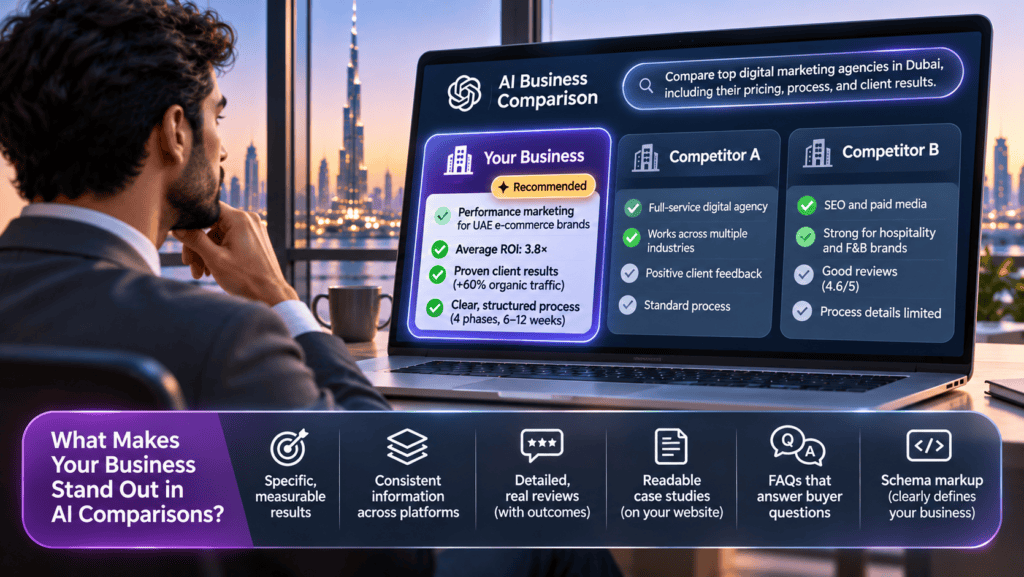
Before you read further, run this test. Open ChatGPT or Perplexity and type: “Compare the top [your service] companies in Dubai, including their pricing, process, and client results.” Read what comes back carefully.
Notice which businesses are named. Notice how they’re described. Notice what evidence is cited and what’s left as a vague impression. Most UAE business owners who run this test for the first time have an uncomfortable few minutes, either because their business doesn’t appear at all, or because the description of their business is thinner and less specific than what’s written about a competitor they know they outperform.
The comparison has already happened. The question is whether you’re being represented accurately.
How does AI actually build a business comparison?
When a user asks an AI engine to compare businesses, the engine isn’t searching for a “best of” list someone has already written. It’s synthesising information across multiple sources in real time to produce its own evaluation.
The process works roughly like this: the AI identifies businesses that match the query criteria, looks for information about each from multiple sources, and forms a summary for each. The more specific, consistent, and well-sourced the information about a business, the more confidently the AI describes it. The more vague or fragmented the information, the thinner the description and the more likely the business is omitted entirely.
Confidence is the key driver. An AI engine doesn’t guess about businesses it knows little about. It describes the ones it has enough information on to say something specific, and skips or minimises the ones it doesn’t.
What makes one UAE business come out better in AI comparisons?
Specific, named credentials and outcomes. A business whose website says “we helped a retail group in Dubai reduce their customer acquisition cost by 38% over six months” gives an AI something to cite. A business whose website says “we deliver measurable results for our clients” gives the AI nothing to work with. The first gets a specific, confident description. The second gets a generic one or gets skipped.
Multi-source agreement. When your website, Google Business Profile, LinkedIn page, and review platform all describe your business in the same way, an AI engine is confident in that description. When your website says you specialise in hospitality but your LinkedIn bio is vague and your Google Business Profile categories are from a different era, the AI is less confident and therefore less detailed in how it describes you.
Recent, specific reviews. Review content that mentions specific services, specific people, or specific outcomes contributes to how an AI describes your business. A review that says “their SEO team increased our organic traffic by 60% in three months” is cited material. A review that says “professional team, highly recommend” is not.
A clear specialisation rather than broad positioning. The businesses that get the most confident, specific descriptions in AI comparisons tend to be the ones that have staked out a clear position in a particular industry or service type. “We’re Dubai’s specialist for restaurant group marketing” gets a cleaner AI description than “we’re a full-service digital agency serving all industries.” Specificity earns confidence; breadth earns hesitation.
The signals that move you up, and the ones that don’t
Several things that UAE businesses invest in heavily don’t contribute much to how AI comparison queries describe them.
Beautiful website design doesn’t factor in. AI engines read text, not visual impression. A well-written page on a simple website outperforms a vague page on an award-winning design.
Keyword density in content doesn’t help. AI engines aren’t counting keyword occurrences. They’re reading for meaning, specificity, and factual content.
Follower counts and social media presence on platforms that aren’t publicly indexed don’t contribute. Your Instagram following, however large, doesn’t feature in how Perplexity describes you in a comparison query.
High Google rankings contribute indirectly. They confirm that your website is indexed and carries domain authority, which means AI engines visit and read it. But the ranking itself doesn’t influence how your business is described in a comparison.
What does move you up: named client outcomes on your website, review content that mentions specific services and results, consistent descriptions across platforms, FAQ sections that directly answer the questions buyers ask, and schema markup that tells AI engines exactly what your business is and does.
Working with a Generative Engine Optimization Dubai specialist is often how UAE businesses approach this systematically, because it requires changes across the website, third-party platforms, and content strategy simultaneously.
What UAE businesses consistently get wrong about competitive AI visibility
The most common mistake is treating all website copy as equivalent. A client outcome buried in a generic paragraph carries far less weight than a client outcome stated in a specific, structured case study page. The format matters as much as the information.
The second common mistake is assuming that review quality means star rating. An AI engine reading your Google reviews can’t use a five-star rating with no text. It can use a four-star review with three paragraphs of specific feedback about what your team did and what changed for the client.
The third is positioning so broadly that AI engines have nothing concrete to anchor their description of your business to. “Performance marketing Dubai” and “digital marketing UAE” are broad categories that many businesses occupy. “Paid media for UAE e-commerce brands scaling past AED 50 million annual revenue” is a description an AI can use to place your business precisely in a comparison.
A performance marketing Dubai agency and a broad generalist agency might appear in the same comparison query. The specialist usually gets the more confident description because the AI has more anchoring information to work with.
Your website also needs to be structured so that AI engines can extract the right information. A web development agency in Dubai that understands AI crawlability will structure service pages with direct answer content and schema markup, which makes your information easier to extract accurately.
Content strategy plays a role too. A viral content agency in Dubai that produces specific, service-relevant content adds to the body of information AI engines have about your business, strengthening the picture they form over time.
For more on how Gemini specifically conducts multi-source vendor research, how Gemini Deep Research is changing the way UAE buyers choose vendors covers the mechanics in detail.
How AI comparison queries affect buyer behaviour in the UAE is part of a broader shift we’ve examined here: competitor analysis in the age of AI search visibility in the UAE.
Before your competitor reads this
Here is a practical checklist for improving how your UAE business appears in AI comparison queries:
1. Add specific, named outcomes to your main service pages. Actual numbers, actual industries, actual timelines.
2. Convert your best case studies from PDFs or slide decks into text-based web pages that AI engines can read.
3. Audit your Google Business Profile. Update the description, services, and any outdated information. Verify that it matches your website.
4. Look at the text content of your most recent 20 Google reviews. If the majority say nothing specific, implement a review-gathering process that prompts clients to mention what specifically changed for them.
5. Update your LinkedIn company page bio to reflect your current specialisation in specific language.
6. Add FAQ sections to your service pages. These are among the most-extracted content types in AI comparison responses.
Frequently Asked Questions
Can a UAE business influence how it’s described in AI comparison queries without paying for advertising? Yes. AI comparison descriptions are based on publicly available information, not advertising spend. The changes that improve how you’re described are all organic: better content on your website, more specific review text, consistent entity information across platforms, and structured data.
What happens if an AI engine describes our business inaccurately in a comparison? This is more common than most businesses realise, and it usually happens because the AI is filling gaps in its knowledge with inference. The fix is the same as improving visibility: give the AI more specific, accurate information from more sources so it has less need to infer.
How often do AI comparison results change for the same business? They can change frequently. AI engines re-read source material regularly, so changes to your website or third-party profiles can affect how you’re described within weeks. Businesses that consistently improve their content and reviews tend to see their AI descriptions improve over time.
Is it possible to be completely removed from an AI comparison if the results are unfavourable? No. If an AI engine has found enough information to include your business, it will include it. The goal is to ensure that the information it uses is accurate and specific, not to control whether you appear.