
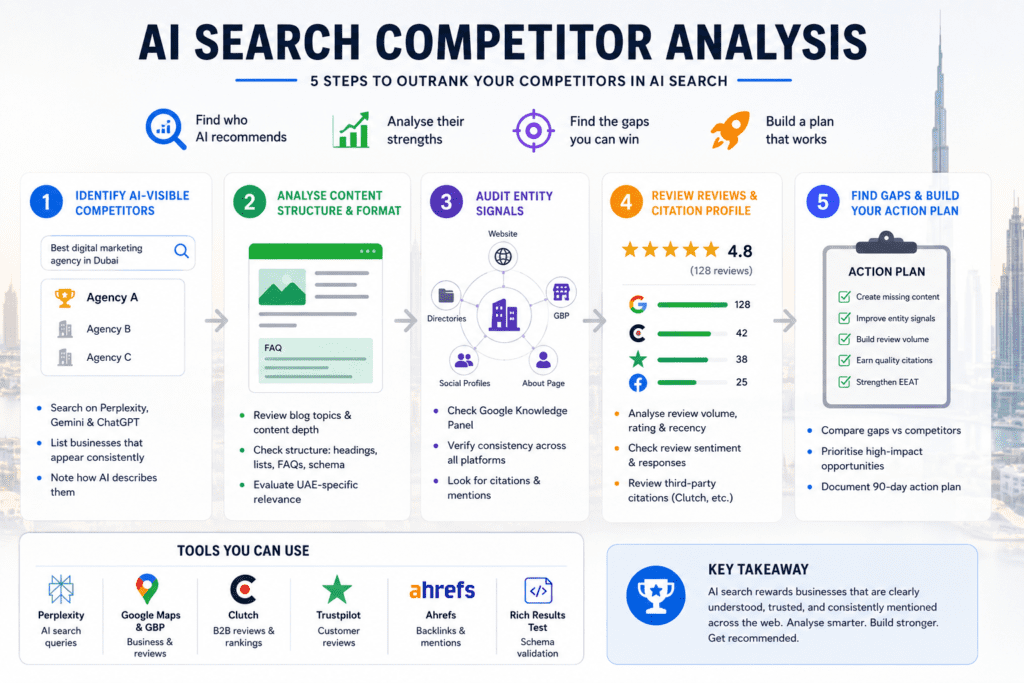
If a potential customer in Dubai typed “best [your service] in Dubai” into Perplexity or asked Google Gemini for a recommendation and your competitor appeared while you did not, there is a gap. Understanding what is causing that gap is the starting point for closing it.
Traditional SEO competitor analysis looks at keyword rankings, backlink profiles, and domain authority. AI search competitor analysis looks at something different: which businesses are being cited, described, and recommended by AI engines, and what specific signals have earned them that visibility.
This article is a step-by-step guide to conducting that analysis for a UAE service business without needing specialist tools or technical SEO expertise.
Why AI Search Competitor Analysis Is Different From Traditional SEO Audits
Traditional SEO analysis asks: which keywords does my competitor rank for, and how strong is their domain?
AI search analysis asks: what does the AI know about my competitor, and why is it confident enough to recommend them?
The key differences:
| Factor | Traditional SEO Analysis | AI Search Analysis |
| What you analyse | Keyword rankings, backlinks | Entity signals, content structure, citations |
| Tools used | Ahrefs, SEMrush, Moz | AI engines directly, GBP analysis, manual review |
| Primary question | Where do they rank? | Why do they get recommended? |
| Output | Keyword gap list | Entity and content gap list |
| Timeline | Can be done in an afternoon | Requires 3 to 5 hours for a thorough analysis |
Both types of analysis have value. But for businesses competing on AI search visibility, the entity-focused approach is more directly actionable.
Step 1: Identify Which Competitors Are Appearing in AI Search
Before you can analyse the gap, you need to know which competitors are being recommended by AI engines for queries relevant to your business.
How to identify AI-visible competitors:
Run these query types on Perplexity, Google Gemini, and ChatGPT (browsing mode):
- “Best [service type] in Dubai”
- “Which [service type] company should I use in [UAE city]”
- “Top [service type] agencies in UAE”
- “[Specific problem] service Dubai”
- “Recommended [service type] for small businesses UAE”
Document every business named across at least 10 relevant queries. Some will appear multiple times, others once. The ones appearing most frequently across multiple AI engines and query types are your highest-priority competitors to analyse.
What to record:
- Business name
- How frequently they appear across queries
- Which AI engine cited them most often
- The language used by the AI to describe them (this tells you what signals the AI is picking up)
Step 2: Analyse Their Content Structure and Format
AI engines recommend businesses whose websites contain well-structured, directly answerable content. Visit each competitor’s website and evaluate the following:
Content volume:
- How many blog articles or resource pages do they have?
- Do they publish at a consistent frequency?
- Do they cover the full range of questions a potential customer in Dubai might ask?
Content format:
- Do their articles start with a direct answer before expanding?
- Do they use clear H2 and H3 headings?
- Do they use numbered lists, bullet points, and step-by-step structures?
- Do they include FAQ sections?
Topical coverage:
- Are they answering the same questions your potential customers are asking?
- Do they address cost, timeline, and comparison queries specifically?
- Do they include UAE-specific context and examples?
Structured data:
- Use a tool like Google’s Rich Results Test (free) to check whether their pages include Schema.org markup
- Look specifically for FAQ schema, Article schema, and LocalBusiness schema
Create a simple comparison matrix: for each competitor, rate them low, medium, or high across each of these content factors. The gaps relative to your own website are your priority opportunities.
Step 3: Audit Their Entity Signals
Entity signals are the cross-platform consistency and authority indicators that AI engines use to confirm a business is real and well-defined.
Search the competitor’s brand name on Google:
- Does a Knowledge Panel appear? (Indicates strong entity presence)
- What information appears: website, GBP, social profiles, news mentions?
- Is the information consistent across all visible sources?
Check their Google Business Profile:
- Go to Google Maps and search their business
- Note their review count, average rating, and review recency
- Check whether they post GBP updates regularly
- Look at their service listings and business description for specific, keyword-rich language
Check their directory presence:
- Search “[Competitor name] + Clutch” or “[Competitor name] + Trustpilot”
- Note how many platforms they have a verified presence on
- Note review volume and sentiment on each platform
Check their backlink profile (optional):
- A free Ahrefs or Moz lite scan will show referring domains
- Look for mentions in UAE news sites, industry publications, or business directories
- These external mentions are the citation signals that AI engines use for entity corroboration
Step 4: Review Their Review and Citation Profile
Reviews and third-party citations are among the most direct signals AI engines use for business recommendation decisions.
Review profile analysis:
For each competitor:
- Total Google review count
- Average star rating
- Date of most recent review
- Date of oldest review (distribution matters)
- Whether responses are given consistently
- Quality of review text: generic (“great service”) vs specific (“they helped us build a GEO-optimised website in Dubai and our traffic doubled”)
Citation profile analysis:
Third-party mentions to look for:
- News articles that name the business
- Guest posts or contributed articles on industry sites
- Podcast appearances or interviews
- Being listed in “top agencies in Dubai” roundup articles
- Being quoted as an expert source in a publication
Each of these is a citation signal that AI engines treat as third-party validation of the entity.
Step 5: Identify the Gap and Build Your Prioritised Action Plan
With the competitor data collected, compare it against your own position across the same factors.
Gap identification framework:
Content gaps:
- Which questions are they answering that you are not?
- Which formats are they using that you are not (FAQ sections, step-by-step guides, comparison articles)?
- Which UAE-specific topics are they covering that your site does not address?
Entity gaps:
- Is their entity presence (Knowledge Panel, consistent NAP, GBP completeness) stronger than yours?
- Are they listed on platforms you have not claimed yet?
Review and citation gaps:
- What is the review volume differential?
- Are they earning third-party mentions you are not?
- Do their reviews contain more specific, service-describing language?
Prioritisation logic:
Address in this order:
- Entity fundamentals (GBP optimisation, structured data, NAP consistency) – these provide the foundation
- Content gaps for high-intent queries (questions with clear buyer intent that you are not answering)
- Review acquisition velocity (build a consistent system to close the volume gap)
- Third-party citations (guest articles, directory listings, earned mentions)
For UAE businesses that want professional support closing the AI visibility gap, the AI search optimization agency in Dubai work that BRB does starts precisely with this kind of competitor and gap analysis before building any content or optimisation plan.
For more on the specific GEO strategies that drive AI search recommendations in the UAE market, the article on GEO vs SEO which strategy gives better results in 2026 explains how these two approaches interact.
Tools You Can Use for AI Search Competitor Analysis
Free tools:
AI engines directly:
- Perplexity.ai (run queries, note who gets cited)
- Google Gemini (same approach)
- ChatGPT with browsing enabled (same approach)
Google tools:
- Google’s Rich Results Test: checks for structured data on any URL
- Google Business Profile: view competitor profiles directly on Google Maps
Content analysis:
- AnswerThePublic: see what questions people are asking around your service topic
- AlsoAsked: explores question clusters related to your keywords
Paid tools (useful but not essential):
- Ahrefs or SEMrush: backlink analysis and content gap identification
- BrightLocal: citation and GBP analysis for local SEO
The free tools are sufficient for most UAE small and medium businesses to conduct a meaningful AI search competitor analysis.
FAQ
How often should I run a competitor analysis for AI search visibility? A full analysis every 6 months is appropriate for most businesses. Monthly spot-checks, where you run 5 to 10 AI queries and note which competitors appear, keep you informed of changes without requiring a full audit.
What if no competitors in my industry are appearing in AI search yet? This is an opportunity. Being among the first in your UAE niche to establish strong AI search signals means you set the standard competitors will be benchmarking against. Move quickly.
Can I do this analysis without technical knowledge? Yes. The core steps, running queries on AI engines, visiting competitor websites, and checking GBP profiles, require no technical expertise. The structured data check using Google’s Rich Results Test is straightforward to use with no coding knowledge.
What is the most common gap between UAE businesses that appear in AI search and those that don’t? In the UAE service business context, the most common gap is content structure. Businesses that appear in AI search typically have question-answering articles with clear H2 headings and direct answers. Businesses that don’t typically have service pages and a homepage with no dedicated content strategy.
Does competitor analysis for AI search require monitoring Arabic-language queries? Yes, if your business serves Arabic-speaking customers. AI engines handle Arabic queries separately and may return different business recommendations for Arabic vs English queries. Include Arabic query testing in your analysis for a complete picture.
Conclusion
Understanding why your competitors appear in AI search recommendations, and you do not, is the most direct path to closing the visibility gap.
The analysis process outlined here does not require specialist tools or technical expertise. It requires systematic observation: run the queries, examine the patterns, compare their signals to yours, and build a prioritised action plan from the gaps you find.
The businesses in Dubai and across the UAE that have strong AI search visibility in 2026 did not get there by accident. They have specific content structures, established entity signals, and consistent review profiles. All of these are achievable and, once established, difficult for competitors to replicate quickly.
Start with the queries. Know what your competitors are being recommended for. Then build the case for why AI engines should recommend you instead.