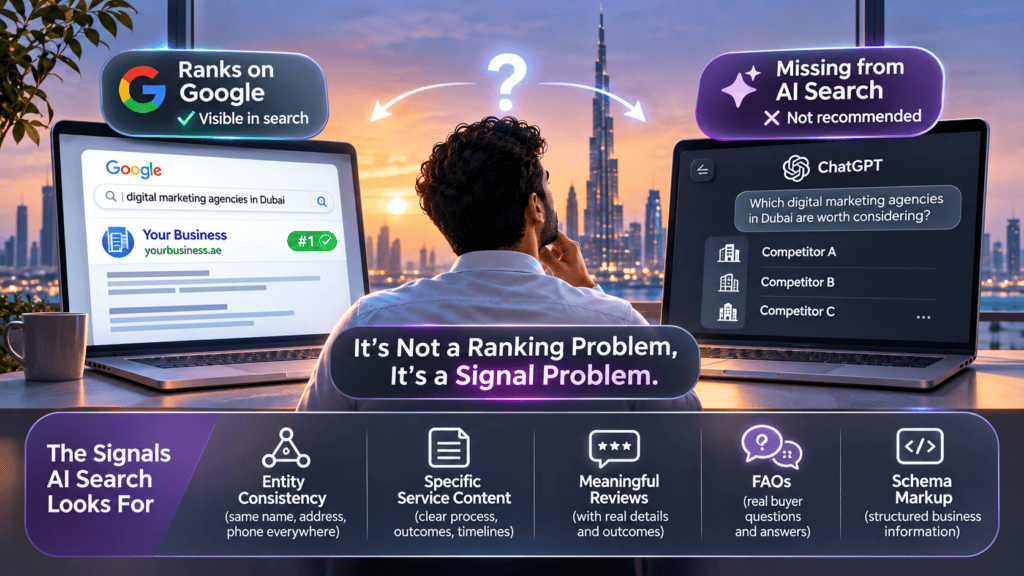
Your website is on page one. Google traffic is steady. The SEO investment from the past few years is showing results. But when a potential client opens Perplexity or ChatGPT and types something like “which digital marketing agencies in Dubai are worth considering,” your name doesn’t come up. A competitor who ranks below you on Google sometimes gets named instead.
This isn’t a ranking problem. It’s a signal problem. Google and AI search engines evaluate your business using different criteria, and the preparation that produces strong Google rankings doesn’t automatically carry over into AI search visibility.
How do Google rankings and AI search visibility actually differ?
Google ranks pages. Its algorithm finds the most relevant page for a keyword query based on content match, backlink authority, and technical signals. An optimised page on a credible domain tends to rank, regardless of whether the business behind it is clearly described across the broader web.
AI search engines evaluate entities. When someone asks Perplexity “which interior design consultancies in Dubai specialise in commercial fit-outs,” it doesn’t look for the most optimised page on that keyword phrase. It tries to identify which businesses it knows enough about to confidently recommend. It synthesises information from your website, your Google Business Profile, review platforms, directory listings, and other sources, building a picture of what your business is, where it operates, and what it does well.
If that picture is incomplete, inconsistent, or vague, the business gets left out. That’s true even when Google has it on page one.
What signals do AI search engines read when evaluating UAE businesses?
Entity consistency. Does your business name, address, phone number, and primary service description appear the same way across your website, Google Business Profile, LinkedIn, and industry directories? Every inconsistency reduces AI confidence in the information and increases the likelihood of being skipped.
Specific, extractable content on service pages. AI engines pull answers directly from your website. A page that says “we deliver outstanding results for our clients” gives an engine nothing to cite. A page that explains who the service is for, what the engagement process involves, what outcomes clients typically see, and how long projects usually take is extractable and useful.
Review content, not just review scores. Forty five-star ratings where every review says “great experience” contribute little. Fifteen reviews where each one mentions a specific service, a specific outcome, or a specific team member give AI engines factual, attributable content to read and cite.
FAQ sections. Direct question-and-answer content is among the most frequently extracted content types from business websites. Service pages with FAQ blocks that address real buyer questions give AI engines clear, attributable answers they can surface when those questions appear in a search.
Schema markup. Structured data tells AI engines and search platforms what type of business you are, where you’re located, what you specialise in, and how to reach you. Without it, they’re making inferences, which creates room for error.
Where most Google-optimised UAE businesses have a gap
Most UAE businesses that rank well on Google but remain invisible in AI search have a predictable set of gaps.
Their service pages were written for keyword targeting. The content is present, but it reads as marketing language: broad claims, vague timelines, no specific outcomes. AI engines can’t extract anything useful from this kind of copy.
Their entity information is fragmented. The trading name differs slightly from the registered business name. An old phone number sits on a directory nobody has updated since 2022. The website lists one district; the Google Business Profile lists another. Each discrepancy erodes the confidence an AI engine has in what it knows about the business.
Reviews are thin or text-free. Most UAE service businesses have fewer than 20 Google reviews that say anything beyond a rating. That’s rarely enough for AI engines to form a useful picture of what the business actually delivers.
Schema markup is absent or outdated, often reflecting services the business no longer prioritises or locations it has since moved from.
Working with an AI search agency in Dubai to identify and close these gaps is often the fastest route, because many of the changes needed are content additions to existing pages rather than full rewrites. A proper GEO audit identifies exactly where the entity picture breaks down.
How do you close the gap without starting over?
Most of what needs to change is content and information structure, not your website design.
Start with service pages. Each one should answer: what this service is, who it’s for, what the process involves, what outcomes clients typically see, and how long engagements usually take. Specific, factual statements are what AI engines cite. Vague copy is invisible to them.
Add FAQ sections to your most-visited service pages. Write questions the way buyers actually ask them, not in polished marketing language. If a real client has asked “do you work with businesses in our industry?” or “how long before we see results?”, those are your questions.
Run an entity audit. Search your business name across the first two pages of results. Find every inconsistency in how your name, address, phone, and services appear. Fix them. Update outdated directory listings. Make your Google Business Profile match your website exactly.
A digital marketing agency in UAE that manages both traditional SEO and GEO typically handles the entity audit as part of a broader visibility review, which is more efficient than treating each platform as a separate project.
Add schema markup. For most UAE businesses on WordPress, a plugin handles this. For custom-built sites, a web development agency in Dubai can implement the right schema types in a day or two. The impact on AI visibility is measurable, particularly for local business discovery queries.
Content strategy also feeds into this. A content marketing Dubai programme that consistently publishes specific, service-relevant material strengthens the entity picture over time. Each piece that names the business, the service area, the specialisation, and real client outcomes adds to what AI engines can confidently say about the business.
The businesses appearing most consistently in AI search are not necessarily the largest or best-funded. They’re the ones with the clearest, most consistent, most specific information about who they are and what they do. That gap is closable, often within a few months of focused work.
We explore how the lead behaviour between Google and AI search actually differs in detail here: how UAE businesses are getting leads differently from Google versus AI search engines.
For the competitive dynamics this creates, including why a newer business sometimes outperforms an established one in AI search, why new UAE businesses can outrank established ones in AI search is worth reading alongside this piece.
Frequently Asked Questions
Does existing Google ranking history help with AI search visibility at all? It helps indirectly. Google rankings confirm that your website is indexed and carries some level of domain credibility, which gives AI engines a place to read from. But ranking and entity clarity are separate requirements. The content on those ranked pages still needs to be structured for AI answer extraction, which is a different standard.
Which AI search platforms should UAE businesses focus on first? Start with ChatGPT Search and Perplexity, which have the highest adoption among UAE professionals searching for business services. Google AI Overviews matter for consumer searches. The entity signals that support all three platforms are largely the same, so optimising for entity clarity benefits all of them simultaneously.
How quickly do AI search visibility improvements typically show? Entity fixes, such as correcting inconsistent information across platforms, can produce measurable improvements within four to eight weeks. Content changes, such as adding FAQ sections and specific outcome statements to service pages, typically take two to four months before consistent AI citation activity appears.
Is a website rebuild necessary to improve AI visibility? No. The majority of AI visibility improvements involve content additions and information corrections, not design changes. Your existing website is the right foundation. What changes is what’s on the pages and how business information is structured across the web.