You have invested in SEO. Your website ranks on the first page of Google for your most important keywords. Traffic is consistent. But something has changed over the past 12 to 18 months. Enquiry volumes are not growing in line with your rankings. Some months they are flat. Some months they are down.
You are not imagining it.
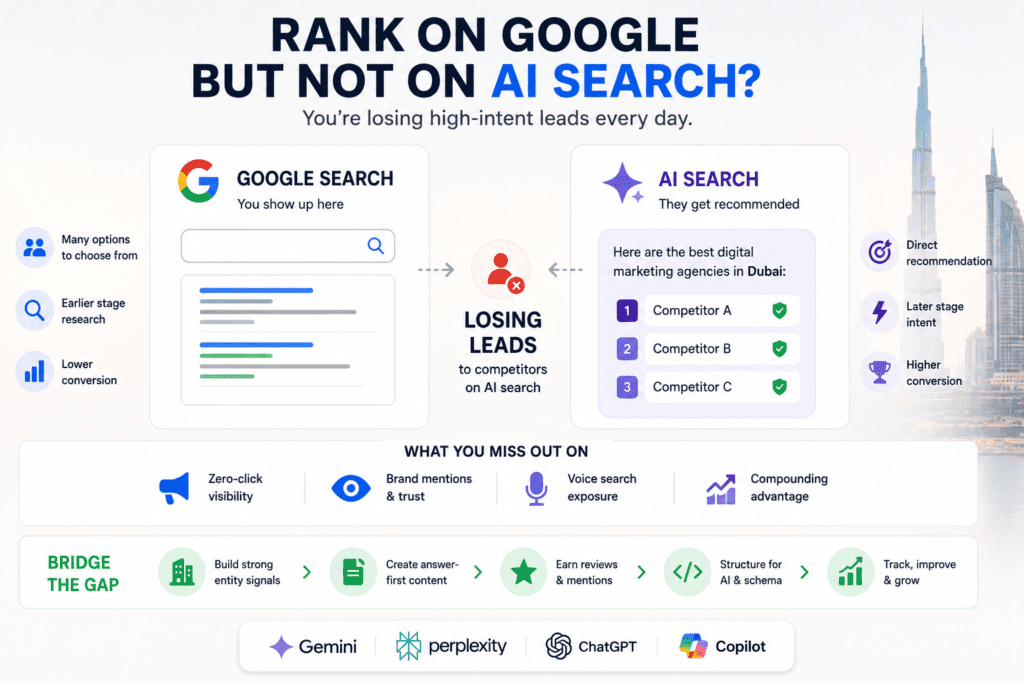
A growing segment of the UAE market is no longer using Google search results to find service providers. They are asking Perplexity, Google Gemini, ChatGPT, and other AI-powered engines to recommend a business for them. These tools do not return a list of blue links. They return a direct recommendation, usually naming two or three businesses by name.
If you are not among the businesses being named, you are invisible to this segment of the market, regardless of where you rank on Google.
This article explains exactly what is happening to lead flows when businesses have Google visibility but no AI search visibility, and what to do about it.
The Search Landscape Has Split: What This Means for UAE Businesses
In 2025 and 2026, search behaviour in the UAE has split into two distinct patterns:
Pattern 1: Traditional search The user types a query into Google, scans the results, and clicks through to websites. This behaviour still represents the majority of search volume. SEO remains relevant and valuable.
Pattern 2: AI-assisted search The user asks a question in natural language to an AI engine (Gemini, Perplexity, ChatGPT, or increasingly voice assistants). The AI provides a direct answer or recommendation, often without the user visiting any website. If a business is named, the user may then visit that specific business’s website directly.
The critical difference between these two patterns is intent depth. AI search users are typically further along in their decision journey. They are not browsing options. They are asking for a recommendation. This means AI search referrals convert at higher rates than typical organic search traffic.
A business that appears only in Pattern 1 and not Pattern 2 is losing access to a segment of buyers who are closer to a purchasing decision.
What Google Ranking Still Gives You in 2026
Before addressing the gap, it is important to be clear: Google ranking remains valuable in 2026. The majority of search queries in the UAE and globally still follow the traditional click-through model.
What strong Google rankings provide:
- Consistent inbound traffic from people searching specific keywords
- Visibility at the moment of active research intent
- Access to the large segment of users who prefer browsing multiple options before deciding
- Supporting signals for AI search (Google is a major source for AI engine training and citation)
Google SEO is not dead. It is incomplete. A business that only has Google SEO and ignores AI search optimisation is running a partially effective strategy. A business that only does AI search optimisation without addressing Google fundamentals would be equally incomplete.
The goal is both, with AI search optimisation as the next layer to build.
What You Are Missing Without AI Search Visibility
1. Direct name recommendation to high-intent buyers When someone asks Perplexity “which digital marketing agency in Dubai should I use for a product launch,” they are not looking for options to research. They are looking for a name to contact. If your competitor is named and you are not, the enquiry goes to them before you have any opportunity to compete.
2. Zero-click brand mentions AI search responses mention businesses by name even when the user does not click through to a website. These brand mentions build familiarity and trust over time. Users who see your business named multiple times in AI responses develop a perception of credibility even before they have visited your website.
3. Voice search recommendations Voice assistants including Google Assistant and Siri increasingly use AI-generated responses to answer “find me a [service] near me” or “what is the best [service] in Dubai” queries. These are recommendation queries. If you are not optimised for AI recommendation, you are excluded from voice search results for high-intent service queries.
4. Compounding visibility advantage AI search recommendations tend to favour businesses with established AI visibility signals. The businesses that are building these signals now are compounding their advantage over businesses that have not started. The gap between AI-visible and AI-invisible businesses will be significantly harder to close in 2028 than it is today.
The Lead Quality Difference Between Google and AI Search Traffic
Not all leads are equal. AI search leads and traditional organic search leads differ in their conversion characteristics.
Traditional organic search leads:
- Often in the early to mid stages of research
- Visiting multiple competitor websites
- Comparing options and pricing
- May require 3 to 7 touchpoints before converting
- Conversion rate: typically 1 to 3% for service business website visitors
AI search leads:
- Often arriving with a specific recommendation in mind
- Lower comparison behaviour (they were told who to contact)
- Shorter decision timeline
- Less price-sensitive in many cases (trust is partially pre-established by the AI recommendation)
- Conversion rate: typically higher, with some service businesses reporting 2 to 4 times the conversion rate of organic traffic
The difference in lead quality is significant enough that even a lower volume of AI search leads can deliver comparable or greater revenue impact than a higher volume of traditional organic leads.
For UAE businesses that have built strong Google visibility, AI search optimisation is not a replacement strategy. It is a quality upgrade to the lead pipeline.
Which UAE Businesses Are Most Exposed to This Gap?
Not all businesses feel this gap equally. Some industries and buyer types are more AI-search-driven than others.
Highest exposure to AI search gap (most leads being missed):
Professional services:
- Legal, accounting, consulting, and advisory firms where buyers research carefully and trust AI recommendations
- B2B service providers where procurement involves AI-assisted research
Health and wellness:
- Medical clinics, physiotherapy, psychology, and wellness services where patients use AI to find trusted specialists
- Buyers in this category are more likely to ask AI for a specific recommendation than to scroll through Google results
Digital and technology services:
- Web design, digital marketing, software development, IT services
- Buyers are often tech-aware and comfortable using AI search tools as their primary research method
High-commitment purchases:
- Real estate, education, legal services, and financial planning in Dubai, where buyers conduct significant pre-purchase research
Lower exposure (for now):
- Hospitality and quick-service food businesses (buyers still typically use Google Maps and review sites)
- Very localised, proximity-based services (nearby hairdresser, neighborhood pharmacy)
That said, AI search adoption is expanding across all categories. Lower exposure today does not mean no exposure in 12 to 24 months.
How to Know If AI Search Invisibility Is Costing You Leads
Run the test yourself:
Open Perplexity.ai and ask these queries, substituting your service and location:
- “Best [your service] in Dubai”
- “Which [your service] company should I use in UAE”
- “Recommended [your service] agency in [your Dubai district]”
Open Google and trigger an AI Overview for similar queries. Check whether an AI Overview appears and what businesses it names.
Open ChatGPT with browsing enabled and run the same queries.
What to look for:
- Are you named in any of these responses?
- Are your competitors named?
- What language does the AI use to describe the businesses it recommends? (This reveals what signals it is picking up)
If your competitors are being named and you are not, you have a measurable AI search visibility gap. The leads going to those competitors via AI recommendation are not coming to you.
What to Do: Bridging the Google-to-AI Search Gap
Closing the gap between Google visibility and AI search visibility requires a specific set of actions that are distinct from traditional SEO.
Priority actions:
- Build entity signals (most foundational):
- Complete and optimise your Google Business Profile
- Implement LocalBusiness and Service schema on your website
- Ensure NAP consistency across all platforms
- Create question-answering content:
- Write articles that directly answer the questions your buyers are asking AI engines
- Structure content with clear H2 headings and direct answers at the top of each section
- Include FAQ sections with schema markup on key service pages
- Build review velocity:
- Establish a consistent process for requesting Google reviews after every successful engagement
- Aim for 3 to 5 new reviews per month with specific, service-describing language
- Earn third-party citations:
- Get listed in relevant UAE business directories
- Seek guest article opportunities in industry publications
- Each external mention corroborates your entity to AI engines
- Build topical authority:
- Publish consistently around the topics your buyers research
- Cover the full question landscape in your industry, not just the commercial keywords
The GEO services for UAE businesses that BRB provides address all five of these layers systematically, rather than applying them as isolated tactics.
For businesses wanting to understand the full strategic picture of how this shift from traditional SEO to AI search is playing out across the UAE market, the article on why successful Dubai companies are shifting from SEO to GEO provides detailed context on the commercial logic behind the transition.
FAQ
Is AI search traffic a significant volume in UAE yet, or is this a future concern? AI search adoption in the UAE is already meaningful among professional and high-income demographics and among buyers of B2B services. For consumer services, adoption is growing rapidly. Businesses that optimise now gain compounding advantage. Waiting until AI search is mainstream means entering a more competitive landscape with less time to build signals.
Will AI search replace Google search entirely? The current trajectory suggests co-existence rather than replacement. Google itself is integrating AI into its search experience through AI Overviews. The most likely outcome is a hybrid landscape where traditional search and AI search serve different query types and buyer stages. Businesses need visibility in both.
How long does it take to start appearing in AI search recommendations? For a business with a well-established website and Google presence, targeted AI search optimisation can produce measurable results in 6 to 12 weeks. For businesses starting from a weaker baseline, a 3 to 6 month timeline is more realistic for consistent AI recommendation visibility in competitive Dubai categories.
Does running Google Ads help with AI search visibility? No. Paid advertising on Google has no direct effect on AI search recommendations. AI engines recommend businesses based on organic signals: content quality, entity strength, reviews, and third-party citations. Paid visibility and AI recommendation visibility are built through entirely different mechanisms.
What is the most important single step a UAE business can take to start closing the AI search gap? Optimise your Google Business Profile completely. It is the single highest-leverage, lowest-cost action available to most UAE service businesses. A complete, actively managed GBP with consistent recent reviews directly feeds Google Gemini’s recommendation engine and provides the entity foundation for all other AI search visibility work.
If my website is already well-optimised for SEO, how much additional work is needed for GEO? A well-optimised SEO website provides a strong foundation. The additional GEO-specific work typically includes: adding FAQ schema and structured data, creating question-based content formats, optimising the About page for entity clarity, and building a review acquisition system. For most businesses with a solid SEO base, the GEO layer adds 3 to 6 months of focused effort.
Conclusion
Ranking on Google in 2026 is a valuable asset. It is also an incomplete one.
The UAE market is producing a growing segment of buyers who go directly to AI engines for service recommendations and contact the business named without visiting multiple websites. If your business is not among those named, you are not competing for those enquiries at all.
This is not a hypothetical future problem. It is a current one that becomes more significant with every month that passes as AI search adoption accelerates in Dubai and across the region.
The businesses that will lead their categories in 2027 and 2028 are the ones building AI search visibility now, while the landscape is still early enough to establish signals without fighting an entrenched competitive hierarchy.
Your Google rankings are the foundation. AI search visibility is the next floor to build.