
Google searches no longer send people to your website. In 2024, nearly 60% of all searches ended without a single click. By 2026, that number has climbed past 65%. Users get their answers directly from Google’s AI Overviews, ChatGPT, Perplexity, and other generative AI tools without ever visiting your site.
For UAE businesses that invested heavily in SEO, this shift feels like a broken promise. You rank on page one. Traffic drops anyway. The game changed, and most companies are still playing by old rules.
The solution isn’t more SEO. It’s Generative Engine Optimization Dubai, a strategy designed to make your brand the answer AI engines cite, recommend, and trust, even when users never click through to your website.
What Are Zero-Click Searches and Why Do They Matter?
Zero-click searches happen when users get complete answers directly on the search results page or inside AI chat interfaces. No website visit required.
Common examples include:
- Asking Google “best time to renew trade license in Dubai” and getting the answer in a featured snippet
- Asking ChatGPT “top-rated web development agency in UAE” and receiving three business names with descriptions
- Using Perplexity to research “GEO vs SEO effectiveness 2026” and getting a full comparison without opening a link
These searches don’t generate website sessions. They don’t appear in your Google Analytics. But they still shape buying decisions.
Why this matters for UAE service businesses:
- Your ideal client researches you on AI tools before contacting you
- If your brand isn’t mentioned, a competitor’s is
- Traditional metrics like traffic and bounce rate no longer reflect your actual visibility
- Brand authority now matters more than backlink count
Service providers in Dubai, Abu Dhabi, and Sharjah are especially vulnerable. High-value clients use AI assistants to vet agencies, compare pricing, and identify specialists before making contact. If you’re invisible in those conversations, you’ve already lost the lead.
How Zero-Click Behavior Changed Between 2023 and 2026
The shift happened fast.
2023:
- Google featured snippets dominated zero-click results
- Most businesses optimized for position zero
- AI tools were experimental, not mainstream
2025:
- ChatGPT integrated real-time browsing
- Google launched AI Overviews globally
- Perplexity gained traction among professionals and researchers
- Voice assistants started citing specific businesses by name
2026:
- AI-first search is the default for younger buyers and tech-savvy professionals
- Google’s AI Overviews appear on 40% of commercial queries
- Users expect instant, synthesized answers, not link lists
- Citations inside AI responses determine brand credibility
Businesses still chasing Google rankings are fighting yesterday’s war. The new battlefield is inside AI-generated answers.
Why SEO Alone No Longer Works in a Zero-Click World
SEO was built for clicks. GEO is built for citations.
Here’s the difference:
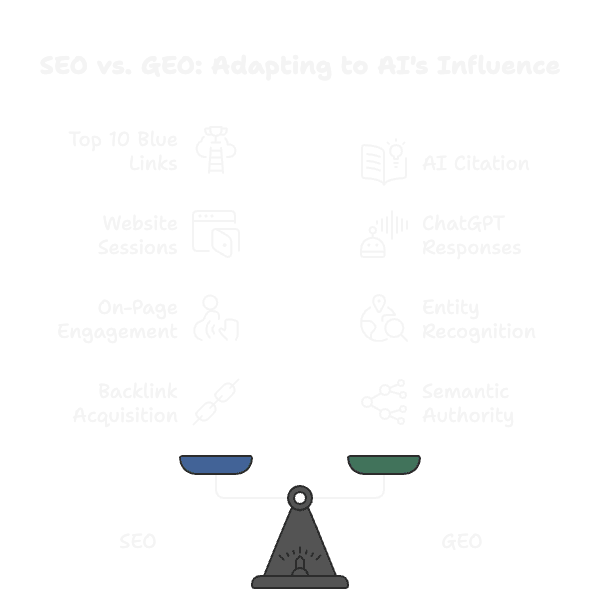
SEO optimizes for:
- Ranking in the top 10 blue links
- Driving sessions to your website
- On-page engagement and conversion tracking
- Backlink acquisition
GEO optimizes for:
- Being cited as a trusted source by AI engines
- Appearing in ChatGPT responses and AI Overviews
- Entity recognition across platforms
- Semantic authority on specific topics
The core problem with SEO in 2026:
Even if you rank number one, AI engines may ignore your page and cite a competitor instead. Rankings don’t guarantee visibility when users never scroll past the AI-generated summary.
A digital marketing agency in UAE can rank for dozens of keywords and still lose leads to a competitor that AI tools recommend by name.
What is GEO and How Does It Capture Value Without Clicks?
Generative Engine Optimization is the practice of structuring your content, brand signals, and digital presence so AI engines recognize you as an authoritative source worth citing.
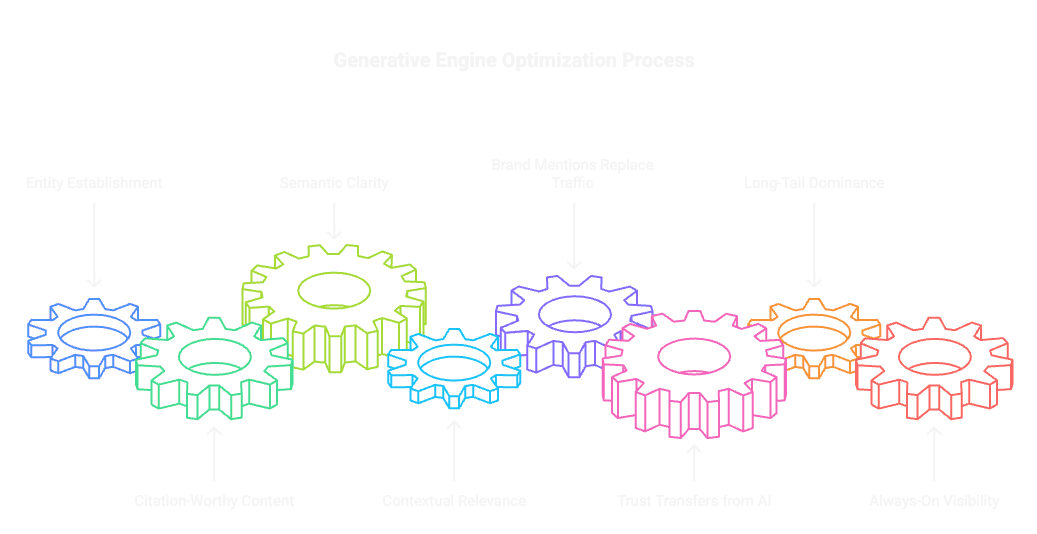
GEO focuses on:
- Entity establishment: Making your business a recognized entity in Google’s Knowledge Graph and AI training datasets
- Citation-worthy content: Publishing content structured for extraction, not just ranking
- Semantic clarity: Using language that mirrors how people ask questions to AI tools
- Contextual relevance: Demonstrating expertise in ways AI engines can parse and validate
How GEO captures value:
- Brand mentions replace traffic: When ChatGPT recommends your agency by name, the user contacts you directly
- Trust transfers from the AI: Users trust AI recommendations more than paid ads
- Long-tail dominance: GEO captures hyper-specific queries traditional SEO misses
- Always-on visibility: Your brand stays visible even as search behavior fragments across platforms
For example, a prospects asks ChatGPT: “Which agency in Dubai offers both viral content and GEO services?”
If your content is optimized correctly, the AI names your business. The user visits your site with intent. No ad spend. No ranking chase.
Key Strategies to Optimize for AI Engines and Zero-Click Dominance
Build Entity Authority
AI engines need to understand who you are and what you do.
How to establish your entity:
- Claim and optimize your Google Business Profile with accurate NAD (Name, Address, Description)
- Publish consistent information across directories, LinkedIn, and industry listings
- Use schema markup on every page (Organization, LocalBusiness, FAQPage, Article)
- Earn mentions on authoritative third-party sites
- Publish thought leadership under your name, not generic brand accounts
Your goal: when an AI engine evaluates your business, it finds clear, consistent, structured signals that confirm your expertise.
Structure Content for Answer Extraction
AI engines extract answers from content that follows clear, logical structures.
Best practices:
- Start every section with a direct answer (1–2 sentences)
- Use bullet points over dense paragraphs
- Include comparison tables (A vs B, pros vs cons)
- Add mini-FAQs within articles
- Use headings that mirror real user questions
Example of extraction-friendly content:
Poor structure (not GEO-optimized): “There are many factors that influence website conversion rates, and businesses often overlook the importance of page speed, mobile responsiveness, and clear calls to action when designing their sites.”
Strong structure (GEO-optimized): “Website conversion rate depends on three core factors:
- Page load speed (under 2 seconds)
- Mobile-first design
- Clear, action-oriented CTAs
Each factor directly impacts whether visitors trust your site enough to contact you.”
The second version is easier for AI to extract, cite, and recommend.
Answer Follow-Up Questions Preemptively
AI tools generate answers by predicting follow-up questions. If your content answers them in advance, you stay in the conversation.
Common follow-ups for service businesses:
- How much does this cost?
- How long does it take?
- Who is this best suited for?
- What happens if I don’t do this?
- How do I know if I need this?
Embed answers to these questions naturally throughout your content. Don’t save them for a separate FAQ page.
Use Natural, Conversational Language
AI engines are trained on human conversation. They recognize and favor content that mirrors how people actually speak.
Write like you’re advising a client:
- Avoid jargon unless explaining it
- Use “you” and “your business”
- Write in active voice
- Keep sentences under 25 words when possible
- Use analogies and real-world examples
For instance, instead of writing “Organizations seeking to enhance digital presence via content amplification,” write “Businesses that want more visibility through viral content.”
Integrate Schema Markup Across All Pages
Schema tells AI engines exactly what your content represents.
Critical schema types for service businesses:
- Article schema: Identifies your content as editorial and citable
- FAQ schema: Highlights question-answer pairs for direct extraction
- LocalBusiness schema: Establishes location, services, and contact details
- Organization schema: Confirms your brand identity and authority
AI engines read schema before they read your copy. Without it, your content is harder to parse and less likely to be cited.
If you’re unsure how to implement schema correctly, a web development agency in Dubai with GEO experience can integrate it into your site structure.
Real-World Example: How a UAE Agency Gained Visibility Without Ranking
A Dubai-based business consultancy struggled with SEO. Despite ranking on page one for “business setup UAE,” traffic dropped 40% year-over-year due to zero-click dominance.
They shifted to GEO:
What they did:
- Published content structured for AI extraction (bullet-heavy, question-based headings)
- Added comprehensive FAQ schema to every service page
- Optimized Google Business Profile with detailed service descriptions
- Earned mentions in ChatGPT training data by contributing to industry publications
- Focused on entity-building instead of backlink volume
Results after 6 months:
- ChatGPT began recommending them by name for “business setup consultants Dubai”
- Lead quality increased—prospects arrived pre-qualified and ready to book
- Website traffic stayed flat, but inquiry volume doubled
- Cost per lead dropped by 35%
They stopped measuring success by sessions. They measured it by how often AI tools mentioned their name.
How to Measure GEO Success When Traffic Isn’t the Goal
Traditional metrics don’t capture GEO performance. You need new benchmarks.
Key GEO metrics to track:
- Brand mention frequency: How often does your business appear in AI-generated answers? (Use manual queries and tools like BrandMentions)
- Direct inquiry volume: Are prospects contacting you without visiting multiple pages first?
- Lead quality score: Are leads arriving with higher intent and context?
- Entity recognition: Does Google autocomplete your business name when users type related queries?
- Schema validation: Are your FAQ and Article schema elements indexing correctly? (Use Google’s Rich Results Test)
- Voice search citations: Does your business appear in voice assistant responses?
Track these weekly. If your brand appears more often in AI responses, your GEO strategy is working, regardless of traffic trends.
Why GEO and SEO Should Work Together, Not Compete
GEO doesn’t replace SEO. It extends it.
How they complement each other:
- SEO ensures your content ranks and gets indexed
- GEO ensures AI engines cite that content even when users don’t click
Where they overlap:
- Both require authoritative, well-structured content
- Both benefit from schema markup
- Both depend on consistent brand signals
Where they differ:
- SEO optimizes for human clicks
- GEO optimizes for AI extraction and citation
The best strategy combines both. Rank your content so it gets indexed. Structure it so AI engines trust and cite it.
For example, a well-optimized article about AI search optimization agency in Dubai should rank on Google and also appear when someone asks ChatGPT for agency recommendations. One feeds the other.
If you want to understand the technical differences in depth, explore GEO vs SEO, which strategy gives better results in 2026? for a full comparison.
Common Mistakes UAE Businesses Make When Adapting to Zero-Click Search
Ignoring AI Tools Entirely
Many businesses assume Google is the only search platform that matters. Meanwhile, their target audience is asking ChatGPT, Perplexity, and Google’s AI Overviews for recommendations.
Fix: Start testing. Search for your services on multiple AI platforms. If your business doesn’t appear, your competitors likely do.
Over-Optimizing for Keywords Instead of Entities
Keyword stuffing doesn’t work in GEO. AI engines care about entities (brands, people, locations, concepts), not keyword density.
Fix: Focus on entity-building. Publish under real names. Get listed on credible directories. Establish your expertise in specific categories.
Publishing Generic, Thin Content
AI engines prioritize depth and specificity. Generic blog posts that repeat common knowledge get ignored.
Fix: Publish content competitors won’t. Include real data, case examples, cost breakdowns, timelines, and decision criteria.
Neglecting Schema Implementation
Without schema, AI engines struggle to understand what your content represents.
Fix: Add Article, FAQ, and LocalBusiness schema to every relevant page. Validate it using Google’s tools.
Measuring Only Traffic
If you’re still tracking success by sessions and bounce rate, you’re missing the bigger picture.
Fix: Track brand mentions, lead quality, and direct inquiries. These reveal whether your GEO efforts are converting, even without clicks.
How BRB Helps UAE Businesses Win in a Zero-Click World
We don’t just optimize websites. We optimize for how people actually search in 2026.
Our approach combines:
- Content structured for AI extraction: Every article, service page, and FAQ is designed to be cited, not just ranked
- Entity authority building: We establish your brand as a recognized expert in your category
- Schema implementation: Full technical integration across your site
- Cross-platform visibility: We optimize for Google, ChatGPT, Perplexity, and emerging AI tools
- GEO + SEO integration: You rank and get cited
Whether you need GEO services for UAE businesses, content that drives demand without traffic, or a complete digital presence overhaul, we build strategies that align with how search actually works today.
FAQ
What is the difference between zero-click searches and traditional searches?
Traditional searches result in users clicking a link to visit a website. Zero-click searches provide answers directly on the results page or inside AI tools, so users never leave the platform. In 2026, the majority of searches are zero-click.
Can my business still succeed if website traffic keeps declining?
Yes. Success in a zero-click world depends on brand mentions, citations, and direct inquiries, not sessions. If AI engines recommend your business by name, prospects will contact you directly, often bypassing your website entirely.
How long does it take to see results from GEO?
Most businesses see measurable brand mention increases within 3–6 months. Full entity recognition and consistent AI citations typically take 6–12 months, depending on content volume, industry competition, and schema implementation quality.
Is GEO only relevant for large enterprises?
No. GEO is especially valuable for small and medium-sized businesses in competitive markets like Dubai. It allows you to compete on authority and specificity rather than budget. A well-optimized SMB can outrank larger competitors in AI-generated answers.
Do I need to stop doing SEO to focus on GEO?
No. GEO and SEO work together. SEO ensures your content ranks and gets indexed. GEO ensures AI engines cite it. The best strategy integrates both, maximizing visibility across traditional and AI-powered search.
Which AI platforms should I optimize for in the UAE?
Focus on Google AI Overviews, ChatGPT, and Perplexity. These are the most widely used by UAE professionals and consumers. Voice assistants like Siri and Alexa are secondary but growing in importance.
Conclusion
Zero-click searches aren’t killing websites. They’re killing outdated strategies.
The businesses that thrive in 2026 aren’t chasing traffic. They’re building authority, optimizing for AI extraction, and ensuring their brand is the answer AI engines cite.
If you’re still measuring success by page views, you’re already behind. The future of search is citability, not clicks.If you’re ready to stop losing leads to zero-click dominance, it’s time to integrate GEO into your strategy. And if you’re unsure where to start, explore What is generative engine optimization and how does it work? to understand the fundamentals, or reach out to discuss how we can make your business the answer AI engines trust.