
The maths stopped making sense somewhere around 2023.
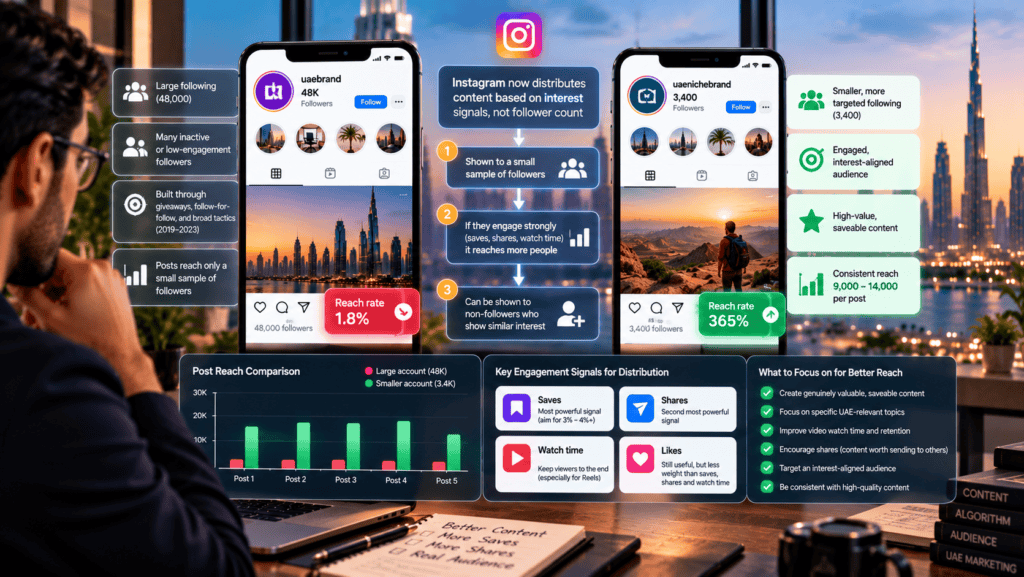
A UAE business account with 48,000 Instagram followers. Posts reaching 700 to 1,100 people. A reach rate of under 2%. Meanwhile, a competitor account with 3,400 followers whose posts are consistently reaching 9,000 to 14,000 people per post.
The large account has not been penalised. The algorithm is not working against it. Everything is operating exactly as Instagram currently intends. The problem is that the rules changed, the large account’s audience was built under the old rules, and nobody told the business.
This is the most common and most misunderstood performance problem in UAE social media management right now.
How the Algorithm Changed
Until roughly 2022, Instagram’s distribution model was primarily subscription-based. When someone followed your account, they were more likely to see your content. A large follower count translated, imperfectly but meaningfully, into broader organic reach. Posting to 40,000 followers meant your content at least had a chance of reaching a substantial portion of that audience.
Adam Mosseri, Instagram’s head, has publicly confirmed the shift that changed this. Instagram now distributes content based on interest signals, not on follow relationships. A growing share of the total feed and Reels surface area is allocated to content from accounts the user does not follow, selected based on predicted interest. The algorithm has become closer to a content recommendation engine than a subscription feed.
The consequence: your content is shown first to a small sample of your followers. If that sample engages with it strongly, through saves, shares, and meaningful watch time, the content gets distributed more broadly, sometimes to non-followers who share similar interest profiles. If the sample does not engage strongly, distribution stops there.
Follower count has become a qualifier for reaching the sample, not a multiplier for the result.
Why Large UAE Followings Are Particularly Vulnerable
The large UAE Instagram followings built between 2019 and 2023 were often built through methods that prioritised count over quality: follow-for-follow activity, giveaway campaigns that attracted non-target-audience participants, aggressive posting frequencies that drove follows from casual browsers, and in some cases paid follower acquisition.
These tactics produced large numbers. They did not produce engaged, interest-aligned audiences.
When the algorithm now tests content against this audience, it finds low save rates. Low share rates. Low watch time percentages. Likes from followers who engaged once out of courtesy and have not interacted since. The early test result is poor, and distribution stops early.
The 48,000-follower account reaching 900 people is not failing to reach 47,100 accounts. The algorithm is reading the poor early engagement signals from the diluted audience and concluding that the content is not worth distributing further. It is following the instruction it was given: show content to people who are likely to find it genuinely valuable, as indicated by their actual behaviour, not by whether they once tapped a follow button.
Understanding what happens to this dynamic when you stop posting entirely is the companion question, what happens to your UAE social media reach when you stop posting gives the algorithm-behaviour context that makes the large-following reach problem clearer.
The Signals That Currently Drive Distribution
Save rate is the most powerful current signal. When a viewer saves a post, they are telling the algorithm explicitly that the content has enough value to want to return to it. Save rates above 3% to 4% of post reach indicate content that is being actively stored for future reference by a meaningful share of the audience that saw it.
Share rate is the second most powerful signal. Sending a post to a specific person, or sharing it to your own story, indicates the content is worth passing on. Shares distribute copies of your content to new audiences and produce compounding reach in ways that likes do not.
Watch time percentage for video content determines how broadly Reels get distributed. A Reel that most viewers watch through to completion or near-completion demonstrates content value. A Reel where most viewers scroll away within three seconds does not get pushed further.
Likes are still useful but carry less weight relative to these three signals than they did in 2020. Comment rates, often cited as a key engagement metric, are less predictive of commercial performance in the UAE market than saves and shares, for reasons covered in detail in why UAE audiences save your content but never comment on it.
What the Algorithm Does Not Penalise
There is a common misconception that having a diluted large following actively hurts your content performance. The more accurate picture is that the algorithm does not punish you for having low-quality followers, it simply evaluates your content performance against whoever sees it first, which happens to be a sample of your follower base.
This means each piece of content is evaluated somewhat independently. A large-following account that produces one piece of content with genuinely strong early save and share signals from whoever does see it first can still achieve broad distribution from that following, even if the overall audience is diluted. The algorithm is testing each post, not passing permanent judgment on the account.
This is the reason content quality improvement produces faster recovery than audience cleanup. Removing followers is impractical at scale and addresses the symptom rather than the cause. Publishing content that earns strong signals from whoever sees it addresses the cause directly.
Rebuilding Reach Without Rebuilding the Audience
The practical path forward for UAE accounts in this position is not a follower purge or a restart. It is a content strategy shift.
Move away from content designed to earn likes or prompt comments, which the current algorithm weights lightly, toward content designed to earn saves and shares.
Content that earns saves: specific, useful information the viewer would want to reference again. A UAE-specific data point, a practical checklist, a comparison framework, a clear answer to a question the viewer has been asking. Something with reference value.
Content that earns shares: content that the viewer would send to a specific person. Something that solves a problem a friend is having, or that makes a point the viewer wants a colleague to see. Personally relatable without being personally specific.
Content that earns watch time: video that delivers the most interesting or useful thing in the first three seconds, rather than building to it.
A viral content agency in Dubai building a content brief for a UAE account in this situation will write briefs around save rate and share rate as the primary success metrics, not reach or likes. How posting frequency affects engagement vs reach for UAE accounts addresses the related question of how often to post when rebuilding reach, which is the practical next decision after addressing what to post.
FAQ
Is there a way to clean up a diluted follower base at scale? Instagram does not provide a bulk-remove feature for followers. Individual removal is possible but impractical for accounts with tens of thousands of followers. The more efficient path is content strategy improvement, which produces the same outcome without requiring audience management at scale.
Should we start a new Instagram account rather than recovering the existing one? Not typically. The existing account has historical data, an existing subscriber base however diluted, and an indexed profile. Starting fresh loses all of that. The algorithm evaluates each post on its own merit against recent performance signals, so a recovery on the existing account is achievable without the brand cost of a restart.
Does this dynamic apply to LinkedIn and TikTok as well as Instagram? TikTok’s algorithm is the most aggressively interest-based of the major platforms and has the least correlation between follower count and reach, even new TikTok accounts with zero followers can achieve significant reach on content that earns strong signals. The large-following problem is less pronounced on TikTok. LinkedIn’s distribution model weights comments and reposts more heavily than saves, but the shift away from follower-count-as-reach-multiplier applies there too.
Is running paid promotion a way to bypass this? Paid promotion expands reach but does not solve the underlying engagement signal problem. Paying to reach more people with content that earns poor engagement signals teaches the algorithm that your content is low value, which can suppress organic performance further. Paid promotion works best when the content is already earning strong organic signals and additional reach is the only limiting factor.
The Underlying Point
The algorithm changed what it rewards. UAE businesses that built their Instagram presence under the old reward system are holding an asset that was valuable under those rules and is less valuable under the current ones. That is not a crisis. It is a recalibration.
The content that earns saves, shares, and genuine watch time from UAE audiences is, coincidentally, the content that the UAE save-and-observe culture responds to most commercially. How to measure social media ROI for UAE businesses addresses how to track whether the recalibration is working, because reach alone is not the metric that reveals whether the new content approach is generating commercial outcomes. A social media management Dubai team that reports on save rate and share rate alongside reach is measuring the current algorithm’s signals rather than the old one’s. A digital marketing agencies in Dubai content review that surfaces this for clients is doing something more valuable than a monthly engagement rate report. And marketing agency in Dubai teams writing content briefs for UAE accounts in 2026 should be treating save-worthiness as the primary brief criterion, not audience growth. Why dark social is also part of this picture: the saves and shares that drive distribution are closely related to the private sharing behaviour that makes attribution so difficult, is covered in why dark social is stealing attribution from your best UAE marketing.