
Introduction
Most UAE businesses measuring social media performance are focused on the metrics the platforms make most visible: follower counts, likes, reach, and impressions. These metrics feel meaningful because they are numerical and they grow, or do not grow, in ways that feel responsive to content decisions.
They are largely useless as indicators of whether social media activity is generating commercial value.
The challenge with social media ROI measurement is not that the data does not exist. It is that the most important commercial data is harder to access, requires more deliberate setup to capture, and often involves connecting signals across multiple platforms and tools. The path of least resistance is to report on vanity metrics and call it performance tracking. The result is a business that does not know whether its social media activity is driving revenue or simply driving itself.
This article covers how to measure social media ROI honestly, specifically for UAE service businesses where the connection between a piece of content and an eventual client is rarely a single click.
Why Most UAE Businesses Are Measuring the Wrong Things
Follower count is not a business outcome. A UAE fitness brand with 80,000 Instagram followers and a Dubai consulting firm with 2,000 LinkedIn followers may generate similar monthly revenue from social media. Follower count measures audience size, not audience quality or commercial intent.
Reach and impressions measure visibility, not impact. A Reel that reaches 50,000 people is not demonstrably more valuable than one that reaches 5,000 people if the 50,000 includes no one who would ever hire the business.
Engagement rate is a platform-specific signal, not a business signal. High engagement on an entertaining post frequently comes from people who will never buy from the business. Low engagement on a specifically relevant professional post may come from exactly the right decision-makers. Engagement rate tells you about content resonance, not commercial relevance.
Post-level analytics are the least useful unit of analysis. Optimising individual posts for individual metrics rarely reflects the cumulative effect of a content strategy on buyer perception over time. Social media works through repeated exposure, relationship-building, and trust accumulation, none of which is visible in a single post’s metrics.
The Metric Hierarchy: From Vanity to Value
Tier 1 (most valuable, hardest to measure):
- Revenue directly attributed to social media touchpoints
- Client lifetime value from social media-sourced clients
- Conversion rate of social-referred traffic vs other channels
Tier 2 (valuable leading indicators):
- DM and enquiry volume originating from social platforms
- Profile link clicks (bio links, WhatsApp clicks, booking links)
- Website sessions from social referral with conversion behaviour
- Branded search volume increases over time (indirect signal of awareness building)
Tier 3 (useful for content decision-making):
- Saves and shares (indicate content with sustained perceived value)
- Comments from identifiable potential customers (not generic engagement)
- Profile visits per post (indicates whether the content attracted interest in the business)
Tier 4 (limited standalone value):
- Reach and impressions
- Total engagement and engagement rate
- Follower growth
Most UAE social media reports heavily feature Tier 4 metrics and rarely mention Tier 1. The inverse would produce far more commercially actionable information.
How to Attribute Revenue to Social Media Activity
Social media attribution is genuinely difficult because the path from content to client in a service business is typically long and non-linear. A potential client may discover a business through an Instagram Reel, follow the account, receive 8 weeks of content exposure, visit the website, send a WhatsApp message, attend a discovery call, and then sign a contract. Attributing that contract to the original Reel is technically possible but practically challenging.
Practical attribution methods for UAE service businesses:
Direct attribution through source tracking. Using UTM parameters on bio links and any trackable links in content allows Google Analytics to attribute website sessions and conversions to specific social channels. This captures a share of social-driven traffic but misses dark social (untracked shares, direct messages, or someone manually typing your URL after seeing your content).
CRM and enquiry source tagging. Asking every new enquiry “how did you hear about us?” and recording the answer in a CRM or spreadsheet creates a simple but genuinely useful direct attribution dataset. Many UAE business owners are surprised to find that social media features more frequently in this answer than their analytics data suggests.
WhatsApp and DM enquiry tracking. Recording the volume and source of enquiries received through WhatsApp and Instagram/LinkedIn DMs monthly provides a consistent signal of social-driven lead volume that platform analytics do not capture.
Cohort-based analysis. Comparing business enquiry volume and revenue in periods of active social content production against periods of inactivity provides a coarse but useful directional signal that is meaningful even without precise attribution. A Generative Engine Optimization Dubai programme that also encompasses social content will typically track this across both channels simultaneously, since the compounding effect of AI search plus social is more visible at cohort level than in platform-specific monthly reports.
The dark social problem in UAE: A significant portion of social media influence on UAE buying decisions happens through channels that are invisible to standard tracking. WhatsApp forwards of content between friends, colleague referrals that start with “I saw this post from [agency],” and word-of-mouth that was originally triggered by social content all contribute to revenue without appearing in any analytics report. Accounting for this in ROI calculations requires a discount or adjustment factor to avoid systematically undervaluing social media activity.
Platform-Specific Metrics Worth Tracking in UAE
Instagram:
- DM enquiry volume (tag by source content piece where possible)
- Profile visits per post (Instagram Insights provides this per-post)
- Bio link clicks (measurable through your link management tool)
- Story swipe-up or link interactions (for accounts with link sticker access)
- Saves per post (strongest signal of sustained content value)
LinkedIn:
- DM connections and enquiry messages from non-connections
- Profile views (measurable in LinkedIn Analytics)
- Post link clicks (available for posts with outbound links)
- Newsletter subscriber growth (if using LinkedIn newsletters)
- Content engagement from specific company or role types (through audience demographics in Analytics)
TikTok:
- Profile clicks per video (TikTok Analytics provides this)
- Bio link clicks
- Comment sentiment from potential customer types
- Average watch duration (indicates content quality alignment with audience expectation)
WhatsApp Business:
- Monthly message volume from social referrals (self-reported or tracked through campaign links)
- Response rate and response time (affects conversion, not attribution)
- Recurring contact rate (clients who re-engage through WhatsApp from original social discovery)
How to Build a Meaningful Social Media ROI Report
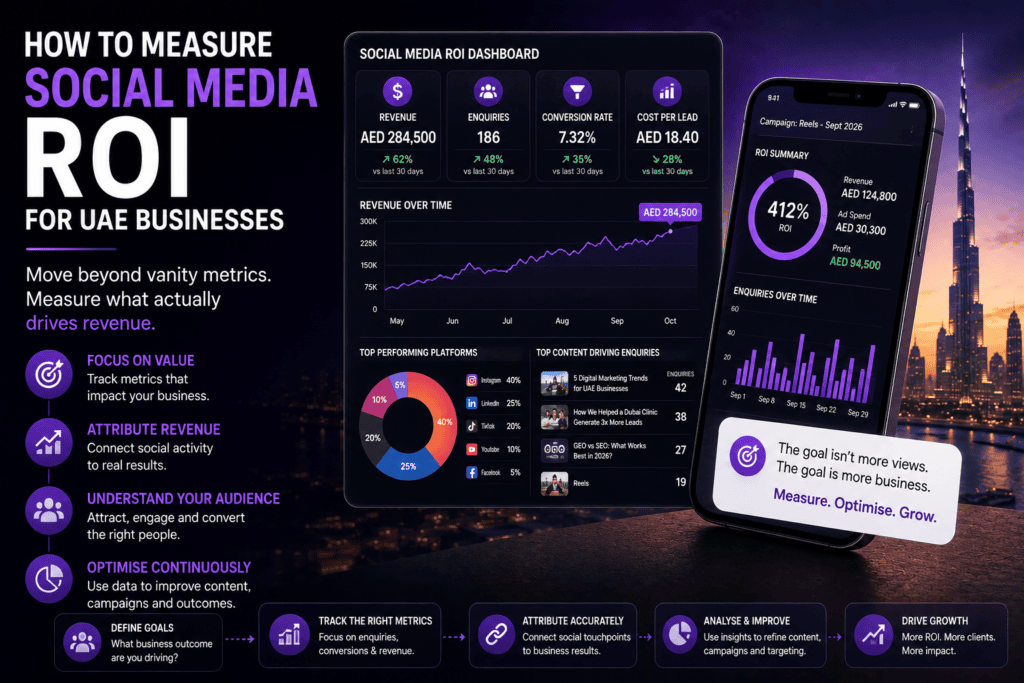
A social media ROI report for a UAE service business should answer these five questions:
1. What social-sourced activity is happening? DM volume, profile visits, bio link clicks, website sessions from social referral.
2. How is that activity converting? Enquiry rate from DMs, conversion rate of social-referred website visits, booking rate from bio link clicks.
3. What is the revenue value of that activity? Average client value multiplied by the number of clients who identified social as a source or whose first contact came from a social channel.
4. What is the cost of the activity? Content production time (hours x hourly cost) plus any paid social spend plus any agency or freelancer fees for content management.
5. What is the ratio of (3) to (4)? This is your social media ROI. A ratio above 1 means social media is generating more value than it costs. The specific ratio provides a benchmark to improve against.
Most UAE businesses cannot answer questions 2 and 3 with precision on their first attempt at this framework. That is normal. Building the measurement infrastructure in the first 30 to 60 days makes the second and third attempts significantly more accurate.
A social media agency in Dubai that reports DM volume, enquiry conversion rates, and revenue attribution alongside platform metrics is providing the information needed to manage social media as a business investment rather than a creative exercise.
What Benchmarks Make Sense for UAE Service Businesses
DM enquiry rate: For UAE service businesses with active, commercial-CTA-inclusive content strategies, 1 genuine enquiry DM per 1,000 to 3,000 post impressions is a realistic benchmark for well-targeted content.
Bio link click rate: 0.5% to 2% of post reach clicking through to a bio link is typical for content with a clear next-step direction. Below 0.3% suggests either the CTA is missing or the link destination is not aligned with what the content promised.
Social-to-client attribution rate: In honest self-reported attribution surveys, UAE service businesses typically find 15 to 40% of new clients cite social media as a discovery touchpoint. For businesses with high social media activity and good content quality, this figure can be higher.
Content production ROI threshold: For a UAE service business with an average client value of AED 15,000, converting one social-sourced enquiry per month into a client means social media needs to generate AED 15,000 in attributed revenue. If total monthly content costs (production + management) are below that figure, social media is ROI-positive even by the most conservative attribution method.
For UAE businesses that also invest in AI search visibility alongside social content, the measurement challenge extends to organic search sources as well. A framework that measures all digital marketing channels in terms of enquiry attribution and revenue value, not just platform-specific metrics, gives a complete picture of where marketing investment is and is not generating returns. A digital marketing agency in UAE that builds this cross-channel measurement framework as a client deliverable is providing significantly more commercial intelligence than one that reports each channel independently.
FAQ
Is it realistic to expect direct revenue attribution from social media for a UAE service business? Partial attribution is realistic. Full attribution, accounting for every social touchpoint across the buyer journey, is not practically achievable for most businesses. Combining direct attribution data with self-reported source surveys and directional comparisons provides a meaningful enough picture to manage the channel as a business investment.
How long should a UAE service business invest in social media before expecting measurable ROI? For most UAE service businesses starting with a new or previously inactive social presence, 3 to 6 months of consistent, commercial-CTA-inclusive content is a realistic minimum before expecting consistent, measurable social-attributed enquiries. Earlier results are possible but should not be expected.
Should I include my own time in the cost side of social media ROI? Yes, if you are producing content yourself. The cost of your time at your market rate is a real cost of the activity, even if it does not appear in any invoice. Including it produces a more honest ROI calculation and often reveals that hiring specialist support is more cost-effective than self-production above a certain volume.
Does social media ROI differ significantly between B2B and B2C businesses in UAE? Yes. B2C UAE businesses typically see shorter attribution paths, higher conversion volumes, and more direct DM-to-purchase behaviour. B2B businesses see longer paths, lower volumes, and higher average client values. The ROI framework is the same, but the benchmarks, attribution windows, and typical conversion mechanisms differ.
Conclusion
Measuring social media ROI honestly is harder than reporting follower growth and reach. It requires setting up attribution infrastructure, asking every new client how they found you, and accepting that some commercial value from social media will always be invisible in any analytics platform.
It is also the difference between managing social media as a genuine business investment with a known and improvable return, and running it as a feel-good activity with no accountability to commercial outcomes.
UAE service businesses that build even a basic social media measurement framework, DM volume tracking, source attribution surveys, and quarterly ROI calculation, will make significantly better content and budget decisions than businesses that do not. A viral content agency in Dubai that ties every content sprint to a measurable enquiry outcome rather than a follower growth target is the only kind of agency that can tell you whether your content investment is actually working.