
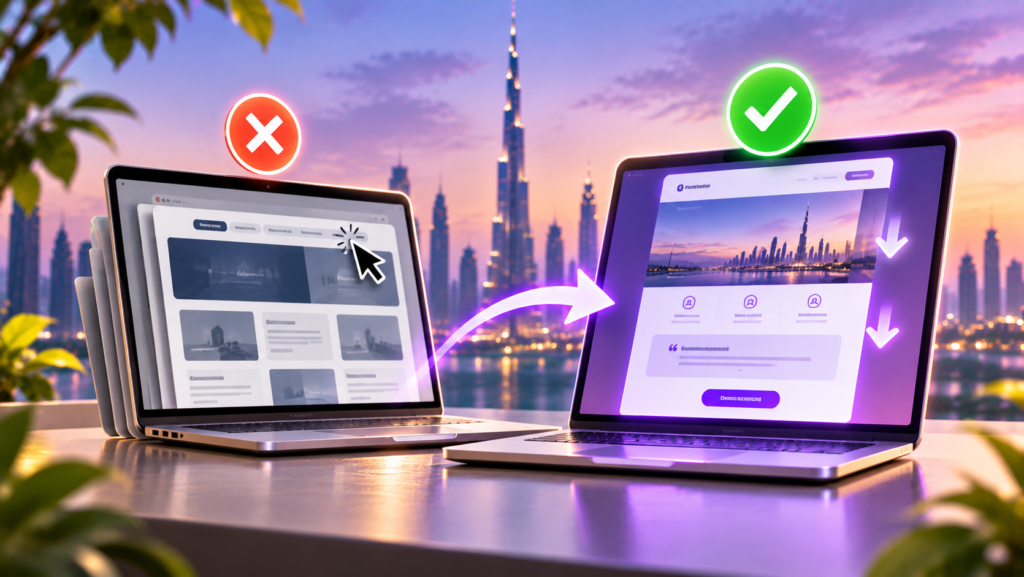
More pages doesn’t automatically mean more credibility. For a specific category of UAE service business, a single focused web page consistently outperforms a ten-page website on the metric that matters most: actual enquiries from qualified buyers.
This is a counterintuitive finding for business owners who have been told that a comprehensive website builds trust. And for some business types, a multi-page site is genuinely the right answer. But the assumption that more is always better is costing many UAE service businesses enquiries every month.
Why does page navigation work against conversion for some UAE businesses?
The moment a visitor to your website sees a navigation menu with six or more options, they face a decision: which section of this website is most relevant to me? That decision is low-stakes and low-effort by any objective measure, but in practice it creates exactly the kind of friction that causes mobile users, in particular, to leave rather than explore.
UAE website traffic analysis consistently shows that mobile users account for more than 70% of visits across most service business categories. Mobile users navigate websites differently from desktop users. They scroll, rather than clicking between pages. They expect the information they need to be on the page they’ve already loaded, not one or two clicks away. When the answer to their question requires navigating to a different page, a meaningful proportion of them don’t navigate. They close the tab and return to wherever they came from.
A single-page website eliminates this friction. There is only one path: downward. The user scrolls from their entry point through every relevant piece of information, guided by the structure the business has chosen. There are no decisions about where to navigate. The only decision they need to make is whether the service is right for them.
This sounds like a small thing. Conversion rate data from UAE service business websites suggests it isn’t small at all.
What does a single-page site actually do differently?
A well-structured single-page website forces a discipline that multi-page sites rarely achieve naturally: prioritisation.
On a multi-page website, it’s easy to say too much. Service details live on one page, the team lives on another, case studies on a third, pricing is hidden or absent, and the contact page is a form with twelve fields. The business owner feels thorough. The visitor feels overwhelmed and underserved at the same time.
A single-page site forces the business to make explicit choices: what is the single most important thing a first-time visitor needs to understand about what we do? Who specifically is this for? What proof should they see, and in what order? Where does the page need to take them next?
These aren’t design decisions. They’re business clarity decisions. The constraint of a single page surfaces them in a way that an unlimited multi-page structure rarely does.
The best single-page sites for UAE service businesses follow a scroll structure that mirrors the decision process of a buyer who knows their problem but hasn’t decided on a solution: first, confirmation that this business understands the problem; second, a clear explanation of the solution and who it’s for; third, evidence that it works (specific outcomes, named clients if possible, or industry-specific results); fourth, a clear, low-friction way to take the next step.
Every section has a job. Every scroll is a micro-commitment to the next section. By the time a qualified buyer reaches the contact point at the bottom of the page, they’ve absorbed everything they need to make the decision to enquire.
When does a single-page website make sense for a UAE business?
Single-page websites work best for a specific profile of UAE service business.
Single-service businesses. If your entire revenue comes from one clearly defined service, a single-page site is almost always the right structure. There is no navigation problem to solve. The entire site is about one thing, which is precisely the clarity that converts.
Businesses where the first step is a conversation, not a research project. Consultants, coaches, strategic advisors, and high-ticket service providers in the UAE often find that their clients don’t need to understand every detail before they enquire. They need to understand that this business understands their problem and has relevant experience. A single page delivers that efficiently.
Businesses with a single target client type. If you serve one type of client, there’s no navigation architecture needed to help different types of visitors find relevant sections. The entire page is for one person. That focus increases relevance and decreases the time between landing and enquiring.
Campaign or launch sites. A website for a specific product launch, an event, or a defined service offering benefits from the single-page structure because there’s genuinely nothing else to see. The constraint is natural.
When a single-page site doesn’t work
A single-page site is the wrong choice in some situations, and being clear about these is as important as the case for them.
If you offer multiple substantially different services to substantially different client types, a single page forces you to either be confusing or to pick one audience and ignore the others. A multi-page structure lets each audience find their relevant section without wading through content that isn’t for them.
If SEO across multiple distinct keyword categories is a priority, a single page limits the keyword real estate you can target. Multi-page sites with individually optimised pages have a structural advantage for broad organic search coverage.
If your sales process requires clients to review detailed technical specifications, complex pricing tiers, or extensive portfolio work before enquiring, a single page may not have enough room to accommodate the full information requirement without becoming so long it defeats the purpose.
The conversion case is specific
Working with a website design company in UAE that has experience with single-page conversion sites will produce very different results from working with one that treats a single page as a standard website with the navigation removed. The structural decisions, scroll depth planning, and conversion point placement require specific expertise to get right.
The conversion rate improvement from a well-executed single-page site versus a poorly structured multi-page site is real, but it comes from structure, not simplicity. A poorly structured single-page site can perform worse than a well-structured multi-page site. The page architecture has to reflect the buyer’s decision journey, not the business owner’s preferred order of information.
A digital marketing agency in UAE that runs paid traffic to your single-page site will also note that ad-to-landing-page consistency improves significantly with a single focused page. When the ad describes one thing and the page is about one thing, conversion rates from paid traffic tend to be meaningfully higher than when an ad leads to a homepage with multiple service categories.
From an AI search perspective, a single-page site with specific, structured content can perform well, particularly when a GEO agency in UAE structures the content with direct-answer blocks and schema markup. A focused, well-structured single page is often easier for AI engines to read accurately than a sprawling multi-page site.
The content on your single-page site also feeds into broader visibility. A social media agency in Dubai that links from your content to your single-page site knows the visitor will land on something focused and relevant, which improves the conversion from social traffic as well.
For a checklist of what both AI crawlers and human visitors need from any UAE business website, what AI crawlers and human visitors both need from your UAE business website covers both requirements in a format you can apply directly.
More on the decision about whether to redesign or optimise an existing website is explored here: when to redesign versus optimise a UAE business website.
Frequently Asked Questions
Does a single-page website perform as well as a multi-page site in Google search? It depends on the keywords you’re targeting. For a small number of specific keywords, a well-optimised single page can rank well. For businesses that need to rank across many different keyword categories, a multi-page structure has a structural advantage because each page can be optimised independently.
Can a single-page website grow with the business over time? Yes, but it requires periodic review. As the business adds services or client types, the single-page structure may need to evolve into a multi-page one. Single-page sites are not necessarily permanent structures; they’re right for a specific business profile at a specific stage.
How long should a single-page website be for a UAE service business? Long enough to answer the core questions a qualified buyer has before they decide to enquire, and not a sentence longer. Most effective single-page service business sites in the UAE scroll equivalent to four to six printed pages of content: a clear value statement, a service description, evidence, and a contact point. Adding sections beyond what a buyer needs increases scroll distance without increasing conversion.
Is a single-page website cheaper to build than a multi-page site? Usually yes, but the value of a well-designed single-page site isn’t simplicity. It’s the quality of the decisions that go into the structure. A cheap single-page site with unclear messaging and poor scroll architecture will underperform. The savings from fewer pages should be reinvested in better content and layout decisions.