
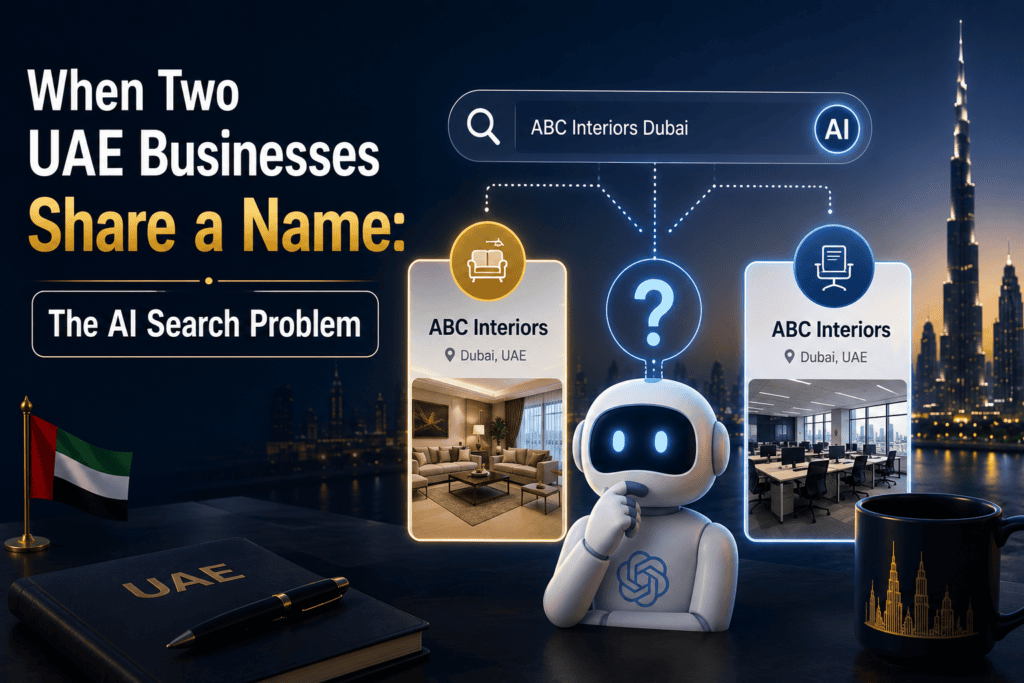
When two businesses operating in the same market have the same or very similar names, AI search systems face an entity disambiguation problem: which business does the user mean? The response AI engines produce in this situation is not random. They make a probabilistic judgement based on available signals, and that judgement consistently favours whichever entity has stronger, more specific, and more consistent signals.
For the entity with weaker signals, this means one of two problems. Either the AI conflates both entities and produces inaccurate information about the business (mixing details from both), or the AI consistently defaults to the competitor, effectively making the weaker-signalled entity invisible for queries where its name is the intended search subject.
Both situations are commercially damaging and neither one gets fixed without deliberate intervention. This article covers how to identify whether you have a name collision problem in the UAE market and what to do about it.
What Entity Collision Actually Is
Entity collision occurs when AI systems cannot reliably distinguish between two business entities because they share a name (or very similar name) and neither has differentiated its entity signals sufficiently for the AI to resolve the ambiguity confidently.
The collision is not always between businesses in the same category or the same city. A digital marketing agency in Dubai named “Crescendo” and a music school in Abu Dhabi also named “Crescendo” can create collision in AI search results if both have indexed web presence and neither has built sufficiently specific entity signals to enable disambiguation. An AI answering “what does Crescendo do in UAE?” has to make a judgement call without reliable disambiguation data.
Entity collision is distinct from simple brand confusion. Brand confusion refers to customers mixing up two businesses because of similar names. Entity collision refers specifically to AI systems being unable to reliably distinguish between two entities in their structured knowledge of the world, which produces incorrect or inconsistent AI search responses regardless of whether humans are confused.
How Common Is Name Collision in the UAE Market
The UAE market has specific characteristics that make name collision more common than in many other markets.
The repeated use of Arabic-derived brand names. Words and phrases that carry positive connotations in Arabic culture, terms relating to trust, excellence, vision, leadership, or prosperity, are popular brand names across many UAE businesses in many categories. The concentration of similar-root brand names creates a higher density of potential name collisions than markets with more diverse naming cultures.
The free zone structure and its effect on entity naming. Thousands of businesses incorporate through UAE free zones each year. The combination of popular name patterns with high registration volume produces frequent cases where two or more businesses in the UAE share substantially similar names.
Transliteration variations. Arabic business names that appear on their English-language websites and directories with multiple possible transliterations create additional entity fragmentation, where the same UAE business is indexed under multiple name spellings that AI systems may treat as separate entities.
How AI Engines Handle Ambiguous Business Entities
When AI search systems encounter a query for a name that matches multiple entities without strong disambiguation signals, they follow one of several resolution strategies.
Default to the highest-authority entity. The entity with the stronger domain authority, more indexed mentions, more review presence, and more structured data will typically be selected as the most probable intended entity. This means the weaker-signalled business of the two is consistently underrepresented for its own name.
Return a hedged or uncertain response. For sufficiently ambiguous queries, Perplexity and similar systems will note the ambiguity in their response: “There appear to be multiple businesses with this name in the UAE. Could you clarify which one you mean?” This is better than defaulting to the wrong entity but represents a failure mode where neither business benefits.
Merge entity attributes incorrectly. In some cases, particularly where the two businesses operate in similar categories, AI systems may produce a merged entity description that combines attributes of both businesses. A merged description is inaccurate for both entities and produces confusion rather than useful information.
Consistently favour local over global. For UAE-specific queries, AI systems typically bias toward locally registered and locally reviewed entities over global businesses with similar names. This benefits UAE-based businesses against global brand overlap, but not against other locally registered businesses with similar names.
How to Know If You Have a Name Collision Problem
Run your business name as a direct query on Perplexity, ChatGPT Search, and Google AI Overviews. Read the results carefully. Do the descriptions match your actual business? Is your location, your category, and your service description accurate? Or are there attributes mixed in that belong to a different business?
Search your business name on Google images. Logo images, team photos, and office images that appear under your name in image search should be your assets. If a different business’s imagery appears under your name, entity confusion is happening at the image layer.
Check what Google Knowledge Panel appears for your name, if any. A Knowledge Panel populated with wrong information is a strong signal of entity collision. Knowledge Panels draw from the same entity graph that feeds Google AI Overviews and AI Mode.
Search for “[your business name] + [city]” and “[your business name] + UAE” and compare results across platforms. Inconsistent descriptions across platforms are a collision signal.
Ask a colleague unfamiliar with the collision to search your business name on Perplexity and read the result aloud. If they read attributes that do not match your business, the problem is real.
The Costs of Unresolved Entity Collision
Lost recommendation citations. When AI search cannot confidently distinguish between two entities, it defaults to the stronger one or returns an uncertain response. Both outcomes mean the collision is costing you recommendation appearances you should be receiving.
Trust damage from inaccurate AI descriptions. A prospective client who searches your name and receives an AI description that mixes your attributes with a competitor’s will form an inaccurate impression of your business. Some will contact you with wrong expectations. Some will not contact you at all because the description does not match what they are looking for.
Negative trust verification outcomes. Trust verification queries about your business may surface complaints or negative information about the other entity with the same name, damaging your reputation based on another company’s behaviour.
Review confusion. In some cases, AI trust assessments may draw on review content for the similarly-named entity, particularly if that entity is more prominently reviewed on a shared platform.
A Generative Engine Optimization Dubai engagement for a UAE business with a name collision problem begins with a specific disambiguation strategy before any other GEO work, because all other optimisation is undermined by a system that cannot reliably tell the two entities apart.
How to Differentiate Your Entity From a Similar Name
Add highly specific entity modifiers to all your business descriptions. The combination of your legal business name, your Dubai mainland or free zone jurisdiction, your specific service category (not a broad one), and your founding year makes your entity description unique even if the name is not. Use this full description consistently everywhere.
Build structured data that explicitly defines your entity. LocalBusiness schema with your specific registered address, your sameAs links to your verified social profiles, and your specific business categories gives AI systems the machine-readable data they need to distinguish your entity from a similarly-named one.
Differentiate your GBP category and location from the collision entity. If both businesses are in Dubai, being specific about your physical address and your primary GBP category creates a spatial and categorical distinction that AI systems can use for disambiguation.
Build third-party citations that include your specific differentiators. Press mentions, reviews, and directory listings that consistently refer to you as, for example, “the Dubai-based GEO agency” rather than just the business name give AI systems specific contextual signals that belong to your entity and not the collision entity.
Invest in a Google Knowledge Panel. A verified Knowledge Panel for your business provides an authoritative entity definition that AI systems use as a primary disambiguation reference. Claiming and verifying your Knowledge Panel should be a priority for any UAE business with a collision problem.
FAQ
Can I force the collision entity to change its name if it is causing confusion? Legally, this depends on trademark registration and UAE commercial registration rules. Digital marketing GEO strategy cannot compel a name change. The GEO approach is to differentiate your entity signals sufficiently that AI systems reliably distinguish between the two regardless of name similarity.
What if the collision is with a much larger or more established business than mine? Highly specific entity differentiation becomes even more important. The goal is not to out-compete the larger entity for the shared name overall, but to ensure that queries specifically about your entity’s context (your city, your category, your services) reliably return your information rather than the larger entity’s.
Does name collision affect Google local search as well as AI search? Yes. Google’s local search entity graph is the foundation that both Google Local Pack and Google AI Overviews draw from. Entity collision at the Google Knowledge Graph level affects local search, AI Overviews, and AI Mode simultaneously.
How long does it take to resolve a name collision through entity differentiation? Typically 3 to 6 months of consistent differentiated signal building for basic resolution, with full disambiguation achieving a stable state closer to 6 to 12 months. The timeline depends on how established the collision entity is and how actively you are building differentiating signals.
Conclusion
Name collision is one of the most consistently under-diagnosed problems in UAE GEO strategy. It does not announce itself visibly. The business simply underperforms in AI search relative to its actual quality and client base without an obvious explanation.
If you have not run your own name as a query across major AI search platforms and verified that the descriptions returned accurately describe your specific business, do it today. The 15 minutes of self-testing is the most direct available signal of whether entity collision is silently limiting your AI search visibility. An AI search optimization agency in Dubai running a new client onboarding will always perform this name collision test in week one, because a collision problem that is not identified immediately undermines every subsequent GEO action. The GEO services for UAE businesses that BRB delivers include entity disambiguation as a foundational step rather than an optional add-on, and any digital marketing agency in UAE treating this as secondary to content and schema work is building on an unstable foundation.