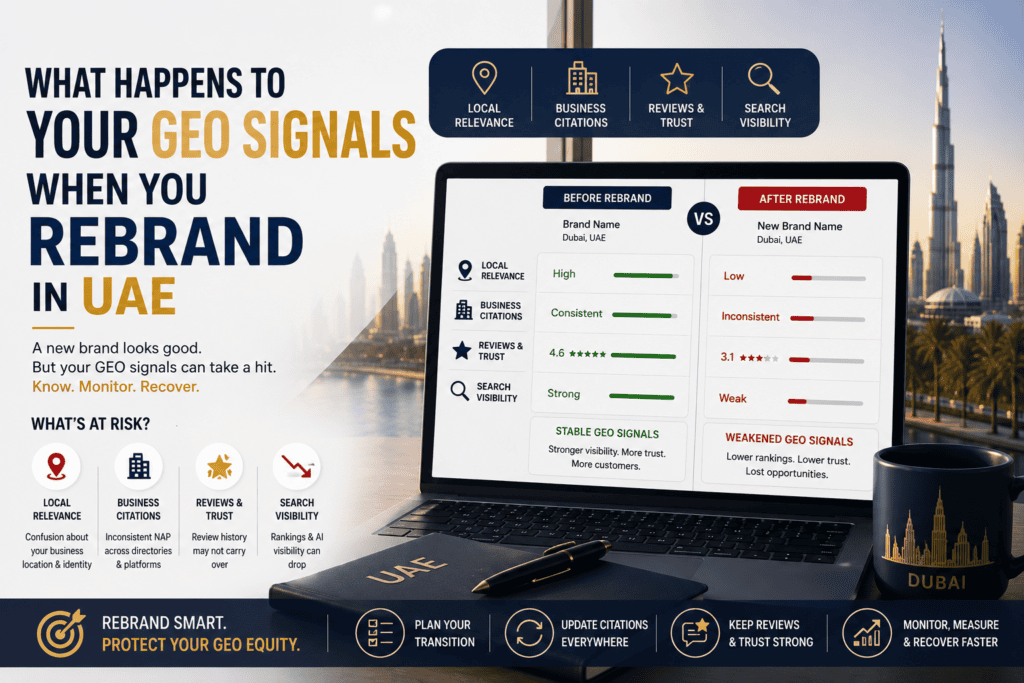
A rebrand in the UAE context means a new name, a new domain, a new brand identity, and a new presentation to the market. What it also means, though few businesses account for it, is that the accumulated entity signals in AI search systems that were attached to the old name no longer point to you.
AI search engines learn business entities gradually, through consistent mentions, citations, structured data, reviews, and published content accumulated over time. When a business changes its name, that accumulated entity knowledge does not automatically transfer. The old name’s AI entity remains in the index, increasingly becoming orphaned from active web content. The new name starts with near-zero AI entity recognition, competing from scratch against competitors who have been building their signals for years.
This article covers what specifically happens to GEO signals during a rebrand and how to manage the transition so the new name inherits as much entity authority as possible from the old one.
Why Rebranding Is a GEO Problem, Not Just a Design Problem
Traditional rebrand planning covers visual identity, messaging, domain migration, social handle changes, and communication to existing clients. The GEO layer is almost never included in a rebrand project scope, which creates a period of AI search invisibility that can last 6 to 18 months post-rebrand if not actively managed.
The invisibility happens because AI search entity recognition is not built from a single authoritative source. It is built from pattern recognition across many independent sources: your website, your GBP, your social profiles, your directory listings, client reviews, press mentions, backlinks, and third-party content that references your business name. All of these sources need to reflect the new name, consistently and simultaneously, before AI engines begin building a confident entity representation of the new brand.
In practice, no rebrand achieves this simultaneously across all sources. Some directories take weeks to update. Old press mentions remain indexed with the old name indefinitely. Client reviews referencing the old name stay in place. The result is a fragmented entity picture where the AI sees both names associated with overlapping signals and lacks the confident entity resolution needed to recommend either with specificity.
What AI Engines Know About Your Old Brand
Before evaluating your rebrand’s GEO impact, it is useful to understand how much entity knowledge existed for the old name and in which sources. Run a set of queries for the old business name across Perplexity, ChatGPT Search, and Google AI Overviews. Note: How is the old name described? What sources are cited? Is the entity description accurate and positive?
This baseline reveals what you are migrating from. A business with strong entity recognition for the old name has more accumulated signals to transfer than one that was just building visibility. Paradoxically, the more successful the old brand was at GEO, the more disruptive the rebrand is to AI search visibility, because there is more to rebuild.
How Entity Signals Get Fragmented During a Rebrand
The fragmentation happens in layers:
Website migration. If the rebrand involves a new domain, the move from old domain to new domain affects the underlying authority signals that fed entity recognition for the old name. Even with proper 301 redirects, the entity signal transfer is not immediate and may be incomplete for AI systems that do not follow redirect chains the same way traditional search crawlers do.
Google Business Profile. Updating the GBP name is straightforward, but the accumulated reviews on the old GBP listing reference the old name. If the profile name changes but the reviews still mention the old name, AI engines reading the GBP will see an inconsistency that reduces entity confidence.
Third-party directories and citations. Every directory that lists the old business name with the old domain creates a conflicting signal for the new entity. The NAP inconsistency between old and new name listings directly degrades AI entity confidence for both the old and new name.
Social profiles. Handle changes on Instagram, LinkedIn, and Twitter/X are instantaneous, but the historical content on those profiles references the old name in captions, bios, and engagement interactions. Archived content with the old name does not disappear from AI training data simply because the handle has changed.
Client reviews. Reviews on Google, Clutch, Trustpilot, and similar platforms that reference the old business name by name in their text cannot be edited. They remain as indexed mentions of the old name, contributing to a persistent entity presence for a name that is no longer active.
The Name Change Announcement Problem
Most businesses announce their rebrand with an announcement post or press release: “We are excited to announce that [Old Name] is now [New Name].” This is the right communication for existing clients and followers. It is problematic for AI entity signals.
The announcement content creates a published bridge between the two names. AI engines reading this content now associate both names with the same entity, which is helpful for disambiguation. But the announcement also reinforces the old name as a descriptor of the same business in AI training and retrieval systems, slowing the transition to exclusive new-name recognition.
A better approach is to also publish substantial new-name-first content: service pages, case studies, blog articles, and structured data that exclusively use the new name without the old-name reference. The announcement serves existing contacts; the new-name-first content builds the new entity in AI systems.
A Generative Engine Optimization Dubai rebrand project includes a specific content publication plan for the post-announcement period: a sequence of new-name-first articles and landing pages designed to accelerate AI entity recognition of the new name independently of the old one.
How to Rebuild Entity Signals Under the New Name
Update your GBP to the new name immediately and completely. This is the highest-authority local entity signal for Google AI systems. A mismatched GBP name creates fragmentation in every local AI citation that follows.
Update all major directory listings within the first 30 days. Create a list of every directory and citation source that carries your business information and prioritise updating the ones with highest domain authority first. This is tedious but directly proportional in its effect on AI entity clarity.
Publish new-name-first structured data. Update all schema markup on the website to use the new business name, and add schema that explicitly declares the new name as the primary entity name with the old name as a former name property where the schema supports it.
Generate new reviews under the new name. Ask satisfied clients who engaged with the new brand to leave reviews on GBP and other indexed platforms using the new name. This begins building a review profile for the new entity.
Earn press mentions and third-party citations of the new name. A press release or media placement announcing the rebrand, published on a credible regional outlet, gives AI search systems an authoritative, dated source for the new entity name. This is one of the most impactful early GEO actions in a rebrand.
For the full entity building methodology that applies both to rebrands and to new businesses building AI search recognition from scratch, the article on why unlinked brand mentions drive AI citations covers the independent citation sources that build the entity confidence AI engines need to recommend a business.
The Transition Window: Managing Both Names Simultaneously
For the first 3 to 6 months of a rebrand, AI systems will see both names as associated entities. Queries for the old name may still return results referencing the new name alongside the old. Queries for the new name may produce thin or uncertain responses.
This is normal and temporary, but managing it proactively shortens the window. The key actions during this period:
Do not remove or redirect the old name from GBP before updating everything else. Premature removal creates entity orphaning rather than entity transfer.
Monitor both names in AI search queries monthly. Tracking what Perplexity, ChatGPT Search, and Google AI Overviews say about both names during the transition reveals how quickly the migration is progressing and where persistent old-name associations are coming from.
Invest in new-name content volume. The more high-quality, specific content that exclusively uses the new name accumulates in the index, the faster AI systems build confident entity recognition for the new brand.
FAQ
How long does it take for AI search to fully recognise a rebranded UAE business under the new name? Typically 6 to 12 months for basic recognition, 12 to 18 months for the new name to have comparable entity confidence to the old name at the time of rebrand. Proactive management shortens this window; passive management extends it.
Should we keep the old domain and redirect, or switch to the new domain immediately? Keep the old domain with a 301 redirect to the new domain. This preserves as much link equity as possible and helps traditional SEO signal transfer. For AI search specifically, the content signals on the new domain are what matter most, which means publishing high-quality content under the new domain immediately is the priority alongside the technical redirect.
Will our old reviews mentioning the previous name hurt us under the new name? Not directly, but they slow entity migration because they maintain an indexed presence for the old name. Over time, as new reviews accumulate under the new name, the ratio shifts and AI entity confidence in the new name grows. There is no way to edit or remove reviews that mention the old name.
Is there any benefit to keeping the old name as a “doing business as” or secondary name? In some cases yes, particularly if the old name has strong local recognition or appears in long-term client contracts. Using “New Name (formerly Old Name)” in content during the first year of the rebrand provides disambiguation without completely abandoning the accumulated recognition of the old name.
Conclusion
A rebrand is a reset of AI search entity recognition that most businesses do not plan for. The accumulated GEO signals of the old name do not transfer automatically, and the new name starts with minimal entity recognition in AI systems regardless of how well-established the old brand was.
Active GEO rebrand management, treating the transition as a deliberate entity migration rather than a passive name change, can reduce the visibility gap from 18 months to 6 to 9 months. That difference translates directly into lead volume and commercial performance during the transition period. An AI search optimization agency in Dubai that includes rebrand GEO planning in its scope from day one will consistently deliver a shorter transition window than one that addresses AI entity migration as an afterthought once the new brand is already live. A digital marketing agency in UAE managing the rebrand across all digital channels should treat entity signal migration as a parallel workstream to the creative and communication rebrand, not a follow-on task.