
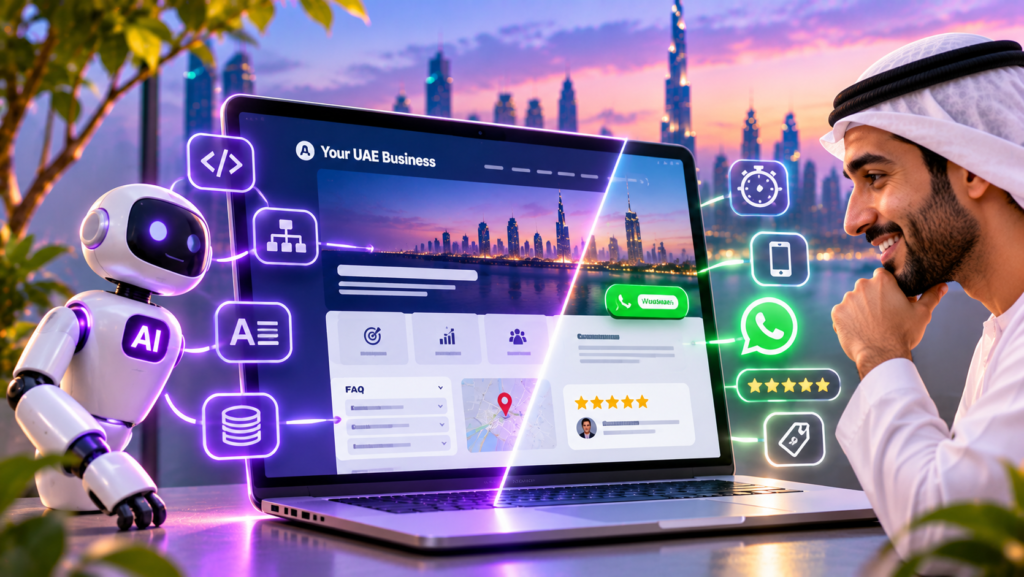
Your UAE business website is being evaluated by two fundamentally different audiences at the same time, and most websites are failing at least one of them.
The first audience is the AI crawlers from Perplexity, ChatGPT, and Google that visit your website to decide whether to recommend your business in AI search results. They’re reading your text, parsing your structure, and checking whether your information is specific enough and consistent enough to cite.
The second audience is the human visitor who arrives after that recommendation, or from a Google search, or from a social media link. They’re making a different kind of evaluation: does this website feel trustworthy, does it answer my question, and is the next step obvious enough that I’ll take it?
These two audiences are compatible, but they’re not the same. A website optimised purely for human conversion can still fail the AI crawlability test. A website structured purely for AI extraction can feel cold and mechanical to human visitors. Getting both right requires understanding what each needs.
What AI crawlers need from your UAE website
AI crawlers don’t see your website the way a human visitor does. They don’t register beautiful design, colour palettes, or animations. They read text, parse structure, and extract information. Here is what they need to do that accurately:
1. Your business name in your H1 heading or your page title, consistently. If your H1 says “Welcome to Our Services” and your business name only appears in the footer, AI crawlers have a harder time associating your content with your entity.
2. NAP (name, address, phone) as readable text, not an image. Text embedded in an image is invisible to crawlers. Your address and phone number need to appear as actual HTML text somewhere on the page.
3. Schema markup for LocalBusiness and your service types. Structured data tells AI engines precisely what type of business you are, what you do, where you’re located, and what your contact details are. Without it, they’re inferring.
4. FAQ sections on service pages. Directly answered questions are among the content types most frequently extracted by AI engines. A FAQ block that answers real buyer questions in plain language gives crawlers extractable, attributable content.
5. Clear, specific service descriptions with outcomes. “We provide digital solutions” is invisible to AI engines. “We build Arabic and English websites for UAE retail and hospitality businesses, typically delivered in six to twelve weeks” is readable, specific, and citable.
6. Descriptive alt text on all images. Images are invisible to AI crawlers without alt text. Every image on your service pages should have an alt text that describes what it shows in the context of your business.
7. Content that loads in the HTML source, not rendered by JavaScript. Some UAE websites use JavaScript frameworks that render content dynamically after page load. AI crawlers often see the empty pre-render state rather than the populated page, which means your content doesn’t get read.
8. Clean, crawlable internal links. If AI engines can follow links between your pages, they build a better picture of your full service offering. Broken links, nofollow tags on internal pages, and navigation that requires JavaScript interaction all reduce crawlability.
9. A robots.txt file that doesn’t block AI bots. Some website plugins or developers add rules to robots.txt that block all or specific bots. Check yours. If you’re blocking GPTBot, PerplexityBot, or similar AI crawler user agents, those platforms can’t read your website at all.
10. Consistent entity information that matches your other platforms. Your website name, address, phone, and service description should match your Google Business Profile exactly. Each inconsistency reduces AI confidence in your information.
What human visitors need from your UAE website
Human visitors arrive with limited patience and a specific question in mind. They’re on mobile, in a waiting area or during a commute, and they’ve given you about five seconds to confirm that this website is worth their time.
1. Loads in under 3 seconds on a UAE mobile connection. Use Google PageSpeed Insights to check your score for mobile. A site that loads in 5+ seconds on a standard UAE mobile network loses a meaningful proportion of visitors before they’ve seen anything.
2. Passes the 5-second test. A first-time visitor should be able to tell, within five seconds of landing on your homepage, exactly what you do and who it’s for. If this requires reading carefully, you’ve already lost a portion of your mobile audience.
3. A WhatsApp button visible on mobile. In the UAE, WhatsApp is often the preferred contact method for initial enquiries. A floating WhatsApp button or a prominent WhatsApp link in the mobile header converts meaningfully more mobile visitors than an email contact form.
4. Trust signals above the fold. Before a first-time visitor scrolls, they should see at least one trust signal: client logos, a specific number (years in operation, clients served, projects completed), a relevant certification, or a review score. Generic “we are your trusted partner” text is not a trust signal.
5. Pricing information or a clear price range. UAE buyers frequently list the absence of pricing information as a reason they didn’t enquire. They don’t need an exact number, but “projects start from AED X” or “monthly retainers from AED X” removes the ambiguity that causes many qualified buyers to look elsewhere.
6. An enquiry form with three fields or fewer. Name, email, and message. Anything beyond this increases abandonment significantly. Full address, company size, VAT number, and service selection are questions for after the enquiry, not before.
7. Testimonials that mention specific outcomes and clients. “Great service, highly recommend” helps less than “the redesign increased our online bookings by 40% in the first month, Fatima, Director at [Company].” Specificity is what makes a testimonial credible rather than cosmetic.
8. A date stamp or recent activity indicator. A blog post last updated in 2022 or an “upcoming event” from 18 months ago signals a neglected website. Recent activity indicators, a recent case study date, a blog post from last month, signal an active business.
9. An explainer element for complex services. If your service requires more than one sentence to describe, a short video, an animated overview, or a visual process diagram helps human visitors understand what they’d be getting before they commit to an enquiry.
10. Mobile-friendly navigation with a clear path to the most important action. On mobile, navigation menus that are difficult to open, that have many levels, or that bury the “contact us” option create friction. Your primary call to action should be reachable within one tap from any page.
Where AI and human needs overlap
Several things benefit both audiences simultaneously:
Specific, readable text content. AI engines extract it; human visitors trust it.
Fast load times. AI crawlers don’t cache slow sites efficiently; human visitors leave.
Clear structure with descriptive headings. AI engines use headings to understand content hierarchy; human visitors use them to scan.
Proof elements that are text-based. A written case study is readable by AI engines and trusted by human visitors. An image of an award or a photo of a happy client serves the human but contributes nothing to AI visibility.
Consistent information. When your website matches your other platforms, AI engines form a confident picture; human visitors who cross-check your details find the same information everywhere, which builds trust.
What to fix first if you’re failing both checklists
If you’ve run both checklists and have failures in multiple areas, prioritise in this order:
First, fix anything that blocks AI crawlers completely: robots.txt issues, JavaScript rendering problems, or missing schema markup. These are the highest-leverage fixes because they determine whether you’re visible in AI search at all.
Second, fix the human visitor trust signals: load time, 5-second test, pricing presence, and WhatsApp button. These directly affect the conversion rate of every visitor you receive, regardless of how they arrived.
Third, improve the quality of your text content: specific service descriptions, FAQ sections, and outcome-based testimonials. These improvements serve both audiences simultaneously.
Working with a web development agency in Dubai that understands both AI crawlability and human conversion design is the most efficient way to address the full checklist, because many of the fixes require code-level changes that can’t be made through your CMS alone.
An AI search agency in Dubai will focus specifically on the AI-side checklist, including schema markup, entity consistency, and content structure, as part of a GEO audit that identifies exactly where your website is falling short for AI engines.
A viral content agency in Dubai that drives traffic to your website can tell you very quickly which parts of the human visitor checklist are failing, because their traffic data shows where visitors are arriving, what they’re doing, and where they’re leaving.
A marketing agency in Dubai that manages both your traffic acquisition and your website conversion can address both checklists as a unified project, since fixing AI crawlability without fixing human conversion means more traffic to a website that doesn’t convert, which is only half a solution.
For the specific question of whether your website needs a full rebuild or a targeted optimisation layer, why UAE businesses with existing websites need a GEO layer, not a redesign covers when to add rather than replace.
The AI-specific signals your website sends are also covered in detail here: are your robots.txt settings accidentally blocking AI bots from reading your UAE website.
Your action priority list
- Check your robots.txt file and unblock any AI crawler user agents that are currently blocked
- Run your site through a mobile speed test and address anything scoring below 70
- Add schema markup (LocalBusiness minimum)
- Add a WhatsApp button to your mobile navigation
- Rewrite your homepage H1 to clearly state what you do and who for
- Add specific outcome statements to your service pages
- Add a FAQ section to your most-visited service page
- Check that your NAP appears as readable text (not image)
- Update or add trust signals above the fold
- Ensure your most important content renders in the HTML source, not client-side JavaScript