
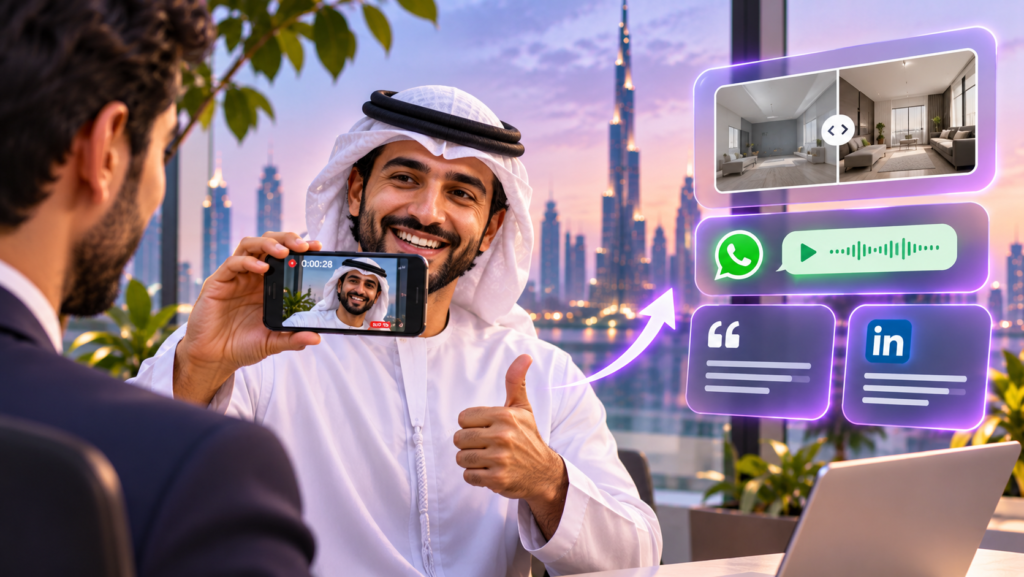
Most UAE businesses that ask clients for content get one of two things back: a polite non-response, or a generic review that does nothing for their credibility. The businesses that regularly have clients filming reactions, sharing outcomes, and posting about their experience have a fundamentally different approach to the moment of delivery, and very little of it involves asking.
This distinction matters because client-created content about your business carries a different kind of weight than anything you create yourself. A potential client in the UAE who sees another business owner describing a specific result, in their own words, in their own environment, is receiving peer-level testimony that no produced testimonial video can replicate. It’s not just more credible. It’s the kind of content that gets saved, shared, and forwarded in WhatsApp groups of the exact people you’re trying to reach.
Why the typical UAE approach to getting client content fails
The usual method is to ask. You complete a project, the client seems happy, and you follow up with a request for a testimonial, a Google review, or a case study interview. Sometimes you get something back. More often you don’t, not because the client is unhappy, but because creating content feels like effort, and effort requires a reason.
There’s also a UAE-specific dynamic at play. Business owners and professionals in the UAE tend to be more protective of public visibility than counterparts in some Western markets. Many clients in the UAE, particularly in B2B sectors, don’t want their vendor relationships visible to competitors. Some have cultural or personal preferences about appearing in public-facing content. Others simply don’t know what to say or how to say it in a way that would be useful to anyone.
Asking a satisfied client to “leave a review or a testimonial” puts the burden of creation entirely on them. For busy UAE business owners, that burden rarely gets prioritised. The request gets left in the inbox until it’s too late to act on.
What actually creates the conditions for client-produced content
The businesses that consistently generate client content understand a simple principle: the most powerful moment of any successful project is the moment the result becomes real for the client. That moment is usually brief, usually unexpected in its emotional weight, and usually happens in a physical or digital space where recording is possible.
The mistake is waiting until after the moment has passed to ask for content about it. The businesses that capture client content well are present for the moment and create the conditions for it before it arrives.
Make the result visual and immediate before anything else. If your service produces a visible outcome, a redesigned space, a launched website, a dashboard showing a new metric, a piece of finished creative work, arrange for the client to see it for the first time in a setting where you can ask them to film their reaction. The reaction at the moment of reveal is a completely different emotional register from the review someone writes three weeks later from memory.
Co-create the content rather than requesting it. “Would you be willing to film a 30-second reaction to this right now, while we’re here?” is a very different ask than “could you write us a testimonial sometime?” One is immediate and specific. The other is deferred and vague. Immediate specific asks succeed at a much higher rate.
Give them the format in advance. Many clients in the UAE don’t create content because they don’t know what to say. Removing that barrier is simple: before the delivery meeting, let them know you’d love to capture their reaction on the day. Give them a prompt: “All you need to say is what your situation was before we started, and what you’re seeing now.” That framing does most of the work.
Use WhatsApp to capture informal moments. The UAE’s near-universal WhatsApp adoption creates an informal content channel that most businesses ignore. When a client sends you a genuinely positive message, a voice note, a result screenshot, or an enthusiastic WhatsApp about an outcome, ask them whether you can share it (with name, with an anonymised reference, or however they prefer). These informal moments of genuine satisfaction are often more credible than produced content.
Content types UAE service businesses can realistically generate
Not all client content is equally achievable. Here is what service businesses in the UAE can realistically expect to generate with consistent effort:
Before-and-after documentation. For businesses that produce a visible change, this is the most accessible format. A side-by-side of the before state and the after state, with or without the client on camera, is compelling and doesn’t require much creative effort from the client.
Screen recordings of positive messages. A screenshot or screen recording of a genuine client message (WhatsApp, email, LinkedIn) with identifying details adjusted to the client’s comfort level can be very effective social proof. Ask permission to share it, and most satisfied clients will agree.
Brief quote cards. You write the quote, the client approves it. You design the visual. The client shares it if they’re willing to. This is a low-friction format that many UAE business owners are comfortable with because they have full editorial control.
LinkedIn recommendations converted to visual content. A LinkedIn recommendation is already public. Designing it as a visual and posting it (with credit to the recommender) repurposes content the client has already chosen to make public.
Voice note reactions. In the UAE, voice notes on WhatsApp are a normal communication format. After a successful delivery, ask the client to send you a 30-second voice note about what changed for them. Many clients who would never write a testimonial will send a voice note without hesitation, and an audio testimonial clip is highly effective social content.
Building a UGC system rather than hoping for it
The difference between businesses that consistently generate client content and businesses that occasionally get lucky is process.
Working with a social media agency in Dubai that builds UGC capture into the client delivery process means you stop depending on clients spontaneously deciding to create content about you. The prompt, the timing, the format, and the follow-up become part of how your business operates rather than an afterthought.
The moment of delivery is the highest-leverage point in the entire client relationship for content generation. It’s also the moment most UAE businesses completely ignore from a content perspective, because they’re focused on the delivery itself rather than the evidence it creates.
A digital marketing agencies in Dubai that manages both your social media and your client communication strategy can integrate these moments across your business, so that content capture is a natural part of how projects close rather than something you remember to try occasionally.
The AI search visibility dimension of client content is also worth noting. Reviews and client mentions across indexed platforms contribute to the entity picture that AI engines build about your business. A GEO agency in UAE will account for this in how client content is encouraged and distributed, ensuring it contributes to both social proof and AI search signals.
Your website also needs to be equipped to receive the interest this content generates. A web development agency in Dubai that designs for inbound conversion from social traffic will ensure that visitors arriving from client content find a page that captures their interest and makes the next step obvious.
For a look at how to structure video content around client results in a B2B context, B2B short-form video in the UAE and why it plays by different rules covers the format and platform decisions that determine whether client story content actually converts.
How you turn one client result into multiple content formats is explored in detail here: how to turn client results into repeatable content for your UAE business.
Frequently Asked Questions
What if UAE clients are reluctant to appear publicly in content? This is common and legitimate. The solution is to offer options: anonymised by industry (“a logistics company in Dubai”), fully attributed, or anything between. Many clients who won’t appear on camera will allow a named quote in a graphic. Many who won’t provide a public testimonial will allow a private reference call with a prospect. Work with their comfort level rather than defaulting to the most visible format.
How soon after project completion should we try to capture client content? At the moment of delivery or within 48 hours of it. Enthusiasm and specificity both decay quickly after a project closes. The emotional peak of seeing the result is the right moment to capture content, and it becomes progressively harder to recreate that energy later.
Does client content on social media actually help with AI search visibility? Directly, less so, because most social media content isn’t indexed by AI engines. Indirectly, yes, because content that drives referrals and reviews contributes to the review and mention volume that AI engines do read. The social content creates the conversation; the reviews and mentions that flow from it create the AI visibility signal.
What if we don’t have permission to share the client’s results publicly? Use the outcome without identifying the client. “A consulting firm in Abu Dhabi reduced their client onboarding time by 60%” tells the story that matters, the result, without revealing the client. Most UAE buyers understand and accept anonymised case studies without requiring full attribution.
Is formal written consent needed before sharing client content in the UAE? For commercial use of images or video, written consent is the safest approach. For quotes, most businesses in the UAE use a verbal or WhatsApp-based agreement, which is generally understood as informal consent. If your content strategy involves significant production value, a simple one-paragraph release agreement sent via WhatsApp is sufficient for most contexts and takes less than a minute for the client to respond to.