
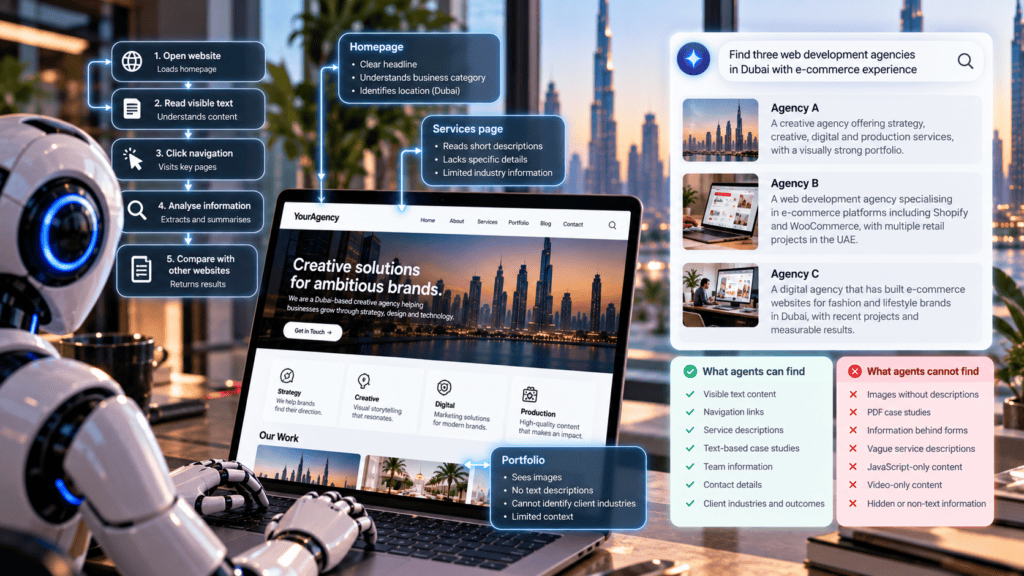
An AI agent opens your website. Not a crawler reading the underlying code: a browser session, the same interface a human visitor would use.
It loads your homepage. It reads the visible text. Your headline says “Creative solutions for ambitious brands.” It notes this and moves on. Navigation links: Home, About, Services, Portfolio, Contact. It clicks Services.
Your services page loads. It has four illustrated cards: Strategy, Creative, Digital, Production. Each card has an icon and a one-line description. “Strategy: We help brands find their direction.” “Creative: Visual storytelling that resonates.” The agent reads these lines. It has learned almost nothing about what you specifically do.
It clicks Portfolio. A grid of project images loads, all beautifully composed. No captions. No text. No client names. It sees images and nothing else.
A buyer asked this agent to find three UAE agencies with e-commerce experience. The agent returns to the comparison and describes your agency as: “a creative agency offering strategy, creative, digital, and production services, with a visually strong portfolio.” It cannot say more because it found nothing more.
The competitor whose portfolio descriptions read “Built a Shopify-integrated UAE fashion e-commerce platform for [Client Name], handling 2,000 daily transactions, May 2024” comes back looking specific, credible, and relevant to the buyer’s brief.
This is happening now, to varying degrees, on every UAE business website. Most businesses do not know it.
What Makes a Website Readable for an AI Agent
The difference between what the agent found on your website and what it found on the competitor’s is not technology. It is content.
AI browsing agents are text readers navigating a visual environment. They read what appears as text on screen. They cannot interpret images. They cannot access files behind form submissions. They do not follow links to PDF downloads automatically. And they cannot infer from a polished aesthetic what the underlying services actually are.
Here is a practical breakdown of what agents handle well and what stops them:
The agent reads efficiently: Clear headline text that names your service category and client type. Navigation with descriptive labels. Prose descriptions on services pages that name specific specialisations. Case study pages with written paragraphs about the project, client industry, challenge, and outcome. Team pages with names and written role descriptions. Contact information visible as text on the page: a phone number that can be read, an email address that can be extracted.
The agent hits a wall: Portfolio sections that are image grids with no text. Case studies that exist only as downloadable PDFs. Services pages that use marketing language without naming specific capabilities. Pricing information accessible only through a contact form submission. JavaScript-powered elements that only appear after specific interactions, like filtered gallery views or dropdown-triggered service lists.
The agent returns thin results for: Anything described in language so generic that it could apply to any agency anywhere. About pages that describe values and culture without naming what the business actually does. Navigation labels like “What We Do” that take the user to a page that still does not say specifically what you do.
The Gap Between SEO-Optimised and Agent-Readable
A website can rank well on Google while being nearly invisible to AI agent research. The signals are different.
Google’s crawler reads meta descriptions, schema markup, keyword density in headings, and link structure. An AI browsing agent ignores all of this and reads what a visitor sees. A page that Google ranks highly for “web design agency Dubai” because it has optimised H1 tags and clean URL structure can still return almost no useful information to an agent if the visible page content is sparse or image-dependent.
One practical way to test whether your UAE website is easy to read quickly by an agent or a first-time visitor is the five-second test, what the five-second test reveals about UAE business websites covers how rapid-evaluation behaviour applies to both human and automated visitors, and the specific adjustments that address both at once.
A Content Audit Checklist for Agent-Readability
Run through this for each of your core web pages:
Homepage
- Does the visible headline text name what the business does and who it serves, in specific terms?
- Does the first screen of content give an agent enough to categorise the business accurately?
Services page
- Are specific service names written as text, not just as visual card icons?
- Does each service have at least one sentence of specific description beyond a tagline?
- Are client industries or use cases mentioned?
Portfolio or Work page
- Does each portfolio item have a text description? Minimum: client industry, project type, one specific outcome.
- If the portfolio is image-based, is there any text at all that names what was built?
Case Studies
- Are case studies available as web pages, or only as PDF downloads?
- Does the web page version include the key information an agent would need: client context, scope, outcome?
Team page
- Are team members named in text?
- Are roles described specifically rather than generically (“Senior UX Designer with 8 years of UAE e-commerce experience” vs “Creative Thinker”)?
Contact / About
- Is contact information available as readable text without requiring form submission?
- Does the About page name specific capabilities rather than only values?
A web design agency UAE building new client websites should be including agent-readability as part of every project brief. The changes required are content decisions, not technical ones, and they improve human usability and GEO performance simultaneously.
FAQ
Do I need to redesign my website to fix these issues? Almost never. Agent-readability problems are content problems, not design problems. Adding text captions to portfolio items, writing case study paragraphs, and naming specific capabilities on services pages are content tasks that can be done on any existing website without redesigning anything.
Will improving my website for AI agents hurt its visual design? Done well, no. A sentence of text below a portfolio image, a short description on a services card, and a paragraph in a case study can all be designed to complement rather than compete with visual content. The best implementations are invisible as text additions because they are designed as part of the page.
How do I know if AI agents are currently visiting my website? You cannot see agent visits in standard analytics in the way you see human visits. The more practical test is the output test: run an AI agent on a task that would involve visiting your website, and read what it comes back with. If the summary is thin or generic, the content gap is real.
What is the difference between how Google’s Googlebot and an AI browsing agent read my site? Googlebot reads the underlying HTML of your page, including meta tags, schema markup, and structured data. An AI browsing agent reads what renders in a browser: the visible experience. A page well-optimised for Googlebot can still be poorly informative for an AI browsing agent if the visible page content is sparse.
The Business Case for Action
The category of buyers most likely to use AI agents for vendor research is also the category most valuable to UAE B2B service businesses: time-constrained senior professionals who would rather delegate the first round of vendor comparison than spend two hours visiting ten agency websites.
A website design company in UAE that makes its portfolio text-rich, its services page specific, and its case studies readable as web pages rather than PDFs is positioning itself to be well-represented in every agent-compiled vendor comparison where its category and location are relevant. The investment is not in technology. It is in having something specific to say about your work and saying it in text.
How to build a UAE website that works for both Google and AI search covers the structural and content principles that make a website perform well across every channel, crawlers, agents, and human visitors simultaneously. And for the buyer-side context that explains who is actually running these agent research tasks and why, what OpenAI Operator means for how UAE buyers will research your business is the companion piece.
A digital marketing agency in UAE conducting a website audit for a client should now be adding agent-readability to the standard checklist alongside technical SEO, mobile performance, and conversion path analysis. The gap between what most UAE business websites currently show an agent and what they should show is one of the most actionable improvements available in 2026. How to improve website conversion rate for UAE service businesses addresses the human-visitor side of the same content quality improvements.