
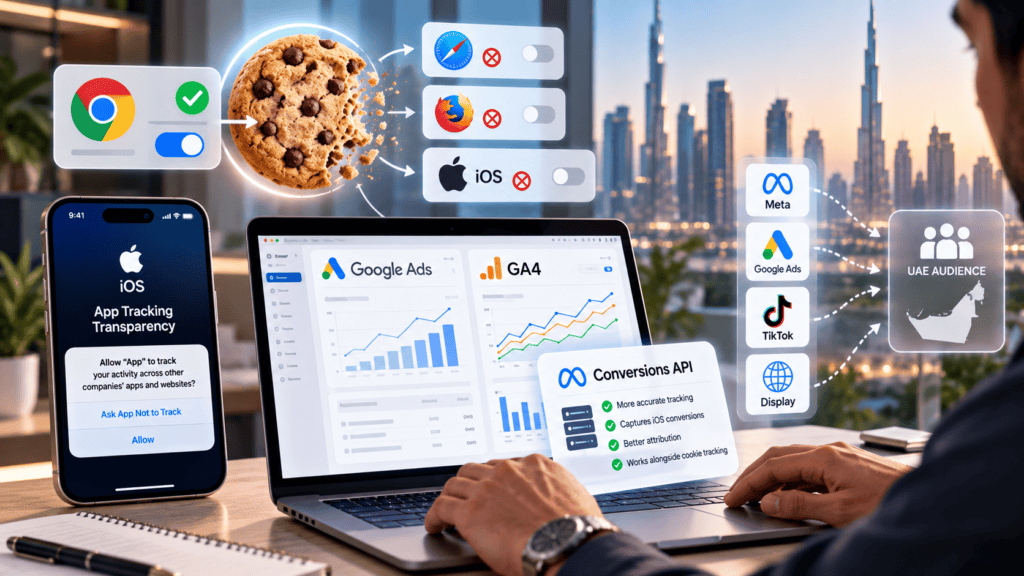
In July 2024, Google announced it was not going ahead with third-party cookie deprecation in Chrome. After years of preparation, industry upheaval, and a string of postponements, the answer turned out to be: cookies stay.
For UAE advertisers who had spent two to three years preparing for their removal, this was news worth processing carefully. Not because the preparation was wasted, it was not, but because the reversal changes what to prioritise next. The industry spent a long time solving the wrong version of the problem at the Chrome level. The actual problem, which never went away, sits in Safari, iOS, and the share of the UAE audience that was never reachable by third-party cookies in the first place.
What Actually Changed
Google’s revised approach asks Chrome users to make an informed choice about cross-site tracking rather than removing that tracking entirely. In practice, this means the third-party cookie infrastructure that UAE advertisers rely on for retargeting, cross-site attribution, and lookalike audience building continues to function for Chrome users who allow it, which, given typical consent behaviour, is a meaningful share of the audience.
What did not change: Safari continues to block third-party cookies. Firefox continues to block them. iOS app environments continue to restrict cross-site tracking under Apple’s App Tracking Transparency framework. For UAE advertisers, this matters because iPhone penetration in the UAE is among the highest globally. A significant portion of any UAE paid campaign audience has been operating in a cookieless environment for years regardless of what Chrome does.
The reversal restored one slice of addressable audience tracking. It changed nothing about the rest.
The Asymmetry UAE Advertisers Need to Understand
Here is where the practical picture gets nuanced.
If your UAE campaigns run primarily through Google Ads and target desktop Chrome users, the reversal matters directly. Your retargeting audiences, your cross-site attribution, and your campaign measurement were threatened and are now preserved. The technical infrastructure you were using continues to work.
If your campaigns reach UAE audiences through Meta ads, TikTok, programmatic display, or any channel where iOS and Safari audiences are a meaningful segment, the reversal makes almost no difference to your actual attribution accuracy. The SEO agency in Dubai teams and Performance marketing Dubai consultants who built first-party tracking infrastructure during the deprecation window are better positioned than those who treated the reversal as permission to stop.
The reversal is breathing room for Chrome-specific tracking, not a resolution of the broader measurement challenge.
What the First-Party Work Was Actually Building
Many UAE businesses invested in building first-party data infrastructure in anticipation of cookie deprecation: CRM enrichment, server-side tracking implementation, Meta Conversions API setup, GA4 migration. Some have paused that work since the reversal.
That is the wrong response. Here is why.
Server-side tracking through the Meta Conversions API captures conversions that the browser pixel misses in Safari and iOS environments. If your UAE audience has meaningful Apple device penetration (and it does), CAPI is not a cookieless workaround. It is better tracking than third-party cookie-based pixel tracking regardless of Chrome’s position. Pausing CAPI investment because of the cookie reversal is equivalent to removing a better tool because a worse one survived.
First-party data infrastructure built for cookieless environments typically outperforms cookie-dependent tracking across all environments, not just cookieless ones. A business that now has a well-structured GA4 setup, CAPI integration, and CRM-enriched audience data is running better campaigns than one that maintained pure cookie dependency. The reversal did not make these improvements obsolete. It made them optional for Chrome, and still essential everywhere else.
Paid advertising UAE strategy that combines cookie-based Chrome tracking with server-side tracking for the Apple ecosystem produces more complete attribution than either approach alone.
What to Do With Your Attribution Model Right Now
Last-click attribution in Google Analytics has always undercounted the contribution of early-funnel channels. With GA4’s data-driven attribution model now the default, and with more than two years of clean GA4 data available for most UAE businesses, the comparison is instructive. Channels that look weak under last-click often appear much stronger under data-driven attribution, particularly social, display, and brand awareness campaigns that influence buyers before they return via branded search.
The cookie reversal has no effect on this attribution model question. But it is a useful moment to check whether your campaigns are still being evaluated on last-click data when GA4 has more complete modelled attribution available.
Keeping your Google Business Profile consistent and accurate is also relevant here, what Meta Advantage+ means for UAE advertisers in 2026 covers how Meta’s own platform is handling the same privacy pressures through first-party signal optimisation, independent of the Chrome decision.
Three Things Worth Doing Now
Audit your CAPI setup. If you paused or deprioritised Conversions API implementation because of the reversal, restart it. The gap between what CAPI captures and what the browser pixel captures in iOS environments is real and ongoing regardless of what Chrome does.
Review your attribution model. Move from last-click to data-driven attribution in GA4 if you have not already. The reversal changes nothing about the value of more accurate cross-channel attribution.
Stop comparing GA4 data to UA data. Universal Analytics is gone. Comparing current performance to UA-era numbers using incompatible session definitions and attribution models produces misleading conclusions. Set your comparison baseline inside GA4.
FAQ
Do UAE businesses need to change their Google Ads campaigns because of the reversal? Existing cookie-based retargeting and audience features continue to work as they did before. No urgent campaign changes are required. The more valuable action is auditing what percentage of your audience was reachable by cookies in the first place, since a significant UAE audience segment never was.
What happened to Google’s Privacy Sandbox APIs? They still exist and remain available as an alternative to cookie-based tracking. Google has not abandoned Privacy Sandbox; it is now supplemental rather than mandatory. The Topics API and Protected Audience API remain options for advertisers exploring privacy-preserving alternatives.
Is the UAE subject to any cookie consent requirements similar to GDPR? The UAE does not currently have cookie consent legislation equivalent to GDPR. UAE-focused campaigns have fewer prescriptive consent requirements than EU-targeted ones. However, UAE businesses with EU operations or EU customers still need to manage GDPR consent separately.
One thing the reversal does not change
The direction of the industry is still moving toward reduced third-party tracking. Regulatory momentum outside Chrome, Apple’s continued enforcement of ATT, and growing user privacy awareness all point the same direction. The Chrome reprieve bought time. It did not alter the destination.
A digital marketing agency in UAE that built first-party infrastructure during the deprecation window is now ahead, not behind. The reversal gives everyone who paused that work a second chance to catch up. What two years of GA4 data now reveals, spanning attribution, channel performance, and the actual multi-touch journey UAE buyers take, is covered in what two years of GA4 data finally reveals about UAE website behaviour, which picks up exactly where this article leaves off.
For the full picture of how AI-powered search is also shifting the value equation between paid and organic channels in the UAE, what AI Overviews are doing to Google Ads costs in the UAE covers another pressure point that the cookie reversal does nothing to address.