
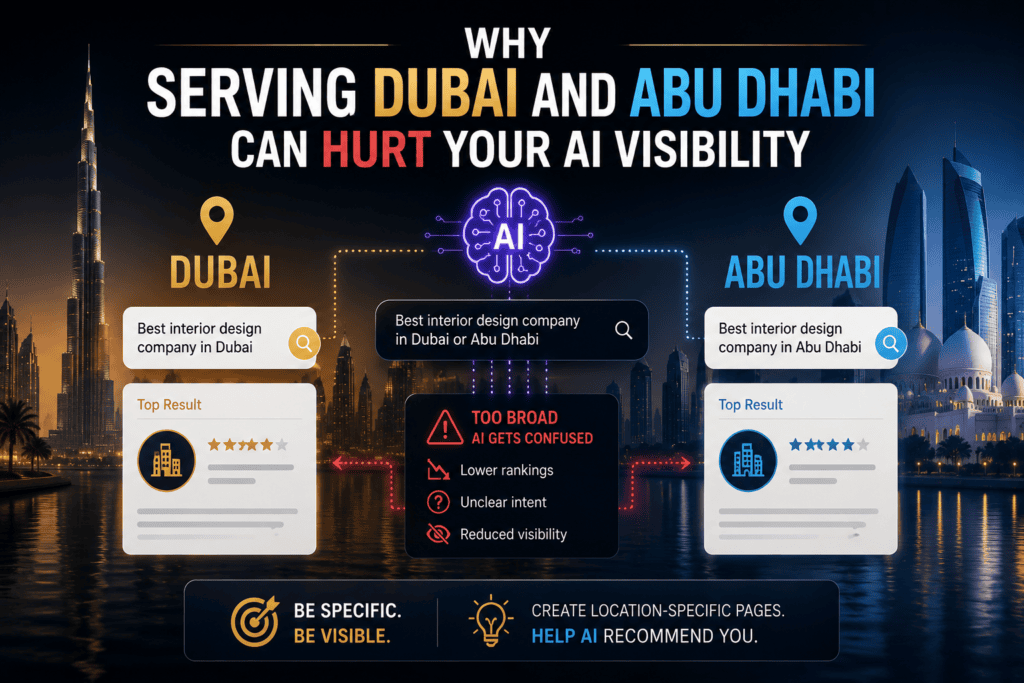
Many UAE service businesses serve clients across Dubai, Abu Dhabi, and sometimes Sharjah or the Northern Emirates. Their website says “UAE-wide service.” Their content uses “UAE” as the primary geographic reference. Their Google Business Profile is listed in Dubai but their description mentions Abu Dhabi.
The result, counterintuitively, is that AI search tools frequently recommend them for neither city with the confidence they would receive if they had positioned for one city specifically.
This article explains why multi-city positioning without city-specific content actually undermines AI search recommendation performance in both markets, and how to build genuine multi-city visibility rather than diffuse UAE-wide presence.
The Multi-City Visibility Paradox
The paradox is this: a UAE-wide claim without city-specific content signals to AI engines that the business is less relevant to Dubai queries than a Dubai-specific competitor, and less relevant to Abu Dhabi queries than an Abu Dhabi-specific competitor, leaving the UAE-wide business weaker in both city markets than a narrower competitor in either one.
AI search systems are designed to match the most relevant entity to a specific query. When someone in Abu Dhabi asks Perplexity to recommend a digital marketing agency in Abu Dhabi, the AI ranks entities by how specifically their signals match the query. An agency with an Abu Dhabi address, Abu Dhabi-specific reviews, Abu Dhabi case studies, and an About page that specifically mentions Abu Dhabi clients is a stronger match than an agency that lists UAE as its market and mentions Abu Dhabi once in passing.
The Dubai-based agency with “UAE-wide” positioning is penalised not because it does not serve Abu Dhabi, but because its entity signals do not specifically demonstrate Abu Dhabi relevance with the same specificity that a locally-positioned competitor can provide.
How AI Search Engines Resolve City-Specific Queries
AI search engines use a layered approach to geographic query resolution.
Physical location signals. Google Business Profile address and Local Pack presence are the strongest signals for the city where the business is physically located. For city-specific queries, the physical presence signal is heavily weighted.
Content specificity signals. Content that specifically names the city in context, not just as a passing mention but as the subject of specific claims, examples, and case studies, is a content-level city signal. An article about “digital marketing for Dubai real estate agencies” generates Dubai-specific relevance signals. An article about “digital marketing for UAE real estate agencies” generates weaker city-specific signals.
Review location signals. Google reviews that mention the city where the service was received generate location-specific review signals. “They transformed our Dubai clinic’s online presence” is a Dubai-specific review signal. “Great service, highly recommend” is location-agnostic.
Schema location data. LocalBusiness schema with a specific city address generates schema-level city signals. A business with a Dubai address in its schema but claims to serve all of the UAE has a mixed signal that is resolved in favour of the schema address for most queries.
Why Generic UAE Coverage Produces Weak City-Level Results
A service business that uses “UAE” consistently as its geographic reference generates signals that are too broad for city-level recommendation queries. The AI search system sees:
- GBP in Dubai, so strong Dubai local signals
- Content using “UAE” throughout, so weak city-specific content signals for any city
- Reviews from clients who are presumably in Dubai (given the GBP location) but the reviews do not specify
- Schema with a Dubai address but copy claiming UAE-wide coverage
The resulting entity profile is strongest for broad, UAE-level queries (“digital marketing agency UAE”) and weakest for city-specific queries in the second city (“digital marketing agency Abu Dhabi”), where a locally-positioned competitor consistently outperforms it.
This is not a limitation imposed by AI systems. It is a reflection of genuinely weaker relevant signals for the specific query context. The AI is correctly identifying that the UAE-wide positioned business has weaker Abu Dhabi-specific evidence than a locally-positioned Abu Dhabi competitor.
The Dubai-Focused vs UAE-Wide Trade-Off
For most UAE service businesses, the practical trade-off is:
Dubai-focused positioning: Strongest AI recommendation performance for Dubai queries. Weak to zero performance for Abu Dhabi queries. Best for businesses whose primary client base is in Dubai.
UAE-wide positioning (without city-specific content): Moderate performance for Dubai queries (diluted by the broad positioning). Near-zero performance for Abu Dhabi queries. Worst of both worlds for businesses trying to serve both markets.
Multi-city positioning with city-specific content: Strong performance for Dubai queries AND strong performance for Abu Dhabi queries, but only if the city-specific content architecture is implemented correctly. This is the right approach for businesses genuinely serving both markets but requires significantly more content investment than either of the first two options.
The most common mistake UAE businesses make is choosing “UAE-wide positioning” because it seems inclusive, without realising that it produces weaker results for every specific city query compared to the local competitor who focused specifically on that city.
How to Build Genuine Multi-City AI Visibility
Create dedicated city-specific landing pages for each major market. A dedicated /dubai page and a dedicated /abu-dhabi page with city-specific content (local client examples, local case studies, specific location references, local team presence if applicable) give AI engines city-specific content signals that the generic UAE service page cannot provide.
Build city-specific content clusters. Blog content, FAQ content, and case studies that specifically name and address each city create a content cluster that reinforces city-level relevance. “How GEO works for Abu Dhabi service businesses” generates Abu Dhabi-specific content signals. “How GEO works for UAE service businesses” generates UAE-wide content signals that are less specific to either city.
Generate city-specific reviews. Ask Abu Dhabi clients specifically to mention Abu Dhabi in their reviews. Ask Dubai clients to mention Dubai. The geographic specificity in review text is a meaningful AI signal for city-level recommendation queries.
Consider a secondary GBP listing for the second major market, if physically justified. A second GBP listing with an Abu Dhabi address (using a real office address, not a virtual office that violates GBP terms) gives the second-city market a physical presence signal that significantly strengthens AI recommendation performance in Abu Dhabi.
Use city-specific structured data on city landing pages. LocalBusiness schema on the /dubai page should reference the Dubai address. LocalBusiness schema on the /abu-dhabi page should reference the Abu Dhabi address. This creates schema-level city disambiguation that AI systems use for geographic query resolution.
The GEO services for UAE businesses that BRB delivers for multi-city clients include a specific multi-city content architecture audit, because the entity signal fragmentation from UAE-wide positioning is one of the most common and most fixable causes of underperformance for UAE businesses trying to serve multiple major markets. Any Generative Engine Optimization Dubai programme that does not address city-level disambiguation as a specific deliverable is leaving a recoverable gap in multi-market clients’ AI search performance.
What the Content Architecture Looks Like
For a UAE service business genuinely serving both Dubai and Abu Dhabi, the content architecture that produces strong multi-city AI visibility has these components:
Home page: Clear service description using UAE as the market, with explicit mentions of both Dubai and Abu Dhabi in the primary copy.
Dubai service page (/dubai or /services/dubai): Full service description written specifically for Dubai clients, with Dubai-specific case examples, Dubai-specific content, and a Dubai physical address in the LocalBusiness schema.
Abu Dhabi service page (/abu-dhabi or /services/abu-dhabi): Full service description written specifically for Abu Dhabi clients, with Abu Dhabi-specific case examples, and Abu Dhabi contact or location information.
City-specific blog content: At least 3 to 5 articles that specifically name each city in their title and content. These generate city-level keyword relevance that reinforces the landing page city signals.
City-specific GBP listings: Ideally one per city with a physical address, each with its own review profile building.
City-specific schema: LocalBusiness schema on each city page that references the correct address for that city.
This architecture produces a business with strong entity signals in both city markets rather than diluted signals in both.
FAQ
Does having a Dubai GBP automatically make my business visible in Abu Dhabi queries? Not for city-specific queries. A Dubai GBP is a strong signal for Dubai local queries and provides some general UAE visibility, but it does not produce Abu Dhabi-specific recommendation performance. Abu Dhabi-specific content and, ideally, an Abu Dhabi GBP listing are needed for strong Abu Dhabi AI visibility.
Is it against GBP terms of service to have a listing in a city where I do not have a physical address? Yes. GBP requires a physical, customer-facing address for each listing. Virtual offices and co-working day passes do not meet GBP’s verification requirements in practice. The city-specific content architecture can produce meaningful Abu Dhabi visibility without a second GBP if the content signals are sufficiently specific.
How much content is needed to build meaningful city-specific AI visibility in Abu Dhabi without a GBP there? A dedicated Abu Dhabi service page plus 4 to 6 Abu Dhabi-specific blog articles and Abu Dhabi-mentioning client reviews will produce a meaningful improvement in Abu Dhabi AI recommendation performance within 3 to 6 months of consistent indexing.
Should the Dubai and Abu Dhabi pages be completely different, or can they share similar structure? The structure can be similar, but the content must be genuinely city-specific, not a template with the city name swapped. AI systems can identify near-duplicate content with location names swapped, and near-duplicate pages do not generate independent city relevance signals.
Conclusion
UAE-wide positioning without city-specific content produces the worst outcome for multi-city visibility: weaker than local competitors in both cities, stronger than neither, while appearing to cover both.
The businesses that serve Dubai and Abu Dhabi with genuinely strong AI search visibility in both markets are the ones that have built specific, city-attributed content for each market rather than generic UAE-wide content that nominally covers everything but specifically demonstrates nothing. A web development agency in Dubai building multi-city service architecture needs to treat city pages as independent SEO and GEO assets, not location-swapped template copies. A digital marketing agency in UAE managing SEO and GEO for multi-city clients should be tracking city-level AI recommendation performance separately for each market rather than reporting a blended UAE visibility score that obscures performance gaps in specific cities.