
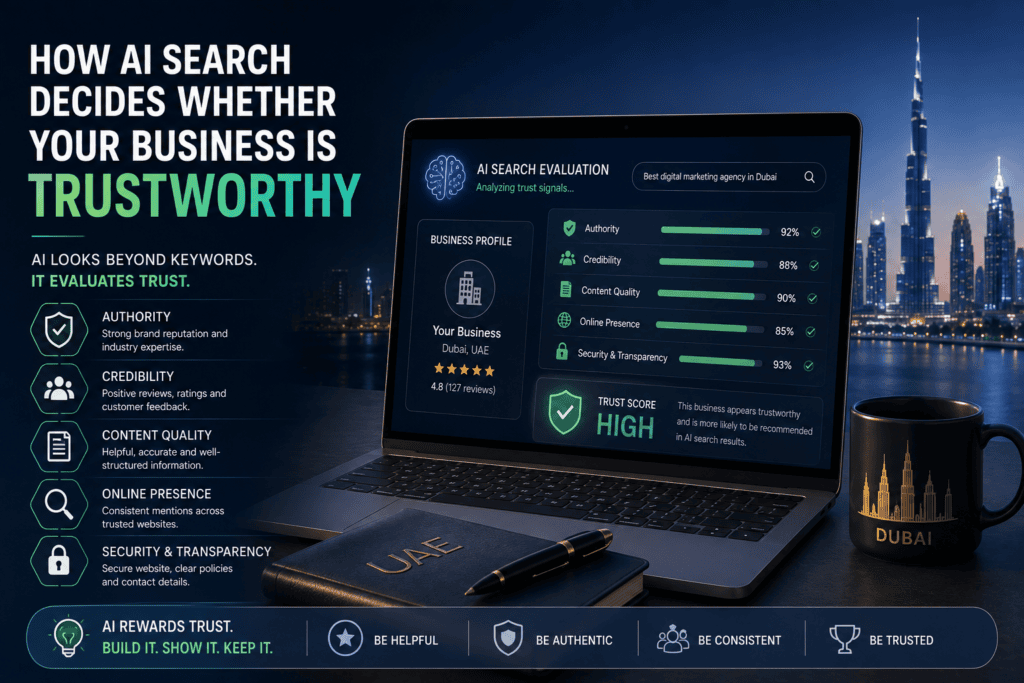
When a UAE buyer uses an AI search tool to ask “is [business name] legitimate?” or “what do people say about [agency] in Dubai?” they are running a trust verification query. This is behaviourally and technically different from a recommendation query like “what is the best GEO agency in Dubai?”
The distinction matters because AI engines treat these two query types with meaningfully different logic. A recommendation query draws primarily on structured entity signals: what you do, where you do it, how well you are described across sources. A trust verification query draws primarily on sentiment, consistency, complaint history, and the presence or absence of specific validating signals that AI systems have learned to associate with trustworthy versus untrustworthy entities.
Most GEO advice focuses on the recommendation query. This article covers the trust verification query, which is the one that stands between a UAE buyer who found you through a recommendation and a buyer who actually contacts you.
The Trust Query: A Different Animal From the Recommendation Query
A recommendation query produces a positive framing from the AI if the entity has sufficient signals. The AI names a business because it matches what was asked for.
A trust verification query requires the AI to synthesise whatever is available about a specific business from an evaluative perspective. It is looking for: What do independent sources say about this business? Are there complaints or negative patterns? Are there specific validating signals (certifications, press, reviews, years of operation) that suggest this is a credible entity?
For UAE businesses, trust verification queries are a routine part of the B2B buyer journey. Before a company in Dubai commits to an agency engagement, a legal service, a healthcare provider, or a financial advisor, someone is running an AI-assisted due diligence check. How that check turns out depends on what the AI can assemble from publicly available sources about the business.
A business with strong recommendation query performance (appearing when “best GEO agency Dubai” is asked) can still perform poorly on trust verification queries (appearing uncertain or with negative nuance when “[Business Name] reviews UAE” is asked). These are independent performance dimensions that require independent management.
What AI Engines Draw On When Assessing Trust
Review content across indexed platforms. Google Business Profile reviews, Clutch, Trustpilot, and any other publicly indexed review platform contribute to the trust assessment. The AI reads not just the star rating but the language of the reviews, including specific complaints, red-flag terminology, or patterns of negative experience that repeat across multiple reviewers.
Complaint and dispute content. Forum threads, social media complaint posts, and any indexed content where a person has publicly described a negative experience with the business contribute to the trust assessment. A single Reddit thread describing a billing dispute or a Twitter thread about a missed deadline can appear in a Perplexity trust query response years after the original post.
Business information consistency. Inconsistent business name, address, or registration information across different indexed sources raises a trust flag. AI systems that see a business listed with three different addresses, two different phone numbers, and an inconsistent name across directories read this inconsistency as a potential indicator of an unreliable or fraudulent entity.
Presence of verifying information. Trade licence information, professional association memberships, specific named team members with verifiable credentials, and press coverage from credible publications all contribute positively to AI trust assessments. A business with no verifying information beyond its own website is harder for AI systems to assess with confidence.
Website accuracy and completeness. A website that lists specific, verifiable information (registered business name, Dubai mainland or free zone, physical address, client list with names) signals a legitimate, established entity. A website with generic claims, stock photography, and no verifiable specifics signals less trustworthy.
The Signals That Raise Trust Scores
Consistent, recent, specific reviews on multiple indexed platforms. Reviews that reference specific services, specific outcomes, and specific team members are more valuable for trust than generic positive reviews. A Clutch review that says “BRB delivered a 3-page GEO strategy for our Dubai clinic and we saw 2.4x enquiry volume in 12 weeks” is more trust-building in AI assessment than “great team, highly recommend.”
Verified business information on Google Business Profile. A verified GBP listing with accurate category, consistent address, and an active posting history is a primary trust anchor for local business AI assessments. Unverified or inactive GBP profiles are weaker trust signals.
Named team members with verifiable LinkedIn profiles. An AI assessing a UAE business entity can cross-reference named team members against LinkedIn profiles. If the people listed on the website have consistent LinkedIn profiles with documented work history, the entity’s legitimacy is more confirmable than if the website names are not findable on any professional platform.
Press coverage from credible UAE business publications. A mention in Arabian Business, Gulf News, Khaleej Times, or Campaign Middle East confirms the business has been assessed as credible enough to mention by an independent editorial source. This is one of the highest-trust signals available for UAE businesses.
Active industry association presence. Membership in UAE-relevant professional bodies, verified certifications, or listed partner status with credible technology providers (Google Partner, Meta Business Partner, etc.) provides verifiable trust markers that AI systems can cross-reference.
The Signals That Reduce Trust Scores
Multiple unresolved negative reviews with specific complaint patterns. A cluster of negative reviews that all describe a similar problem, missed deadlines, billing disputes, service non-delivery, is a strong negative signal in trust queries. The pattern recognition across multiple independent complaints is exactly what AI systems are designed to identify.
Indexed complaint threads on forums or social media. Even a single significant complaint thread on Reddit, LinkedIn, or a consumer forum that appears in indexed search results will typically appear in Perplexity and ChatGPT Search results when someone runs a trust verification query on the business.
Inconsistent or incorrect business information. Name variations, address discrepancies, disconnected phone numbers, and closed social accounts all raise entity inconsistency flags that reduce AI trust confidence.
Very thin online presence for the claimed business size or age. A business claiming to have operated for 8 years in Dubai with minimal indexed presence, no reviews from that period, and no press mentions is an entity mismatch that AI systems flag as unusual.
Negative sentiment in unresponded reviews. A business with negative reviews that received no public response is evaluated more negatively by AI systems than one where the business owner responded professionally to the same review. The response itself is an indexed signal of business engagement and legitimacy.
The Specific Queries UAE Buyers Use to Vet Businesses
Understanding the exact phrasing of trust verification queries helps in preparing for them. UAE buyers typically run variations of:
“[Business name] reviews UAE” / “[Business name] reviews Dubai” “Is [business name] legit?” “[Business name] complaints” “[Business name] scam” (particularly for businesses in categories that attract fraud concerns) “[Business name] experience” or “[Business name] feedback” “[Business name] vs [competitor]”
Running each of these queries about your own business on Perplexity and ChatGPT Search is the most direct way to see what a prospective client conducting due diligence sees. The results of this self-audit are the starting point for trust profile management.
A GEO services for UAE businesses engagement includes this trust verification audit as a standard component, because a business with strong recommendation query performance and weak trust query performance has a specific and fixable gap that directly affects conversion from recommendation to contact.
How to Build a Trust Profile That AI Reads Correctly
Respond professionally and specifically to every negative review. This is the single highest-impact trust-building action available to most UAE businesses. A professional, specific response to a negative review transforms the indexed content from “business had a problem” to “business acknowledged the problem and here is how they addressed it,” which produces a meaningfully different AI trust assessment.
Generate consistent, specific positive reviews on multiple platforms. Diversify across Google, Clutch, and any other relevant industry platform. A spread of reviews across multiple indexed platforms produces stronger trust assessment than all reviews concentrated on a single platform.
Make named team members findable and specific. Ensure that every person named on the website has a consistent, professional, and current LinkedIn profile. This is a free trust signal that most UAE businesses have available but underutilise.
Publish verifiable business information consistently. Use the exact same registered business name, address, and contact information everywhere: website, GBP, all directories, all social profiles. Eliminate any historical inconsistencies by auditing and updating older directory listings.
Seek and publish genuine case studies with client permission. A named case study with a real client company, specific results, and the client’s quoted permission is one of the most powerful trust documents available to a UAE service business. The specificity and verifiability of this content makes it high-trust source material for AI systems assessing credibility.
For the broader entity building framework that trust signals sit within, the article on what E-E-A-T signals tell Google about your business covers the overlapping trustworthiness dimension from Google’s explicit quality assessment framework.
FAQ
Does a single negative review ruin a UAE business’s AI trust profile? A single well-responded-to negative review typically does not. What damages AI trust profiles is a pattern of similar complaints without response, or a small number of negative reviews that are highly specific and which the business has not addressed publicly.
How long does it take for a trust profile improvement to show in AI search results? Faster than most expect, typically 2 to 6 weeks for significant changes (new reviews, responses to existing reviews, GBP updates) to appear in AI search trust query responses. AI systems that actively crawl review platforms pick up new content more quickly than traditional SEO timelines.
Can a UAE business ask for negative reviews to be removed? Reviews can be flagged to platforms for removal if they violate platform policies (fake review, contains inappropriate content, etc.). Google occasionally removes reviews following a flagging request. AI systems update their sources relatively quickly once content changes, so a removed review that was influencing a negative trust assessment can lose that influence within weeks of removal.
Does AI search distinguish between verified and unverified businesses? Yes, meaningfully. A verified GBP, a verified social account, and documented business registration are positive signals in AI trust assessments. Unverified entities are assessed with lower confidence.
Conclusion
The trust verification query is a buying stage that every UAE business faces and almost none manage deliberately. A buyer who received your name as a recommendation will typically run a trust check before making contact. What they find in that check, assembled by AI search from every indexed source about your business, determines whether the recommendation converts.
Managing this layer requires active review generation, consistent business information, professional review responses, and the kind of verifiable specificity in published content that AI systems can use to confirm your business is what it claims to be. None of it is complex. All of it is available to any UAE business willing to approach it systematically. An AI search optimization agency in Dubai that includes trust query auditing in its monthly reporting gives clients visibility into a buying stage that most marketing reports ignore entirely. A digital marketing agency in UAE that manages both recommendation and trust query performance simultaneously is doing genuinely complete AI search work.