
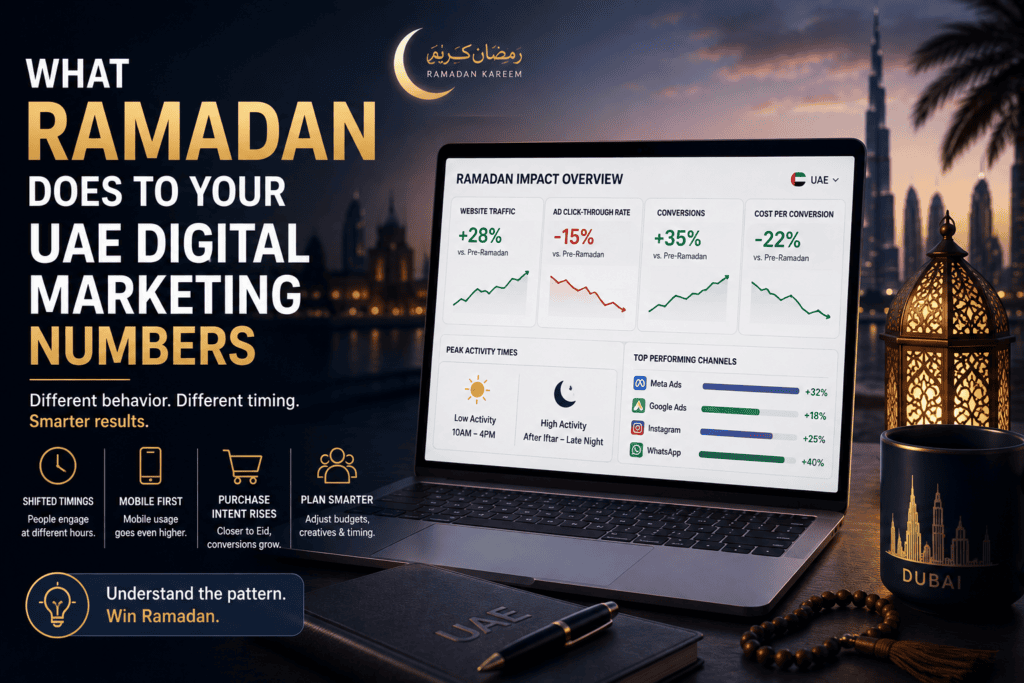
Most digital marketing content about Ramadan is written from the perspective of consumer brands planning Ramadan campaigns. It focuses on content themes, creative guidelines, and charitable messaging. Very little covers what Ramadan does to the underlying performance metrics that UAE service businesses use to make day-to-day marketing decisions.
This article covers the data layer: what specifically changes in your Google Analytics, your Meta Ads dashboard, your Google Ads account, and your enquiry volume during Ramadan, and what the practical implications are for budget and strategy decisions in the weeks before, during, and after.
Why Ramadan Creates a Distinct Marketing Environment in UAE
Ramadan is not a marketing niche. It is a fundamental restructuring of daily schedules, consumption patterns, and attention across an entire country for a full month. In the UAE, where observing Muslims comprise a significant portion of the population and where the social and professional calendar restructures around Ramadan timing, the effects on digital behaviour are measurable and consistent year on year.
Working hours in the UAE are legally shortened during Ramadan for most sectors, with typical office hours shifting to 9am to 2pm or 3pm. Evening hours, from Iftar (sunset) through the early morning, become the peak activity period. This shift is not marginal. It produces measurable changes in when UAE audiences are online, how long they stay, and what they are looking for.
For businesses whose marketing assumptions are based on average data that does not segment Ramadan months, the performance during Ramadan will consistently look anomalous: traffic at unexpected hours, different device patterns, different conversion timing. Understanding what is happening makes it manageable.
What Happens to Website Traffic During Ramadan
Website traffic during Ramadan in UAE typically shows a distinctive daily curve shift. Pre-Ramadan, peak traffic hours for UAE service businesses cluster around standard working hours: 9am to 12pm and 2pm to 5pm. During Ramadan, the peak shifts significantly toward evening and late-night hours: 9pm to 12am and 1am to 3am.
Overall traffic volume on a 24-hour basis does not consistently decline during Ramadan; it redistributes. Daytime traffic drops while evening and post-Iftar traffic rises. Businesses that review their analytics without accounting for this shift may incorrectly conclude that total traffic has declined, when what has actually happened is a time-of-day redistribution that their reports are aggregating as a flat average.
The device split also shifts during Ramadan toward even heavier mobile dominance. Late-night browsing in the UAE during Ramadan is almost entirely mobile, conducted from home rather than from an office environment.
Mobile-specific optimisation, including page speed on mobile, click-to-call and click-to-WhatsApp functionality, and form simplification, becomes more commercially important during Ramadan than at any other point in the year.
What Happens to Social Media Engagement
Social media engagement in UAE during Ramadan follows the same time-of-day shift as website traffic, concentrated heavily in the post-Iftar evening window. Posts published at 9pm to 11pm UAE time during Ramadan consistently outperform the same content published at 10am in terms of reach and engagement for UAE-targeted accounts.
Content type performance also shifts. During Ramadan, content with reflective, community-oriented, or values-aligned themes performs above average for UAE audiences. Purely commercial or promotional content sees relative underperformance compared to non-Ramadan months unless very specifically tied to Ramadan-relevant offers or contexts.
Story and short-form video consumption increases during Ramadan as evening home time extends. UAE audiences in Ramadan typically have more passive consumption time available in the late evening, which drives up video view duration and completion rates for content published in the right time window.
Comments and DMs on social media tend to be slower to arrive during daytime hours and faster to arrive in the post-Iftar window. Businesses that have response time SLAs should adjust their team schedules during Ramadan to cover the evening window rather than defaulting to standard business hours.
What Happens to Google Ads Performance
Google Ads performance during Ramadan in the UAE shows consistent patterns that repeat across years and industries, though the magnitude varies by category.
Click-through rates: CTR typically rises during the post-Iftar evening hours (8pm to 12am UAE time) and declines during the compressed daytime working hours. Day-parting adjustments to bids, increasing bids during evening hours and reducing them during daytime hours, consistently improve CPA during Ramadan for UAE advertisers who make this adjustment.
Cost per click: Average CPC can be volatile during Ramadan as some advertisers pause campaigns (reducing competition) while others increase spend for Ramadan-specific campaigns (increasing competition for specific query types). Category-specific CPC trends should be monitored closely rather than assumed.
Conversion rates: For service business categories, conversion rates during Ramadan working hours tend to be lower as attention and consideration are compressed. Evening and post-Iftar conversion rates can be higher than typical for categories where the slower, more reflective evening consumption mode aligns with consideration-stage decision-making.
Ad scheduling: Day-parting is the highest-impact single adjustment for UAE Google Ads accounts during Ramadan. Running campaigns at full-day budget without day-parting means spending a significant portion of budget during low-conversion daytime hours while potentially missing bid opportunities during the high-activity evening window.
What Happens to Meta Ads Performance
Meta Ads performance during Ramadan in UAE follows similar directional patterns but with some category-specific variations worth noting.
Cost per result: For many UAE consumer categories, CPR decreases during the first two weeks of Ramadan as some advertisers exit the market (reducing competition in the auction) while audiences are still actively browsing. The last week of Ramadan and the Eid period tend to see CPR increases as spend spikes across consumer categories.
Video ad completion rates: Higher in the evening window during Ramadan, as relaxed post-Iftar consumption mode extends average content engagement duration. Video creative planned for Ramadan should account for an audience with more time to watch than typical.
Reach: A larger share of the UAE audience is reachable during the post-Iftar evening window during Ramadan than at equivalent hours outside of Ramadan. This represents a reach opportunity that day-parted campaigns can capture.
Lead quality: UAE service businesses running Meta lead generation during Ramadan should note that lead quality can be more variable. The extended consideration time of Ramadan evenings can attract both higher-intent research-stage users and lower-intent casual browsers who are filling time during quiet evening hours.
What Happens to Conversion Rates and Enquiry Patterns
Enquiry patterns during Ramadan in the UAE for professional service businesses show a consistent pattern worth building into expectations.
The first week of Ramadan typically shows a drop in enquiry volume as routines adjust and businesses and clients both operate in a transitional mode. Weeks two and three tend to normalize. The final week of Ramadan and the days surrounding Eid Al Fitr show another drop as travel and family gatherings take priority.
However, post-Eid (the two weeks following Eid Al Fitr) consistently produces a surge in enquiry activity across UAE service categories. Decision-makers who were in consideration mode during Ramadan but deferring action move to contact mode after Eid. The post-Eid period is one of the most commercially active two-week windows in the UAE marketing calendar for B2B service businesses.
Understanding this pattern changes how budget should be allocated across the Ramadan period. Reducing spend during early Ramadan and the Eid window while increasing budget for the post-Eid period is a more informed allocation than distributing budget evenly.
A social media agency in Dubai managing client campaigns through Ramadan should be presenting clients with an explicit Ramadan-specific media plan rather than continuing the standard monthly plan with no adjustment. The performance differences are large enough to materially affect reported campaign ROI if unaccounted for. A digital marketing agency in UAE tracking year-on-year Ramadan performance for long-term clients will have this data to reference rather than making assumptions.
How to Adjust Your Strategy for Ramadan
Shift Google Ads and Meta scheduling to weight the evening window. Day-parting adjustments to increase bids and budget allocation between 8pm and 12am UAE time during Ramadan consistently improve CPL for UAE service businesses.
Adjust your social media posting schedule to evening hours. Posts published between 9pm and 11pm during Ramadan typically achieve significantly higher reach in UAE than equivalent posts published at 10am.
Plan a post-Eid activation campaign. The two weeks after Eid Al Fitr represent one of the strongest windows for B2B service business enquiry generation in the UAE year. Budget reserved from the quieter Eid window itself should be deployed here.
Ensure evening team coverage for DM and WhatsApp responses. The window when UAE audiences are most active during Ramadan is outside standard business hours. Response time to evening enquiries directly affects conversion during this period.
Review content themes for Ramadan-tone alignment. Purely promotional content underperforms during Ramadan for UAE audiences. Value-led, community-oriented, or genuinely informative content performs above average. This is the highest-value period in the year for long-form educational content with UAE-specific utility. A viral content agency in Dubai that plans Ramadan content separately from the rest of the year’s calendar, rather than adapting a standard monthly brief, will produce content that performs significantly better in this distinct consumption context.
FAQ
Does Ramadan affect B2B marketing in UAE the same way as B2C? Directionally yes, but with lower magnitude. Professional B2B decision-making is less influenced by Ramadan timing than consumer purchasing behaviour, but the time-of-day shifts and the post-Eid activation pattern are relevant for B2B service categories.
Should UAE businesses pause their ad campaigns during Ramadan? Generally not, but budget reallocation toward evening hours and away from peak daytime spending is typically a better use of the same budget. A full pause sacrifices the evening window, which is often more productive for UAE audiences during Ramadan than the equivalent hours outside it.
Is Ramadan performance data from previous years reliable for planning this year? The directional patterns are consistent year on year. Specific figures vary with market conditions, competition, and platform algorithm changes. The time-of-day shift, the post-Eid surge, and the reduced daytime activity pattern repeat reliably.
How should Ramadan affect our content calendar? Evening-first scheduling, values-aligned themes for awareness-stage content, and educational utility content for the consideration audience that uses Ramadan evenings for research. Commercial CTAs are not avoided, but they perform better when embedded in genuinely useful content rather than as standalone promotional posts.
Conclusion
Ramadan produces specific, consistent, measurable changes to UAE digital marketing performance. Businesses that treat it as a standard month with a different creative theme are leaving both efficiency and conversion on the table. Businesses that adjust scheduling, budget allocation, and content approach in response to the actual data patterns will consistently perform better during the same period.
The data tells the same story year on year. The post-Eid surge is one of the most reliable high-activity windows in UAE marketing. The evening window during Ramadan is one of the most consistently underused by businesses maintaining standard-hours campaigns. Both are adjustments that require planning rather than reaction. The digital marketing agencies in Dubai that produce Ramadan-specific media plans for clients as a standard deliverable will show materially better campaign performance data during this period than those running standard plans through a month that behaves nothing like the rest of the year.