
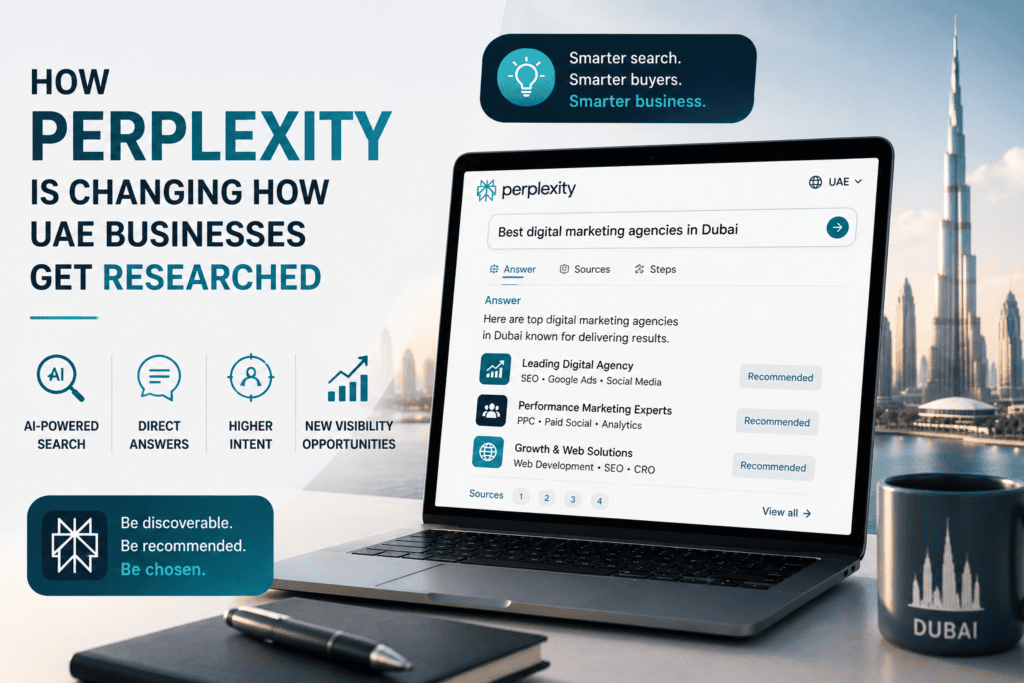
Most GEO content addresses the publisher side of Perplexity: how to get your content cited, how to structure content for AI retrieval, how to build the entity signals that increase citation probability. This article addresses the buyer side: what a UAE professional actually experiences when they use Perplexity to research vendors before making contact.
Understanding the buyer journey through Perplexity changes what you need to optimise for. It is not just about appearing in a citation. It is about what summary Perplexity builds of your business when a prospective client specifically searches for you, how that summary compares to your competitor’s, and whether the composite picture Perplexity draws from available sources would make a UAE buyer confident enough to shortlist you.
The Buyer Side of Perplexity: What UAE Professionals Are Actually Doing
Adoption of Perplexity among UAE professional and technical audiences has grown quickly, particularly among those in finance, technology, consulting, and marketing who conduct regular vendor research and value sources with citation transparency over summary-without-attribution.
The research journey a UAE professional undertaking vendor evaluation on Perplexity typically looks like this:
Stage 1 – Category research: “What should I look for in a GEO agency in UAE?” Perplexity returns a synthesised answer with citations from industry content. The user scans the criteria and forms a mental framework.
Stage 2 – Market mapping: “Which agencies in Dubai offer GEO services?” Perplexity returns a list of businesses with brief descriptions and citations. The user forms a first impression of the category landscape.
Stage 3 – Specific business research: “What do people say about [specific agency]?” or “[Agency name] reviews UAE.” Perplexity assembles everything it can find: website content, review platforms, social mentions, industry citations. The user receives a composite profile of the business.
Stage 4 – Comparison: “Compare [Agency A] and [Agency B] for GEO in Dubai.” Perplexity attempts a side-by-side synthesis based on available information about both.
A business that does not appear at Stage 2 is not shortlisted. A business that appears at Stage 2 but has a thin or negative Stage 3 profile is unlikely to survive to Stage 4. A business that has a strong Stage 3 profile has the highest probability of being in the final comparison.
How Perplexity Answers Research Queries Differently From Google
Google returns a list of results that the user evaluates independently. Perplexity synthesises a direct answer with citations that the user reads as a summary, typically without clicking through to the underlying sources.
This has a specific commercial implication: the quality and framing of what Perplexity writes about you in its summary matters as much as whether you appear at all. A business cited in a Perplexity answer with a vague or unflattering contextual description (drawn from whatever source Perplexity could find) is worse positioned than a business that is not cited.
Perplexity’s synthesis draws from whatever is most available, most recent, and most credible in its indexed sources. For UAE businesses, this means the composite picture Perplexity forms may include:
- Your website’s About page and service descriptions
- Any Google or Clutch reviews that are publicly indexed
- Press mentions or directory listings
- Competitor comparison content published by others
- Social content that Perplexity can access
- Forum or community discussions that mention your business
The user reading the Stage 3 summary of your business does not see these individual sources in detail. They see a synthesised paragraph or two that Perplexity constructed from all of them. That synthesis is effectively your first impression with this buyer.
The Shortlisting Stage: Where Perplexity Most Changes the Process
In traditional vendor research, a business that ranks on Google but has a thin web presence gets shortlisted because the buyer sees enough to spark interest and plans to learn more through direct contact. The gap between search visibility and web presence was acceptable because the buyer tolerated that gap.
Perplexity eliminates that tolerance. If your Perplexity profile at Stage 3 is thin because there is simply not enough published information about your business, Perplexity returns a shorter, less confident summary than a competitor with more published material. A buyer reading two Stage 3 summaries, one detailed and specific and one brief and uncertain, will almost always shortlist the first.
This means content depth and third-party validation, the core building blocks of entity authority, directly affect whether you survive the shortlisting stage when buyers are using Perplexity for research. A business with excellent word-of-mouth but thin online published presence is at a structural disadvantage in this research environment that it would not have been three years ago.
What Perplexity Sees When It Researches Your Business
Running a Stage 3 search on your own business on Perplexity is the most direct way to understand what buyers are seeing. Search your business name with qualifiers like “reviews,” “UAE,” or “services,” and read the synthesis Perplexity produces.
The common findings UAE businesses discover when they run this exercise:
Thin or vague summary. If your published content is sparse, Perplexity returns a brief answer that describes your business in generic terms drawn from your homepage. “A UAE digital marketing agency offering a range of services” is not a compelling shortlisting profile.
Outdated information. Perplexity may surface content from earlier points in your business’s history if that content is more prominently indexed than your current positioning. A business that has pivoted its offering but has not updated its published content will be described by Perplexity in terms of the old positioning.
Competitor content contaminating your profile. Comparison articles, directory listings, or competitor content that mentions your business in passing can influence how Perplexity describes you if it is among the higher-authority sources available about your entity.
Review sentiment driving the summary tone. If your most accessible public reviews are on Google and they contain specific language, positive or negative, Perplexity will often reflect that language in its summary. The tone of publicly indexed reviews shapes the tone of Perplexity’s synthesis about you.
What Shapes the Summary a Buyer Receives About You
Website content quality and specificity. Your About, Services, and case study pages are primary sources for how Perplexity describes your business. Generic website copy produces a generic Perplexity summary. Specific, detailed, claim-rich content produces a specific, detailed summary.
Review volume and language on indexed platforms. Reviews on Google Business Profile, Clutch, and other publicly indexed review platforms contribute directly to what Perplexity synthesises. The specific language in those reviews shapes the language Perplexity uses to describe you.
Press coverage and editorial mentions. A single well-written press mention in a credible regional publication carries significant weight in Perplexity’s synthesis, because it provides authoritative third-party language about your business that Perplexity can draw on.
Competitor and comparison content. If another publication has written a comparison article that includes your business, how you are described in that article influences your Perplexity profile regardless of whether you control that content.
Recency of published information. Perplexity weights recent content. A business that published detailed service content in 2023 but nothing substantive since will see Perplexity drawing from dated sources when describing its current offering.
The GEO services for UAE businesses that BRB delivers include a Perplexity entity profile audit as a standard component, because the summary a buyer receives about your business through this channel is now a direct input into shortlisting decisions that you need to actively manage.
How to Improve the Research Profile Perplexity Builds for Your Business
Run the Stage 3 search on yourself now. The output is the starting point. Note what is accurate, what is outdated, what is missing, and what the overall impression a buyer would receive.
Publish specific, claims-rich content that gives Perplexity better source material. Case studies with real numbers, service pages with specific scope and pricing ranges, team profiles with verifiable credentials, and FAQ content that addresses the most common buyer evaluation questions all give Perplexity better material to draw from when constructing your profile.
Generate reviews with specific language on indexed platforms. Ask satisfied UAE clients to include specific service names, outcome descriptions, and location references in their reviews. “They improved our monthly leads from 8 to 31 in Dubai within 14 weeks” is source material Perplexity can cite. “Great service” is not.
Pitch for editorial coverage in regional publications. A mention in Gulf Business, Arabian Business, or Campaign Middle East with specific language about your services creates authoritative source material that Perplexity treats as highly credible when synthesising your profile. For the complete off-site entity building strategy that feeds into this, the article on why unlinked brand mentions drive AI citations covers the full approach including sources beyond press coverage.
Update your website content to reflect your current positioning. Perplexity describing your business as it was rather than as it is now is a profile problem that is fixable by updating the content Perplexity draws from.
FAQ
Can I see exactly which sources Perplexity is using to describe my business? Perplexity shows inline citations for most answers. Running the Stage 3 search on your own business name and examining which sources are cited tells you exactly which pages are contributing to how Perplexity describes you. Addressing those sources directly, updating them, correcting them, or creating better alternatives, is the most targeted optimisation approach available.
How quickly does Perplexity’s description of a business update when new content is published? Faster than traditional SEO, typically within days to weeks for significant content changes rather than the months a Google ranking change might take. This makes publishing new, specific content an effective and relatively quick intervention for improving a Perplexity profile.
Does Perplexity differentiate between paid and organic mentions when building a business profile? Perplexity cites sources based on credibility and relevance signals rather than distinguishing between paid and organic placement in the traditional advertising sense. A paid press release on a low-authority distribution site carries less weight than an organic editorial mention in a credible publication.
Is optimising for Perplexity’s buyer research queries the same as optimising for Perplexity’s general citation? Mostly yes, but with a specific additional emphasis. General citation optimisation focuses on appearing in category-level and informational answers. Buyer research optimisation specifically focuses on the quality and specificity of what Perplexity says about your business by name, which requires more detailed owned content and more specific third-party validation.
Conclusion
Perplexity’s buyer research journey is quietly reshaping how UAE professionals shortlist service providers before ever making direct contact. A business that has not examined what Perplexity says about it when researched by a prospective client has a blind spot in its sales pipeline that is actively affecting shortlisting decisions.
The fix is not complex. Run the research your buyers are running. See what they see. Then systematically close the gaps between that current profile and the specific, confident, third-party-validated description of your business that would make a UAE buyer confident enough to put you on the shortlist. An AI search optimization agency in Dubai that includes Perplexity entity auditing in its client onboarding will surface these gaps in week one rather than discovering them months into an engagement. A digital marketing agency in UAE that actively monitors how its own clients appear in buyer research queries, not just general citation queries, is providing the commercially relevant intelligence that this shift in vendor research behaviour demands.