
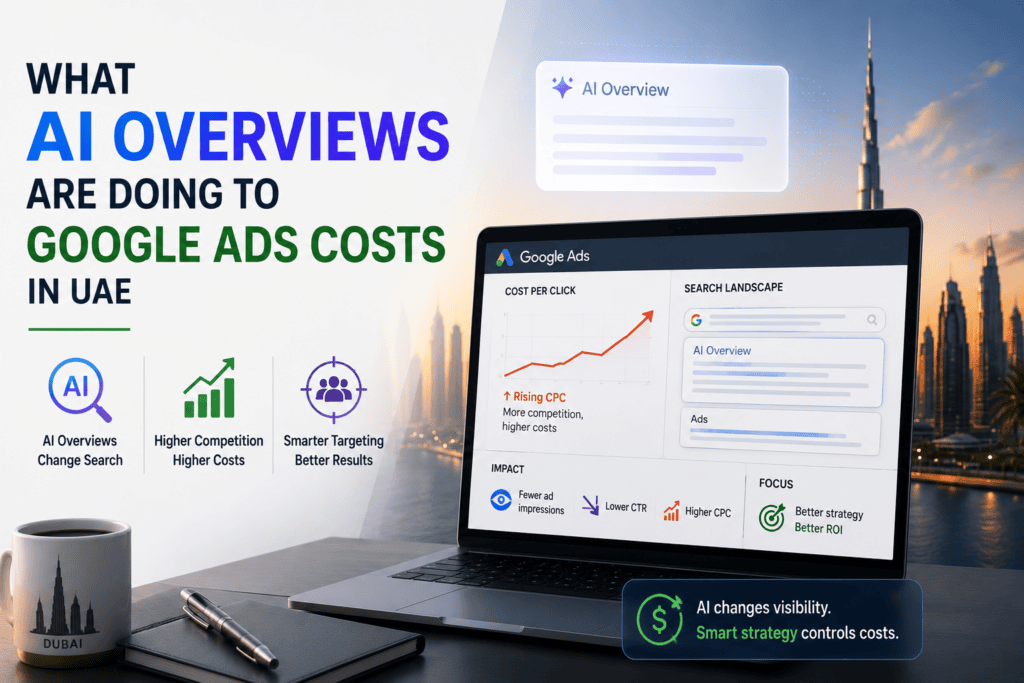
When Google AI Overviews appear in search results, they sit above the organic listings and, in many configurations, above or alongside the paid ads that previously occupied the most visible positions on the page. For UAE businesses running Google Ads, this structural change to the results page has had measurable consequences for click-through rates and cost efficiency that most advertisers have not fully accounted for.
The change is not uniform. AI Overviews do not appear on every query, they appear on different query types at different rates, and their presence affects different ad formats differently. But for the categories of queries where AI Overviews now trigger consistently, the downstream effect on paid search performance is real enough to require a strategic response.
This article explains what has changed structurally on the Google search results page, what the data shows about CPC and CTR shifts in UAE-relevant categories, and how to adjust a Google Ads strategy in response.
How the Search Results Page Has Physically Changed
A standard Google search results page before AI Overviews would show paid ads at the top (typically 2 to 4 ads), followed by the organic listings below. The ads occupied the prime screen real estate and captured the first clicks from high-intent searchers.
A results page with an AI Overview changes this layout significantly. The AI Overview block, which can span several paragraphs with citations and follow-up question prompts, occupies the top position, pushing everything else down. On mobile, which represents the majority of UAE searches, the AI Overview often fills the entire first visible screen and requires scrolling to reach either the paid ads or the organic listings below.
The physical consequence is that ads are pushed below the fold on a meaningful share of queries where AI Overviews trigger. A UAE business paying for a top-of-page ad position is still technically in a top ad slot, but if that slot is below a full-screen AI Overview on a mobile device, the effective visibility of that ad is materially reduced compared to what the same slot delivered 18 months ago.
What Page Position Means for Ad Performance Now
Google’s ad auction still awards positions based on Quality Score and bid. The position labels (top of page, absolute top of page) still exist and still correlate with performance in the traditional sense. But the relationship between position label and actual visibility to the searcher has changed.
An ad in position 1 on a query that triggers a long AI Overview on mobile may have lower effective visibility than the same position on the same query six months ago, before the AI Overview began triggering for that query type. The position label has not changed. The page layout has.
This manifests in ad performance data as unexplained CTR decline on campaigns and ad groups where nothing structurally changed on the advertiser’s side. Bids, quality scores, and ad copy may be unchanged, but click-through rates have dropped. For many UAE advertisers, this drop has been attributed to seasonal variation, creative fatigue, or audience saturation, when the actual cause is a structural change to the search results page.
Impression-weighted average position data in Google Ads does not currently distinguish between impressions where the ad appeared above an AI Overview and impressions where it appeared below one. This gap in reporting visibility makes the impact of AI Overviews on ad performance harder to measure precisely than the underlying effect warrants.
Which UAE Ad Categories Are Most Affected
The impact on paid ad performance is concentrated in categories where AI Overviews trigger most frequently, primarily informational and research-stage queries.
Significantly affected: Healthcare and medical queries. AI Overviews appear on a disproportionately high share of health-related searches, many of which are also commercial in intent (searching for a clinic, comparing treatment options). Paid ads for UAE clinics and healthcare providers running on informational health queries are seeing meaningful CTR pressure from AI Overview displacement.
Legal and financial services queries at the research stage. “How much does it cost to set up a company in UAE” and similar queries increasingly trigger AI Overviews that answer the question directly, reducing the click-through to both organic results and ads below.
Digital marketing and technology service queries. B2B service queries at the awareness and research stage are triggering AI Overviews at high rates, affecting ads from UAE agencies and technology service providers.
Less affected: Transactional queries with strong commercial intent. “Book a car service in Dubai” or “hire a wedding photographer Abu Dhabi” remain predominantly commercial-intent queries where AI Overviews trigger less frequently and ads retain strong visibility.
Brand and competitor queries. Ads targeting branded terms for specific businesses are largely unaffected by AI Overviews, which rarely trigger for navigational brand queries.
Local service queries with immediate intent. “Plumber near me Dubai” and similar high-urgency local queries still show predominantly Local Pack and ad results, with minimal AI Overview interference.
What Is Happening to CPCs and CTRs in 2026
The overall picture in UAE Google Ads data for 2026 shows diverging performance across query types rather than a uniform trend.
For informational-stage queries (the categories where AI Overviews appear most often), click-through rates have declined at a rate that outpaces what would be explained by seasonal or competitive factors alone. The supply of available clicks has contracted because a meaningful share of searchers are getting their answer from the AI Overview and not proceeding to click anything.
CPCs have not uniformly declined in response to lower CTRs. In some categories, CPCs have increased because fewer available clicks create more intense competition for the remaining impressions that do convert. This produces a counterintuitive dynamic: lower CTR and higher CPC simultaneously, meaning advertisers are paying more per click for a smaller total click pool on affected query types.
For commercial-intent and transactional queries, performance has been more stable. The queries where users need to actually complete an action, contact a business, make a booking, get a specific local result, have not been substantially displaced by AI Overviews, and CPC and CTR data in these segments remains more consistent with historical trends.
The strategic implication is to shift paid search investment toward transactional and commercial-intent query types and away from informational queries where AI Overviews are now satisfying the searcher’s need without a click.
The Queries Where Ads Still Win
Understanding which query types AI Overviews do not currently capture effectively is the most actionable insight for UAE Google Ads strategy in 2026.
Transactional queries with a specific action requirement. Searching for a specific service booking, requesting a quote, or looking for an immediate local provider requires a direct business contact, which an AI Overview cannot provide. Ads on these queries retain strong visibility and conversion relevance.
Queries where trust, personalisation, or recency matters more than a generic answer. “Best hair transplant clinic in Dubai 2026” requires current, specific, and trust-validated information that an AI Overview summary cannot reliably provide. These queries still show strong ad performance.
Queries with highly specific product or service specifications. Searches that include specific technical requirements, product model numbers, or service specifications generate results pages where AI Overviews either do not trigger or provide limited value, leaving the ad and organic results field less contested.
Branded competitor queries. Bidding on competitor brand terms remains a domain where AI Overviews have minimal impact and ads retain prominent placement.
A digital marketing agency in UAE running Google Ads for clients in 2026 should be auditing which query categories in each account are showing declining CTR and checking those queries directly in Google Search to confirm whether AI Overviews are now appearing. This diagnosis should precede any bid or budget adjustment.
How to Adjust Your UAE Google Ads Strategy
Audit your current campaign query mix for AI Overview exposure. For your top 20 to 30 keywords by spend, manually search each in Google and note which trigger AI Overviews. These are your highest-risk keywords for continued CTR pressure. Decide whether to maintain spend on these queries or shift budget toward query types with lower AI Overview trigger rates.
Shift budget toward bottom-funnel, high-intent query types. Transactional, booking-intent, and specific service queries retain ad visibility and conversion relevance. If your budget has historically been split between awareness and transactional queries, the case for shifting further toward transactional has strengthened.
Test AI Overview-adjacent ad copy. In some query configurations, ads appear within or immediately adjacent to the AI Overview block. Ad copy that complements the type of information the AI Overview provides, rather than competing with it generically, can capture clicks from searchers who have read the AI Overview and are now looking for a specific provider.
Invest the organic side of your search strategy in AI Overview citation. If AI Overviews are reducing the click value of paid placements on informational queries, the organic answer is to be cited within those AI Overviews. Queries where your paid ads are losing CTR to AI Overviews are exactly the queries where GEO services for UAE businesses should focus, because appearing in the AI Overview on those queries captures the visibility that the paid ad position below it no longer reliably delivers.
Review Performance Max campaigns for AI Overview interaction. Performance Max campaigns, which use Google’s automated targeting and placement, may be spending on query types heavily affected by AI Overviews without the advertiser being aware. Regular search term report auditing for PMax campaigns is more important than ever in this environment. The digital marketing agencies in Dubai managing PMax accounts for UAE clients should be running this audit on a monthly cadence rather than quarterly.
FAQ
Are AI Overviews appearing on Google Ads queries in the UAE specifically, or is this a global issue? It is a global phenomenon. Google AI Overviews are rolling out across markets including the UAE, with the trigger rate and specific query coverage expanding continuously. UAE advertisers should assume the same directional trends apply to their markets even when UAE-specific data is limited.
Should UAE businesses reduce Google Ads spend because of AI Overviews? Not categorically. The impact is query-type specific. Transactional and commercial-intent queries are less affected and ad spend on those query types retains strong efficiency. The case for reducing spend is specific to informational query types where AI Overviews now satisfy the searcher’s need without a click.
Will AI Overviews always push ads below the fold, or is this a temporary layout? Google has been testing multiple layout configurations for AI Overviews, including formats where ads appear within or adjacent to the AI Overview block rather than below it. The layout is not static and may evolve, but the directional trend of AI Overviews occupying prime page real estate is expected to continue.
Is there a way to bid specifically for placement within AI Overview results? Not currently. There is no dedicated auction or bid mechanism for placement within Google AI Overviews. Appearing in an AI Overview is an organic citation outcome, not a paid placement. The GEO strategy of optimising content for AI citation is currently the only controllable lever for AI Overview visibility.
Conclusion
AI Overviews are not making Google Ads obsolete. They are changing which query types deliver strong paid ad ROI and which are now more efficiently served by organic AI citation strategy.
For UAE businesses running Google Ads, the practical response is a query-type audit and budget realignment rather than a wholesale reduction in paid search investment. The queries that AI Overviews have disrupted should become GEO content targets. The queries where ads still win should receive the budget freed up by the shift. An AI search optimization agency in Dubai that manages both paid search and GEO simultaneously is uniquely positioned to model this reallocation accurately, because it can see where organic AI citation is genuinely replacing paid click value versus where paid ads remain the most efficient channel.