
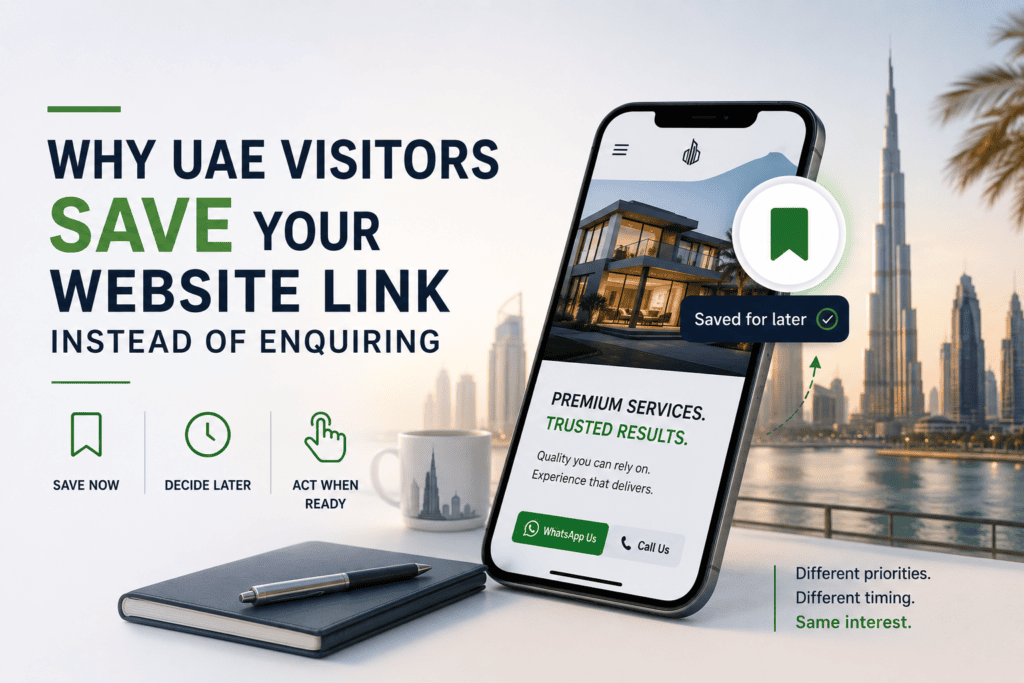
UAE marketers frequently report a pattern that does not fit global conversion benchmarks: high traffic, reasonable engagement time, low bounce rates on certain pages, but disproportionately low enquiry volume relative to what those indicators suggest. At the same time, Instagram saves are high, WhatsApp link forwards track occasionally in referral data, and “how did you hear about us?” surveys reveal that new clients have often been watching a business for weeks or months before making contact.
This is the save-not-enquire behaviour specific to Gulf audiences, and it is one of the most commercially significant and least documented patterns in UAE digital marketing.
Understanding it changes how you interpret your analytics, how you structure your content, and how you think about the conversion path from first touch to first conversation.
The Save Behaviour That UAE Analytics Misses
When a UAE visitor saves your Instagram post, bookmarks your website in their browser, forwards your WhatsApp link to themselves or a colleague, or screenshots your pricing page to review later, none of this appears as meaningful data in your analytics. It leaves no conversion event, no click trail, no attribution signal. From your analytics perspective, that visitor left without converting.
From their perspective, they are in the middle of a purchasing consideration process that may take days, weeks, or months. They have expressed real intent. They have just expressed it privately.
This invisible intent is especially pronounced in the UAE because of a combination of factors that create what researchers in Gulf consumer behaviour have described as high-privacy purchasing consideration: the culture of not visibly committing to a purchase or provider before a decision is made, the preference for consulting within family or professional networks before making business decisions, and a general wariness about being perceived as actively shopping in professional or community contexts.
The result is a funnel that looks ineffective at the bottom when it is actually effective at the top but missing a layer in the middle.
Why Gulf Audiences Save Before They Act
Privacy-conscious browsing culture. In many Gulf societies, publicly engaging with a service provider, commenting on their posts, clicking through ads in ways that are visible to a social graph, or asking for a quote before a decision is made carries a different social weight than in Western markets. Saving privately, bookmarking silently, or forwarding internally to a partner or colleague is the culturally lower-friction evaluation behaviour.
Decision-making that involves consultation. Business purchasing decisions in the UAE, particularly for service categories like digital marketing, legal, healthcare, and real estate, frequently involve more than one decision-maker. A first contact who finds your business may save it to share with a partner, a manager, or a family member whose input is required before any outward enquiry is made.
Higher stakes, longer consideration for certain service categories. For high-value or relationship-intensive services (agencies, consultants, clinics), UAE buyers tend to observe a provider for longer before making contact. Following silently for several months, watching content without engaging, and eventually reaching out is a documented pattern among UAE service buyers in B2B categories.
WhatsApp as a private research-sharing tool. WhatsApp is used extensively in UAE professional and social circles as a research-sharing mechanism. A link to your website or a screenshot of your pricing page, forwarded in a WhatsApp group, can generate indirect traffic and consideration that never appears in your referral data.
How This Shows Up in Your Website and Social Analytics
Higher than expected save rates relative to comments. UAE Instagram accounts in professional service categories typically show save-to-comment ratios that significantly exceed global benchmarks. Global Instagram save rates average around 1 to 2% of reach for strong content. UAE service business content regularly shows save rates of 3 to 7% on the same content, with comment rates that are proportionally lower.
Long average session times on pricing and services pages with no form submission. A visitor who spends 4 minutes on your pricing page and then leaves without contacting you is almost certainly a genuine prospective buyer who is saving, comparing, or consulting. Most analytics setups count this as a non-converting session when it is actually a highly engaged evaluation session.
Direct traffic spikes that cannot be attributed to a campaign. When a business link gets forwarded in a WhatsApp group or Telegram channel, the resulting traffic arrives as direct traffic because the referral source is a private messaging app that does not pass referral data. Direct traffic spikes that are not attributable to any known campaign activity are frequently WhatsApp-forwarded links in UAE analytics.
Return visit patterns. UAE buyers who have saved and are evaluating often return to a website multiple times before making contact. A user who visits your services page on three separate occasions over two weeks and then submits a form is showing a normal UAE consideration pattern. Most attribution models credit the final session; the first session, which may have been the save moment, is the actual conversion point.
The Nurture Gap Between Save and Enquiry
The commercial problem with save behaviour is the nurture gap: the period between when a UAE prospect saves or bookmarks your business and when they actually reach out. During this window, which can range from a few days to several months, they are watching your content, reading your posts, and forming an opinion of your business based on whatever you publish.
A business that understands this gap actively manages it. One that does not is leaving the conversion to chance.
The nurture gap is where consistent content publishing pays dividends that no single campaign can replicate. A UAE prospect who saved your website in March, watched 12 Instagram posts between March and May, saw a LinkedIn article from your founder in June, and then enquired in July was not converted by the July campaign. They were converted by the cumulative effect of the whole sequence. But the July campaign typically gets the credit.
This is why businesses that stop posting during quiet periods, or that post inconsistently, consistently report that their enquiry volume drops with a time lag of 4 to 6 weeks, the approximate length of the nurture gap for the segment of their audience that was in save-and-observe mode.
What High-Save Content Actually Tells You
On Instagram and TikTok, saved posts are one of the strongest positive signals available to a content strategy. In the UAE context specifically, high save rates on a piece of content tell you:
The content addressed a real and specific problem or question that the audience wants to return to. Saves are intentional acts of future reference. Nobody saves content they found mildly interesting. They save content they found specifically useful or relevant enough that they expect to want it again.
The audience is in an active evaluation or consideration mode. Saves on service-category content are disproportionately associated with purchase intent. A save on a “how much does website design cost in Dubai” post is not casual entertainment engagement. It is research behaviour.
The content is being discussed or shared in contexts you cannot see. High save rates on specific content frequently correlate with that content being circulated in private channels, forwarded within networks, or discussed in contexts that never generate public engagement signals.
A social media agency in Dubai that tracks save rates as a leading indicator of enquiry volume, rather than a vanity metric alongside likes, will be better positioned to predict pipeline than one that reports only reach and engagement.
How to Convert Savers Into Enquiries
Make the path from save to contact frictionless at the moment of decision. When a UAE buyer finally decides to act on their saved consideration, the path to contact must be immediate and obvious. A WhatsApp button that works instantly, a phone number that clicks to call, and a clear statement of what happens next (“reply to this post and I will send you a full service guide”) serve this moment better than a multi-field contact form.
Use direct invitation content that explicitly acknowledges the observer. Posts written for the observer segment of your audience, the people who have been watching but not interacting, perform well in UAE markets. “If you have been following for a while and you are still wondering whether this is right for you, message me the word [keyword] and I will give you an honest answer” directly addresses the save-not-enquire audience and lowers the activation energy of reaching out.
Maintain posting consistency during quiet periods specifically. The UAE summer (June to August) is when many businesses reduce content output because engagement drops. But the audience watching in July, when most of the expat population has travelled, is disproportionately made up of the Gulf national and long-term resident segment that tends to be the highest-value buyer profile. Reducing content exactly when this audience has more time to scroll is a recurring strategic error.
Use email or WhatsApp follow-up sequences for any contacts captured. UAE buyers who have expressed any prior signal (website visit, Instagram follow, WhatsApp enquiry that did not convert) but have not yet committed should be receiving regular, low-pressure content via whatever channel the signal occurred on. The sequence should not be a sales cadence. It should be a nurture sequence designed for an audience that is in a consider-and-observe mode.
For the broader measurement framework that makes this behaviour visible and trackable across channels, the article on how to measure social media ROI for UAE businesses covers how to account for save-and-refer behaviour in attribution models that standard analytics tools miss entirely.
A viral content agency in Dubai that produces content specifically designed for the save-then-return consideration journey, rather than for immediate click conversion, will produce different content than one optimising purely for engagement rate, and for UAE service businesses, it will typically produce better commercial outcomes.
FAQ
Can I track how many people have saved my website link on WhatsApp? Not directly. WhatsApp does not pass referral data to analytics tools. The best proxy is monitoring direct traffic volume and looking for spikes that cannot be attributed to any known campaign. You can also add UTM parameters to the links you actively share in WhatsApp to track those specific instances.
Does the save-not-enquire pattern apply equally to B2B and B2C UAE businesses? More pronounced in B2B, where the consideration period is longer and the decision involves more stakeholders. In B2C consumer service categories, it is also present but with shorter save-to-enquiry windows, typically days rather than weeks.
How do I know if my save rates are high relative to UAE benchmarks? On Instagram, a save rate above 2% of post reach on service-category content is strong. Above 4% indicates content that is being actively stored for future reference by a significant share of the audience that saw it. If your saves are high but comments and DMs are proportionally low, you are seeing the classic UAE save-and-observe pattern.
Is there a way to reach people who have saved my content but not contacted me? Not directly through organic channels. The most effective approaches are maintaining consistent content so observers stay engaged during the consideration period, and running retargeting ads to custom audiences built from website visitors and video viewers who have not yet converted.
Conclusion
The save-not-enquire behaviour of UAE audiences is not a funnel failure. It is a market characteristic that requires a different conversion model than the one global digital marketing advice typically describes.
UAE buyers, particularly for professional services, regularly take weeks or months to move from discovery to enquiry. During that period they are watching, saving, forwarding, and consulting. The businesses that convert the highest share of this audience are the ones that understand the nurture gap and fill it with consistent, specific content that earns the continued observation of an audience already interested enough to have saved them once. A digital marketing agency in UAE that builds its reporting to account for this pattern will consistently give a more accurate picture of content performance than one treating a high-save, low-comment post as underperforming.