
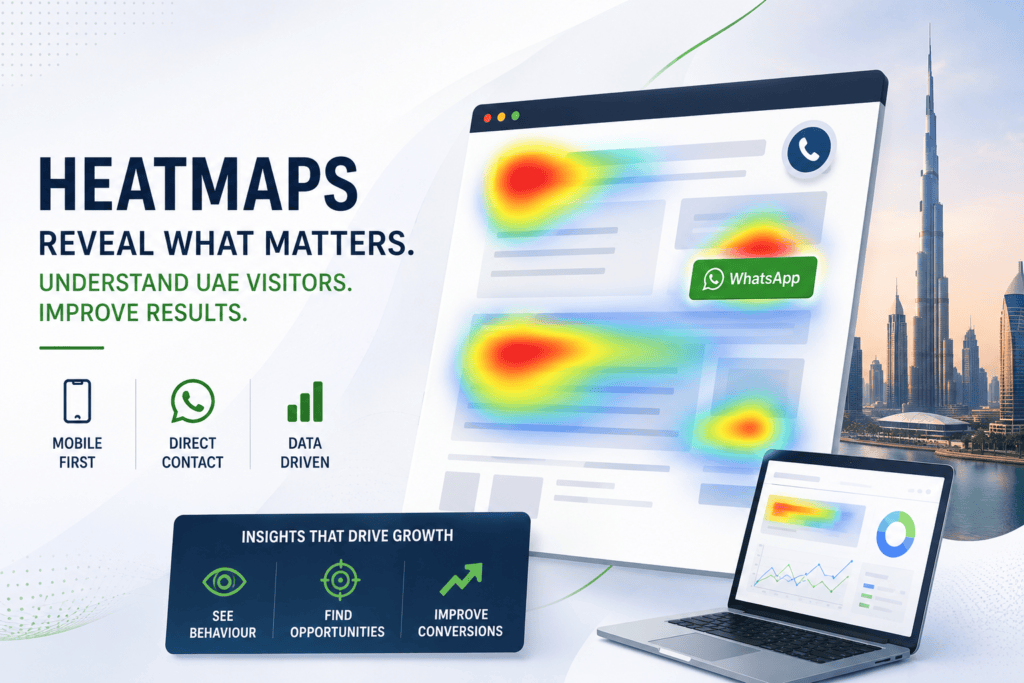
Heatmap tools like Hotjar, Microsoft Clarity, and Crazy Egg reveal where visitors click, how far they scroll, and where attention concentrates on a page. Most guidance on reading heatmap data treats websites as if they serve a homogeneous global audience. For UAE businesses, this produces interpretations that miss the most commercially significant patterns specific to this market.
UAE websites serve one of the most demographically fragmented audiences of any market in the world. A single service business in Dubai may attract Arabic-speaking nationals, South Asian professionals reading in English, Western expats, and GCC visitors, all on the same page, often simultaneously. Their browsing behaviour, attention patterns, and conversion paths differ in ways that aggregate heatmap data obscures unless you know what to look for.
This article covers what heatmap data actually shows when analysed specifically in the UAE context, where the patterns diverge from global benchmarks, and what to do with those insights.
Why Generic Heatmap Advice Does Not Apply to UAE
The most commonly cited heatmap finding in the global SEO and UX literature is the F-pattern: visitors scan a page in an F-shaped pattern, reading the first few lines in full, then scanning down the left side of the page. This is real, documented behaviour for English-language content read by users comfortable with left-to-right layouts.
It tells you almost nothing useful if a meaningful portion of your UAE audience reads Arabic, which flows right to left, or if your audience browses primarily on a phone while commuting on a Dubai Metro rather than at a desktop during a focused research session.
UAE-specific heatmap data regularly shows:
A significantly higher concentration of attention above the fold relative to markets with more desktop-dominant browsing. Mobile users in the UAE rarely scroll below the third or fourth screen height on a homepage they are visiting for the first time. The content that does not appear in the first two visible screens on a phone effectively does not exist for the majority of UAE first-time visitors.
Clicks concentrated on contact icons, WhatsApp buttons, and phone number links at a rate that significantly exceeds what most Western market heatmaps show. UAE visitors who are interested act through direct contact mechanisms rather than through navigation into deeper content pages. This changes where calls to action need to live.
A much lower engagement rate with testimonial sections and case study carousels than global benchmarks suggest. UAE professional audiences are not disengaged with social proof, but they are more responsive to it in video or review formats than in static quote carousels with headshots.
What Scroll Depth Data Shows About UAE Mobile Visitors
Scroll depth measures how far down a page a visitor travels before leaving. For UAE service business websites, scroll depth data typically shows a steep drop-off pattern: a high percentage of visitors see the first 25% of the page, a significant drop occurs between 25% and 50%, and the percentage remaining below 75% is often single-digit.
This is not unique to the UAE, but it is more pronounced here for two reasons. First, mobile dominance compresses the above-the-fold visible area. Second, UAE visiting behaviour tends toward quick-qualification decisions: a visitor determines within the first screen whether the business is worth investigating further, rather than reading progressively deeper to form that judgement.
The practical implication is not to make pages shorter. It is to front-load the page with everything that earns a scroll decision: a specific headline, a trust signal (usually a review count or recognisable client name), and a clear contact path. Everything placed below the 50% mark should be designed for a visitor who has already made a positive engagement decision, not as a persuasion tool for a visitor who is still undecided.
Where UAE Visitors Click That Most Businesses Do Not Expect
UAE heatmaps consistently show heavy click activity on three areas that most websites under-invest in:
Phone numbers and WhatsApp links, regardless of where on the page they appear. UAE visitors who want to contact a business will scroll to find a phone number or WhatsApp link even when no obvious CTA has been placed at the top of the page. This is one of the clearest signals in UAE heatmap data that direct contact is the preferred first action, not form submission or email.
Team and about section photos. Faces receive disproportionate click attention in UAE heatmap data. For a market this multicultural, seeing a recognisable face from your own nationality or cultural background has a documented trust effect. Clicking on a team photo is a trust verification behaviour: the visitor is checking who they would be dealing with before deciding to contact.
Pricing or service fee references, wherever they appear. Even when pricing is not on a dedicated pricing page but mentioned in passing in a service description, click concentration around those figures is high. UAE visitors are looking for financial context early and actively, often before any other content detail.
What is conspicuously underclicked in UAE heatmaps:
Navigation menus receive less click engagement than most businesses assume. For a first-time UAE visitor on mobile, the primary decision is made based on what is visible on load, not on what can be found through navigation. Menu items for services like “About,” “Team,” and “Blog” show very low first-session click rates.
Lengthy service description blocks and multi-paragraph benefit lists show low cursor engagement in move maps, indicating that visitors are not reading this content but are instead scanning for specific signals: location, price reference, contact path.
The Attention Pattern Difference Between Arabic and English Visitors
If your UAE website has both Arabic and English versions, comparing heatmaps between the two language versions reveals consistently different attention patterns that have direct design implications.
Arabic-language visitors show attention concentrated on the right side of the page on first scan, consistent with right-to-left reading. Navigation menus on the left side of an English-language layout receive less initial attention from Arabic-speaking visitors who have switched to the Arabic version but are on a page that has not properly flipped its layout.
Right-to-left layout in Arabic pages is not simply a text mirror. The visual weight of the page, where the eye goes first, where the primary CTA should sit, and where trust signals should be positioned all shift with the reading direction. Heatmaps from Arabic-version pages on sites that have only mirrored text without adjusting layout show attention concentrated in areas where no high-value content or CTA has been placed.
English-language UAE visitors from South Asian backgrounds (a large segment of the UAE professional workforce) tend to show longer scroll sessions and higher engagement with credential-heavy content than Western visitors, who show sharper above-the-fold decision-making patterns. This is relevant if your service targets specific professional segments within the UAE expat community.
A web development agency in Dubai building bilingual websites should be using separate heatmap segments for each language version rather than aggregating data across both, because the behavioural patterns genuinely differ in ways that change layout and CTA placement decisions.
What WhatsApp Buttons and Call Icons Reveal in UAE Heatmaps
The WhatsApp floating button, standard on most UAE service business websites, typically generates more clicks than any other single element on the page including the primary navigation CTA. In Hotjar and Clarity data from UAE business sites, the WhatsApp icon consistently appears as the brightest point on a click heatmap, regardless of its position.
This has several implications.
First, every UAE service business website should have a WhatsApp button visible without scrolling on mobile. If the button only appears at the bottom of a long scroll or as a fixed floating element that loads after several seconds, you are adding friction to the most used conversion path on your site.
Second, the click data on WhatsApp buttons relative to traditional contact forms reveals a conversion preference hierarchy specific to the UAE market. WhatsApp clicks typically outnumber form submissions by a ratio of 3 to 1 in UAE heatmap data, sometimes higher for consumer-facing service categories. If your site is optimised primarily for form submissions, you are optimising for the less preferred contact method.
Third, phone number clicks and WhatsApp clicks together typically account for 60 to 80% of all contact-intent clicks on UAE service websites. This should inform where budget is spent on conversion rate optimisation: improving form UX is less valuable per hour than ensuring the WhatsApp and call path is frictionless, fast, and visible.
The Rage Click Problem on UAE Websites
Rage clicks, repeated frustrated clicks on elements that appear clickable but are not, or on elements that load too slowly to respond, are tracked by tools like Hotjar and Clarity. For UAE websites, rage click data concentrates on three consistent problem areas.
Non-linked phone numbers. A phone number displayed as text on a mobile device that is not wrapped in a tel: link cannot be clicked to call directly. UAE mobile visitors who see a phone number will attempt to click it, fail, and either try again or leave. This appears in heatmap data as a cluster of rage clicks around the phone number text.
Slow-loading WhatsApp buttons. A floating WhatsApp icon that uses a JavaScript load delay of more than 2 seconds will show rage clicks from visitors who tapped the area where the button appeared before it became interactive.
Images and service category tiles that appear to be clickable links but are static. UAE visitors navigating on mobile frequently tap on visual elements expecting them to lead somewhere. Static images used decoratively in service sections without a linked destination generate rage click patterns indicating wasted visitor intent.
For the broader context of how UX failures translate to lead loss on UAE websites, the article on is your website losing leads because of bad UX covers the full diagnostic framework that heatmap data feeds into.
How to Set Up Meaningful Heatmap Tracking for a UAE Site
Segment by device type from the start. Given UAE mobile dominance, a heatmap that aggregates desktop and mobile data produces misleading patterns. Set up separate heatmaps for mobile and desktop sessions and analyse them independently.
Segment by traffic source. Organic search visitors, paid ad visitors, and social media visitors behave differently on the same page. A visitor from a Google search has higher intent than a visitor from an Instagram ad, and their scroll and click patterns reflect this. Analysing them together obscures both.
Segment by language version if you have a bilingual site. As described above, Arabic and English version visitors show meaningfully different attention patterns. Use separate heatmap recordings for each language URL.
Record sessions, not just click maps. Heatmaps aggregate across sessions. Individual session recordings reveal the specific moments where individual UAE visitors get confused, frustrated, or lose interest. A sample of 20 session recordings from real visitors will often surface specific usability problems that no aggregate heatmap would reveal.
Track for at least 500 sessions per segment before drawing conclusions. A 50-session heatmap for a low-traffic UAE business website is too small to reveal reliable patterns. For businesses with under 1,000 monthly visitors, prioritising session recordings over aggregate heatmaps produces more actionable insight from a smaller data sample. Any website design company in UAE doing a post-launch audit should include at minimum 30 days of heatmap data collection before drawing redesign conclusions.
FAQ
Are there specific heatmap tools that work better for UAE websites? Microsoft Clarity is free, has no sampling limits, and performs well for UAE business sites. Hotjar offers more advanced segmentation features that are valuable if you have the volume to use them. Both integrate with Google Analytics 4. For Arabic-language tracking, confirm that the tool handles right-to-left text correctly in its click tracking, as some tools have rendering issues with RTL content.
How often should I review heatmap data for my UAE website? Monthly for sites with consistent traffic, and immediately after any significant page update, content change, or redesign. Heatmap data from before a change and after it provides a direct comparison of whether the change improved engagement patterns.
Can heatmaps tell me why visitors are leaving without contacting me? Not directly, but they provide strong signals. If scroll depth drops sharply at the same point on every visit, the content at that position is not earning continued engagement. If rage clicks concentrate on a specific element, there is a usability failure there. Combining heatmap data with session recordings gives the closest available picture of why contact conversions are not happening.
Does heatmap data help with GEO and AI search optimisation, or only with UX? Primarily UX, but the correlation matters: pages with strong engagement signals, meaning visitors scroll meaningfully and interact with the content, are signals that AI systems and Google’s page quality assessors can detect through Core Web Vitals and behaviour data. A page that every visitor bounces from within 10 seconds is less likely to be cited by AI engines than a page where visitors demonstrably engage.
Conclusion
Heatmap data for UAE websites is most valuable when analysed through a UAE-specific lens rather than applied against global benchmarks. The mobile dominance, multicultural audience composition, WhatsApp-first contact preference, and bilingual browsing patterns all produce behaviour that generic heatmap guidance does not account for.
The most actionable findings in UAE heatmap data are almost always the same: the WhatsApp and call path has friction that is losing intent-ready visitors, non-linked phone numbers are generating rage clicks, and the most important conversion content is placed below the scroll depth where most mobile visitors stop. Fixing these three findings consistently produces measurable contact rate improvements without any other changes to the site. A digital marketing agency in UAE that includes heatmap review in its quarterly client reporting will catch these issues systematically rather than waiting for the client to notice a conversion drop.