
Introduction
Voice search has been “the next big thing” in SEO for the better part of a decade. But its commercial relevance for UAE businesses has shifted substantially with a change in the underlying technology: AI-powered voice assistants have replaced the simpler keyword-matching voice search of the early 2010s.
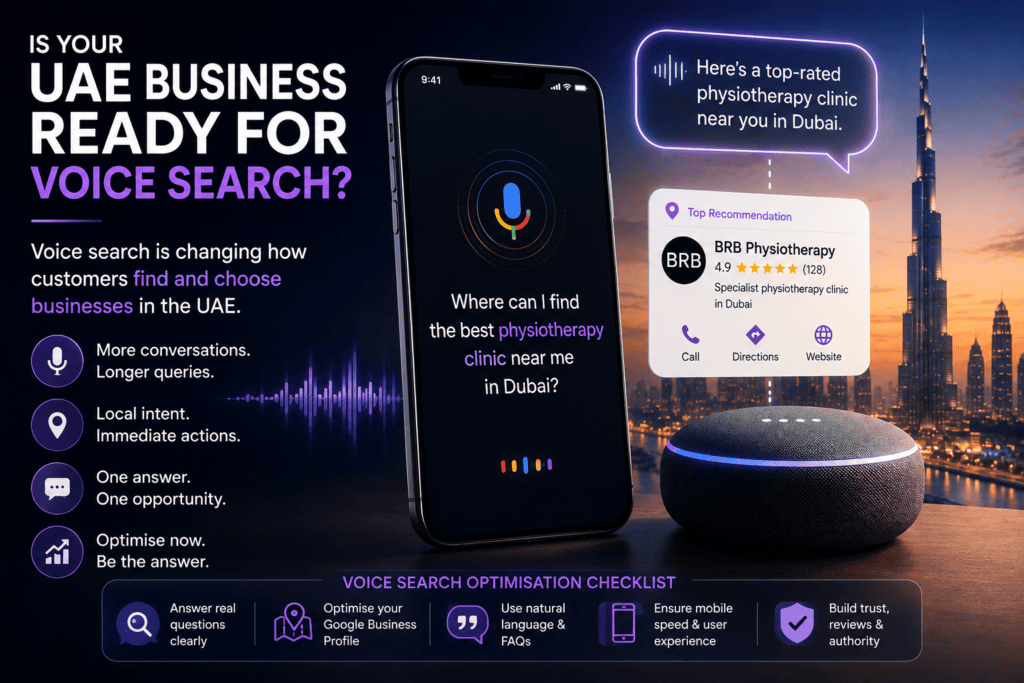
When a UAE resident asks Google Assistant, Siri, or an AI assistant like ChatGPT through voice input to recommend a clinic, agency, or restaurant in their area, the response is not a list of blue links. It is a single spoken recommendation drawn from whatever source the AI determines to be the most credible and relevant answer. In that environment, being visible is binary. You are the recommendation, or you are not mentioned at all.
This article explains how voice search behaviour differs from typed search, what makes a UAE business likely to be the recommended answer, and what to change if you are not currently capturing this traffic.
How Voice Search Behaviour Differs From Typed Search
Query length. Typed searches are typically short and keyword-focused: “physiotherapy Dubai.” Voice queries are longer and more conversational: “where can I find a physiotherapist near me in Dubai?” or “which is the best physiotherapy clinic in JBR?”
Question structure. Voiced queries use natural language question formats beginning with who, what, where, when, why, and how. They mirror the way someone would ask a trusted friend for a recommendation.
Local intent. A significant majority of voice queries have local intent. Voice search is overwhelmingly used for in-the-moment, location-specific needs: finding a place to eat, finding a service provider nearby, getting directions, or checking whether a business is currently open.
Expectation of a single answer. A user who types a search expects a list of results to evaluate. A user who speaks a query expects a single recommended answer they can act on immediately without further research.
This single-answer expectation is the most commercially significant difference for UAE businesses. Position 1 in traditional search is valuable but not exclusive. The voice search answer is exclusive: there is only one.
How Big Is Voice Search in UAE Right Now
The UAE’s combination of near-universal smartphone adoption, very high smart speaker and connected device penetration in home and office environments, and a multilingual population comfortable speaking in multiple languages to AI assistants makes it one of the more voice-search-active markets in the region.
Arabic voice search specifically has grown substantially as Google’s and Apple’s Arabic voice recognition accuracy has improved to the point where it is reliable enough for daily use. This creates a genuine opportunity for UAE businesses with Arabic-optimised content to earn voice search recommendations from a large and commercially significant audience segment that typically searches in Arabic.
Among younger UAE demographics and among the professional expat population, AI assistant usage through voice input is growing rapidly, particularly for local queries made in transit or while multitasking, contexts where typing a full search query is inconvenient.
What Types of Queries Are Most Commonly Voiced
Local service recommendations: “Which is the best [service type] near me?” / “Find me a [service type] in [Dubai area]”
Business information queries: “What time does [business name] close?” / “Is [business name] open on Fridays?”
Directional queries: “How do I get to [business name]?” / “Where is [business name] located?”
Comparison and advice queries: “What is the difference between [option A] and [option B]?” / “Should I choose [service A] or [service B]?”
How-to and process queries: “How do I [do something]?” — particularly common for consumer services where the user is seeking guidance before making a purchasing decision
For UAE service businesses, the highest-value voice query category is typically the local service recommendation type, because these queries represent a user with an active, immediate intent to hire a provider rather than simply gathering information.
How Voice Search Answers Are Selected
For queries processed through Google Assistant and Siri when they pull from Google’s index, the spoken answer is typically drawn from:
- The featured snippet (if one exists for the query)
- The top result from the Local Pack for local queries
- Google Business Profile data for business information queries (hours, location, phone)
For AI assistant queries processed through ChatGPT or similar AI tools, the answer is drawn from the same AI citation pool that drives AI search recommendations — the business with the strongest entity signals, best-structured content, and most credible third-party mentions for the relevant query.
This means the signals for voice search visibility are not a separate discipline from traditional SEO and GEO. They are the same signals, evaluated against a conversational query format rather than a keyword-based one.
The Technical Requirements for Voice Search Visibility
A complete and active Google Business Profile. For local intent voice queries, GBP is the primary data source. Accurate hours, up-to-date location, and a recent activity pattern are all critical for voice search recommendations through Google Assistant. An AI search optimization agency in Dubai that treats GBP as the foundational voice search asset alongside its AI search value will typically audit it at the start of every engagement rather than leaving it as a background task.
Mobile-optimised, fast-loading website. The vast majority of voice searches are conducted on mobile devices. Page speed and mobile UX directly affect whether Google considers a page suitable as a voice search source.
HTTPS (SSL certificate). Google’s voice search responses preferentially draw from secure pages. Any UAE business website without a current SSL certificate is at a disadvantage for voice search inclusion. A web development agency in Dubai should flag this in any technical audit as an immediate fix rather than a low-priority item.
Structured data markup. FAQ schema, LocalBusiness schema, and Speakable schema (which specifically marks up content as suitable for reading aloud by voice assistants) are the three structured data types most directly relevant to voice search visibility.
The Content Requirements for Voice Search Visibility
Conversational question-and-answer format. Content written in the format of questions and direct answers mirrors how voice queries are structured and how voice answers need to sound when read aloud. FAQ sections with natural language questions and concise, complete answers are the single most accessible voice search content format.
Short, complete answers to common queries. The ideal voice search answer is 29 words long, according to Backlinko’s analysis of Google Home responses. Answers in the 25 to 35 word range that are complete, accurate, and self-contained without additional context are the most voice-search-suitable content format.
Local language and terminology. Voice queries in the UAE often include specific location terms (JBR, JLT, Business Bay, DIFC, Al Barsha), neighbourhood references, and colloquial service descriptions that reflect how people actually speak about the area rather than how a business formally describes its location.
Content that matches spoken natural language. If someone asks “who is the best GEO agency in Dubai” aloud, the content that answers it should read naturally as a spoken response, not as a keyword-optimised web page title. Writing FAQ answers with this conversational quality in mind is the most directly actionable content improvement for voice search readiness.
For UAE businesses that have already invested in FAQ content and structured data as part of a GEO strategy, voice search optimisation is largely an extension of that existing work rather than a separate effort. The article on how to write FAQ pages that AI search engines pick up covers the FAQ content format in full, including the structure and specificity that serves both AI search and voice search equally.
FAQ
Does voice search optimisation require different keyword research than standard SEO? Yes, but the primary difference is phrasing. Voice search keywords are conversational, longer, and question-based. Running your existing target keywords through a “how would someone ask this aloud?” filter typically reveals the voice search keyword variants without requiring entirely separate research.
Is Arabic voice search growing in UAE and is it worth optimising for? Yes to both. Arabic voice search adoption in the UAE has grown substantially as AI assistant Arabic language capability has improved. For UAE businesses serving Arabic-speaking audiences, Arabic FAQ content and Arabic-language GBP information are directly relevant to Arabic voice search visibility.
How do I know if my business is currently appearing as a voice search answer? Testing directly, by asking voice query variants on Google Assistant or Siri and observing whether your business is named, is the most straightforward monitoring method available. Voice search visibility is not currently reported in Google Search Console.
Should my pricing information be optimised for voice search? Yes, for appropriate query types. A voice query asking “how much does [your service] cost in Dubai” that returns a clear, spoken pricing range from your website rather than from a competitor is a valuable commercial outcome. Including pricing FAQ content in voice-search-appropriate formats is worthwhile for categories where cost queries are common.
Conclusion
Voice search is no longer a future consideration for UAE businesses. It is a present channel that is growing specifically in the direction of AI-assisted, conversational search, where the answer is a spoken recommendation and the opportunity is binary.
The businesses that appear as voice search recommendations for their service categories in Dubai in 2026 are the ones with complete GBP profiles, structured data markup, and FAQ content written in the conversational question-and-answer format that voice queries and voice responses both require. The GEO services for UAE businesses at BRB include voice search readiness as a standard component of every audit, because the signals are largely shared and the gap in most UAE sites is usually the same FAQ and schema work needed for AI text search as well.