
Introduction
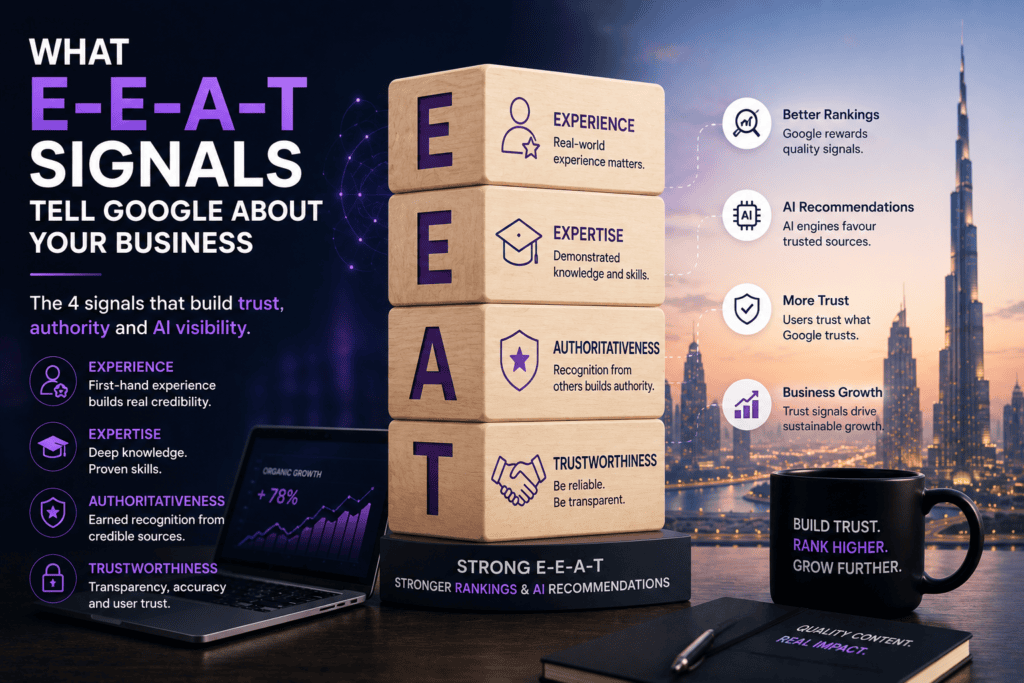
Google’s E-E-A-T framework, standing for Experience, Expertise, Authoritativeness, and Trustworthiness, is the set of quality signals that Google’s human quality raters use to evaluate whether a website or piece of content should be trusted and ranked. It is not a direct ranking algorithm, but it describes the qualities that the ranking algorithm is designed to identify and reward.
For UAE service businesses, understanding E-E-A-T matters for two compounding reasons. First, it explains why Google rewards certain types of content and certain types of sites over others, even when the keyword targeting and technical SEO are comparable. Second, the same signals that build E-E-A-T for traditional search also build entity authority for AI search engines, making E-E-A-T investment doubly valuable in the current landscape.
This article breaks down each signal, explains what it means in practice for a UAE service business, and covers what to actually do to build it.
What E-E-A-T Actually Is
E-E-A-T is the framework described in Google’s Search Quality Evaluator Guidelines, the document used to train the human quality raters who provide feedback on Google’s search results. While human raters do not directly control rankings, their evaluations provide the training signal that helps Google’s algorithms understand what quality content looks like.
The framework was originally E-A-T (without the first E). Google added Experience as a distinct signal in 2022, reflecting a recognition that first-hand experience with a topic, distinct from formal expertise, is a meaningful quality indicator. A physiotherapist writing about recovery exercises has expertise. A patient who has undergone the recovery process and writes about their personal experience demonstrates experience. Both are valuable in different ways.
The four signals work together rather than independently. A site can have demonstrated expertise but low trust (perhaps due to poor privacy practices or misleading claims) and still rank poorly. The strongest sites build all four coherently.
Experience: The Newest and Most Overlooked Signal
Experience refers to first-hand, personal engagement with the subject matter being written about. It distinguishes content produced from direct involvement with a topic from content assembled purely through research.
For UAE service businesses, Experience signals appear in:
- Case studies written from direct client engagement, with specific, real-world details
- Behind-the-scenes content that demonstrates what the service delivery process actually involves
- Owner or practitioner authored content that draws on specific professional situations
- Client testimonials that reference concrete, named outcomes rather than generic satisfaction
The addition of Experience to the framework was partly Google’s response to the rise of AI-generated content, which can be factually accurate and well-structured but lacks the signal of genuine first-hand engagement. Content that clearly could only have been produced by someone who actually did the thing described scores higher on Experience than content that could have been assembled from existing sources.
For a service business in Dubai, this means content produced by the practitioners who actually deliver the service, drawing on specific real situations, is inherently more E-E-A-T-aligned than equally well-written content produced by a writer who has not done the work.
Expertise: How Google Recognises Subject Matter Authority
Expertise is the demonstrated knowledge, skill, and credentials relevant to the topic being covered. Google evaluates it through a combination of explicit signals (credentials, qualifications, named authorship) and implicit signals (depth, accuracy, and specificity of the content itself).
For UAE service businesses, Expertise signals include:
- Named authors with verifiable professional credentials, qualifications, or relevant experience linked from article bylines
- Author biography pages that describe relevant background and expertise in specific terms
- Content that demonstrates deep, accurate knowledge rather than surface-level coverage of a topic
- External validation of expertise through citations, speaking appearances, or media mentions that confirm the author’s standing in their field
The named authorship point is particularly important. Content produced by “the BRB Team” or attributed to a company name alone is less Expert-signalled than content attributed to a named individual whose professional background is verifiable. For UAE service businesses that have previously published all content under a generic company byline, transitioning to named authorship with linked author profiles is one of the higher-impact E-E-A-T changes available.
Authoritativeness: Why Third-Party Validation Matters
Authoritativeness is the recognition of a site or individual as a trusted source within their topic area, particularly as validated by independent third parties rather than by self-declaration. A business claiming to be an authority in digital marketing in the UAE is providing a self-assessment. Other credible sources citing, linking to, or referencing that business as a knowledgeable voice in the field is Authoritativeness in Google’s sense of the term.
Third-party signals that build Authoritativeness for UAE service businesses:
- Links from credible UAE business and industry publications
- Unlinked mentions in editorial content from relevant sources
- Citations in other businesses’ or professionals’ content
- Presence in authoritative directories and professional associations
- Review profiles on credible third-party platforms (Clutch, Trustpilot, Google)
A key nuance is that Authoritativeness is topic-specific. A UAE digital marketing agency may be highly authoritative in GEO and content strategy but have no established authority in healthcare or real estate. Building Authoritativeness within a specific, bounded topic area is more valuable than attempting to claim broad authority across unrelated subjects.
Trustworthiness: The Signal That Underpins Everything Else
Trustworthiness is the foundational signal that determines whether a site is considered reliable in its claims, transparent about its identity, and safe to interact with. Google has described Trustworthiness as the most important of the four E-E-A-T signals, because all the Expertise and Authority in the world is undermined if the site is not trusted.
Trust signals for UAE service businesses:
- SSL certificate (https) and passing Core Web Vitals
- Clear, accurate business information (name, address, phone, registration)
- Consistent identity information across the website and all third-party profiles
- Transparent privacy policy and terms of service
- Review profiles with genuine, specific customer feedback
- Accurate, honest claims in all content (no exaggeration, no unsupported superlatives)
The Trustworthiness signal is often where UAE websites with strong content and credentials fall short because of inconsistent NAP information (business name, address, phone varying across platforms), missing legal pages, or content that makes claims the site cannot substantiate with evidence.
A digital marketing agency in UAE conducting an E-E-A-T audit for a client will typically find Trustworthiness gaps are the most common and most quickly fixable deficiency, even when Expertise and Authoritativeness signals are already reasonably well established.
How E-E-A-T Connects to AI Search Recommendations
The signals that build E-E-A-T for traditional Google search are largely the same signals that AI search engines use to assess the credibility and reliability of a business entity.
Named, credentialed authors signal to AI engines that the content has a real, verifiable person behind it. Third-party mentions and citations signal that independent sources agree with the entity’s claimed expertise area. Trust consistency across platforms and profiles signals that the entity is reliably described and not fabricated or misrepresented.
For UAE businesses building AI search citation visibility, investing in E-E-A-T is not parallel to GEO strategy but foundational to it. The structured data and content optimisation that drives AI citation performs better when built on a foundation of strong E-E-A-T signals.
How UAE Service Businesses Should Build E-E-A-T
Named authorship on all published content. Transition from company-byline articles to named author bylines with linked, detailed author biography pages. Every AI search optimization agency in Dubai building E-E-A-T for a client will start here, because named authorship is one of the clearest and most directly actionable improvements available to most UAE websites.
Real experience signals in content. Where content covers a topic the business has direct experience with, include specific examples, client outcomes (anonymised if needed), and details that demonstrate first-hand engagement with the subject.
External validation through earned media and citations. Pursue genuine press coverage, industry mentions, and credible directory presence specifically for their E-E-A-T signal value, not just link equity.
Complete and consistent business information everywhere. Audit your business name, address, phone number, and description across your website, GBP, directories, social platforms, and professional listings for complete consistency.
Evidence-backed content claims. Every significant claim in published content should be supported by specific evidence, data, or examples. Remove or update any content that makes claims the site cannot substantiate.
For UAE businesses that want to connect E-E-A-T building to their broader GEO strategy, the article on why unlinked brand mentions drive AI citations covers the off-site signals that overlap significantly with Authoritativeness building.
FAQ
Is E-E-A-T a direct Google ranking factor? E-E-A-T is not a single algorithmic signal that can be directly measured and weighted. It describes the characteristics that Google’s ranking algorithms are designed to identify. Improving E-E-A-T signals improves the characteristics that those algorithms reward.
How long does it take to build meaningful E-E-A-T for a new UAE business website? Trust signals (technical, information consistency) can be established quickly. Expertise signals through content depth take 3 to 6 months of consistent publication. Authoritativeness through third-party validation typically takes 6 to 18 months to build to a level that materially affects competitive ranking positions.
Does social media presence affect E-E-A-T? Indirectly. Social media does not directly contribute E-E-A-T signals to your website, but a well-maintained social presence generates the kind of engagement and mention signals that contribute to Authoritativeness. Crucially, social media profiles also contribute to entity consistency and brand corroboration.
Can a small UAE business compete on E-E-A-T with much larger brands? Yes, within a specific topic area. E-E-A-T is topic-relative rather than size-relative. A small specialist consultancy in Dubai with deep credentials, named authorship, and genuine third-party validation in a narrow topic area can build stronger E-E-A-T for that specific topic than a large generalist agency with thin content across many subjects.
Conclusion
E-E-A-T is not a checklist to complete and move past. It is a continuous quality standard that reflects how Google, and by extension AI search engines, assess whether a business is credible enough to recommend to their users. For UAE service businesses, building it requires genuine investment across four dimensions: demonstrating first-hand experience in content, establishing verifiable expertise through named authorship, earning third-party validation through genuine media and community presence, and maintaining the consistent, honest business information that underpins trust.
The businesses that rank most consistently in competitive UAE categories on both traditional search and AI search are almost universally the ones that have taken all four signals seriously. A GEO services for UAE businesses engagement that includes an E-E-A-T audit alongside technical and content work gives a far more complete picture of what is holding a site back than a purely technical approach.