
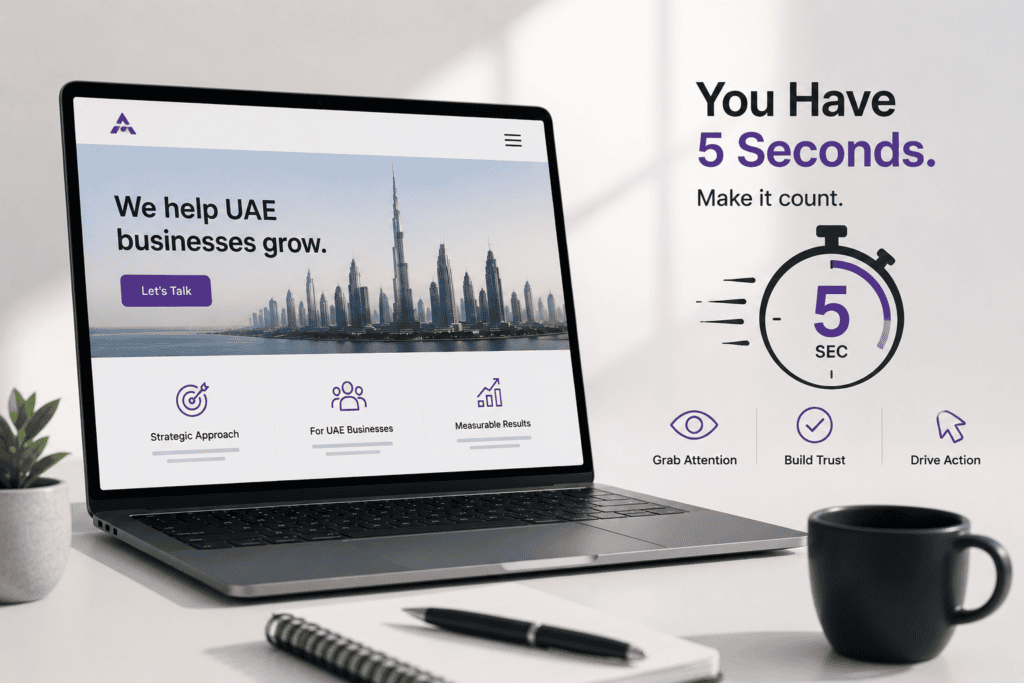
Introduction
You have spent money on ads, on SEO, on content, on social media. A potential client follows one of those channels to your website. Within 5 seconds of landing, they have already made a decision: stay and find out more, or leave and go back to Google.
Most UAE business websites fail this test. Not because they are poorly designed. Because they are designed to impress the business owner rather than to immediately answer the visitor’s most urgent question, which is: am I in the right place?
The 5-second test is not a metaphor. It is a documented, measurable phenomenon in user experience research, and it is directly responsible for a significant share of the high bounce rates that UAE businesses attribute vaguely to “bad traffic” or “wrong audience.” In most cases, the traffic is fine. The first 5 seconds are not.
What the 5-Second Test Actually Measures
The 5-second test is a user experience evaluation method that determines what impression a visitor forms from the above-the-fold section of your website in the first 5 seconds of viewing it. The test was originally developed as a formal research methodology where participants were shown a page for exactly 5 seconds before it was removed, then asked what they remembered and understood.
Informally, it maps to the real browsing behaviour of a visitor who has arrived from a search result, an ad, or a social media link and is making an instant, largely subconscious assessment of whether the page they have landed on is relevant to what they were looking for.
The test measures three things:
- Whether the visitor can identify what the business does
- Whether the visitor can identify who the business serves
- Whether the visitor understands what to do next
If a visitor cannot answer all three within 5 seconds, the statistical likelihood of them leaving immediately increases significantly.
Why 5 Seconds Is the Right Window
Eye-tracking and session recording research from platforms like Nielsen Norman Group and Hotjar consistently shows that users make relevance judgements about a new web page within 2 to 8 seconds. This has been replicated across markets, including mobile-heavy markets like the UAE where attention is particularly compressed.
For UAE businesses specifically, two factors make the 5-second window especially relevant.
First, mobile-dominant browsing means above-the-fold space is smaller than on desktop, which compresses how much information can communicate relevance before the visitor has to scroll. On a phone, your headline and one supporting line may be all that is visible without any action from the visitor.
Second, a multilingual, multicultural market means visitors bring different reading patterns, different trust signals, and different expectations to the same page. A message that communicates instantly to one visitor segment may require significantly more processing time from another. This makes the 5-second baseline even more critical to get right.
How to Run the 5-Second Test on Your Own Site
The self-test (quick version): Open your homepage on your phone with the screen brightness at normal and mobile data (not Wi-Fi) active. Look at it for exactly 5 seconds. Then lock the screen and ask yourself: what does this business do, who do they serve, and what should I do next? If you cannot answer all three from what you saw, you failed.
The external test (more reliable): Ask 3 to 5 people who have never visited your site to look at your homepage for 5 seconds, then describe what they understood about the business. Do not prime them by describing your business first. The gaps between what they understood and what you intended to communicate are your clarity failures.
The formal tool-based test: Services like UsabilityHub and Lyssna offer structured 5-second test tools that recruit panels of online participants to view your page and report their impressions. For a UAE audience, look for panels with relevant demographic characteristics, or supplement a general panel test with local qualitative feedback.
What Visitors Need to Know Within 5 Seconds
There are exactly three pieces of information a visitor needs from your above-the-fold section to decide to stay.
1. What you do. This sounds obvious but is the most commonly failed element of UAE business websites. A headline that reads “Empowering Businesses for a Better Tomorrow” tells a visitor nothing. A headline that reads “Digital Marketing for Service Businesses in Dubai” tells them everything they need to know within a second.
2. Who you do it for. The more specifically your headline or supporting line identifies the type of client you serve, the more confident the right visitor feels that they are in the right place. “We help Dubai clinics fill their appointment books through targeted digital marketing” is more powerful than any generic claim about excellence because it makes the specific right reader feel immediately identified.
3. What to do next. A visible, clear call to action that communicates the next step. Not “click here” or “learn more” but “Book a Free 20-Minute Strategy Call” or “See How We Work.” The visitor should not have to decide what step to take. The page should make it obvious.
Everything else, the portfolio, the case studies, the team bios, the blog, the full service list, is below the fold and will only be seen by visitors who were convinced to stay by the first 5 seconds.
The Most Common 5-Second Failures on UAE Websites
Tagline as headline. Substituting a brand tagline (“We Are Different” / “Your Success Is Our Mission”) for an actual description of what the business does. Taglines are not headlines. They do not answer the visitor’s question.
Feature-first framing. Leading with what the business offers rather than what the client gets. “We use proprietary AI-powered marketing technology” describes a feature. “More qualified leads for your Dubai clinic, within 90 days” describes an outcome. Outcomes win the first 5 seconds; features come later.
Visual-first, copy-second design. A full-screen background video, a large image carousel, or a hero illustration that pushes the headline and call to action to a position where it is less prominent than the visual. Visitors do not process video backgrounds in the first 5 seconds. They read text. If the text is competing visually with an image, the image usually wins and the message is lost. Every website design company in UAE operating at a professional level should run a 5-second clarity test on the homepage before considering any design final.
Multiple competing messages. A homepage that tries to communicate three different services to three different audience types in the first screen. Competing messages produce confusion, not clarity, and confused visitors leave.
No visible call to action above the fold. A beautifully written headline with no actionable next step leaves the visitor with good impressions but no direction. The call to action belongs above the fold, not at the bottom of the page.
As a web development agency in Dubai, BRB reviews homepage above-the-fold clarity as the first step of any website audit, before looking at speed, SEO, or any other technical factors, because none of those matter if the first 5 seconds fail.
How to Fix a Failed 5-Second Test
Rewrite the headline first. Use this structure as a starting framework: “We help [specific client type] achieve [specific outcome] through [specific method/service].” Then compress it to something that fits naturally on one or two lines. Test multiple versions with real people.
Remove the tagline from above the fold. Move it elsewhere or eliminate it. Your visitor does not know your brand yet. They need information, not inspiration.
Make the call to action impossible to miss. High-contrast button, action-specific language, placed immediately below or beside the headline, visible without scrolling on both desktop and mobile.
Cut everything else above the fold. Every element that is not the headline, the supporting line, and the call to action is a distraction from the 5-second test. Navigation, social links, awards, and partner logos all belong below where the visitor has committed to staying.
For a deeper look at how every element of a homepage should work together to convert the visitors who stay past the first 5 seconds, the article on what should a service business homepage actually say to convert a visitor covers the full conversion architecture.
FAQ
Is the 5-second test relevant for mobile-first UAE audiences specifically? Particularly relevant, because the above-the-fold area on mobile is smaller and the browsing context is more distracted. A headline that reads comfortably on a desktop and communicates in 3 seconds may require 7 seconds to read and process on a phone while commuting. Mobile should be the primary context in which you evaluate 5-second test performance.
How do I know if the problem is my headline or my visual design? Run the self-test with your eyes specifically on the text. If you can read and process the headline in 5 seconds and it clearly communicates what you do, the problem is likely the visual design competing with the text. If the headline itself is unclear, start there.
Does every page of my website need to pass the 5-second test? The 5-second test is most critical for pages that receive traffic from external sources: your homepage, landing pages, and any page linked directly from ads or social media. Interior pages reached through navigation by engaged visitors can carry more complexity.
Should the 5-second test result change by country for a UAE business? Yes. A UAE business with a significant Arabic-speaking audience should run the 5-second test with Arabic-speaking participants as well as English-speaking ones, since reading patterns and trust signals can differ meaningfully between the two groups.
Conclusion
The 5-second test is the most honest measurement of whether your UAE website is doing its primary job. Not whether it looks good. Not whether it loads fast. Whether a stranger can understand what you do and who you serve within the window they are actually willing to give you before deciding to leave.
Most UAE business websites fail it. Fixing it requires courage to strip away the taglines, the visual complexity, and the multiple competing messages in favour of one clear, specific, audience-identified statement with a single obvious next step.
The businesses generating the strongest enquiry rates from their websites in Dubai are almost universally the ones who made that simplification and committed to it. A digital marketing agency in UAE that measures homepage clarity as a core conversion metric will prioritise this above visual polish every time.