
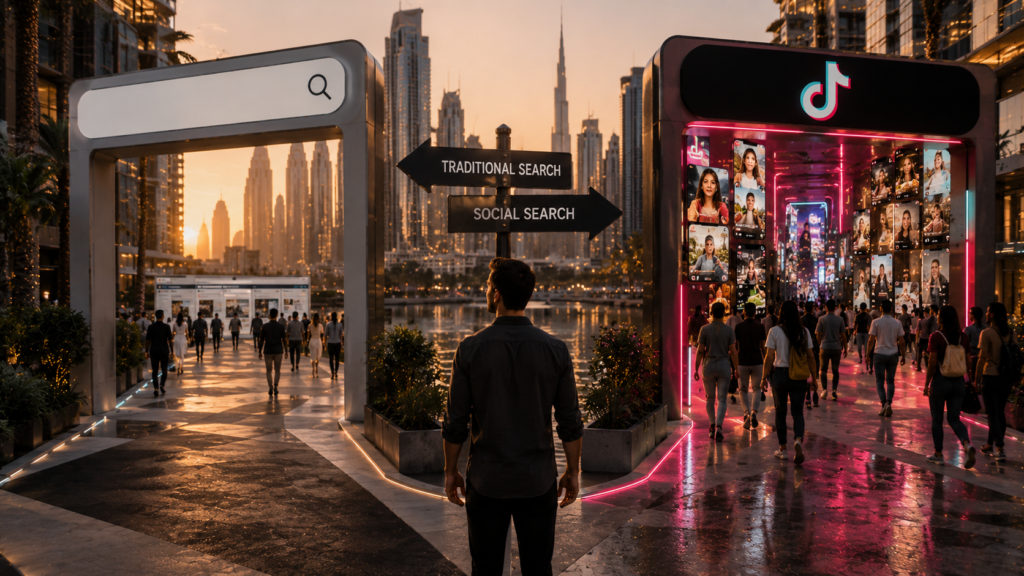
A growing body of consumer research points to the same conclusion: a meaningful share of consumers, roughly one in three by some recent surveys, now skip traditional search engines altogether and start their research directly on social platforms like TikTok, Instagram, or YouTube.
This is not a fringe behaviour confined to a small, younger demographic. It reflects a genuine shift in how an entire generation approaches discovery, treating social platforms as search engines in their own right, complete with the expectation of finding reviews, recommendations, and direct answers without ever typing a query into Google.
For UAE businesses, where social media adoption is already close to total and short-form video consumption is among the highest in the world, this shift is arguably more advanced than in many other markets. This article looks at what the data shows, why it matters specifically for the UAE, and what to actually do about it.
What the Data Actually Shows
Recent consumer research has found that close to a third of consumers skip Google altogether for at least some categories of search, instead beginning their research journey on networks like TikTok, Instagram, or YouTube. This behaviour is most pronounced among younger consumers but is no longer confined to Gen Z alone, with the habit increasingly visible across a broader age range as social search experiences mature.
This sits alongside other well-documented shifts in search behaviour, including the rapid growth of AI-assisted search through tools like ChatGPT and Perplexity. Together, these trends point toward a search landscape that no longer has a single dominant starting point, but is instead fragmented across multiple platforms depending on what a person is looking for and which platform they trust most for that specific type of decision.
Why Younger Consumers Are Bypassing Traditional Search
Visual and video answers feel more trustworthy for certain decisions. For categories like restaurants, beauty services, fashion, and travel, a short video showing the actual experience feels more credible and useful than a list of text-based search results.
Social platforms surface peer opinion more directly. Comments sections under a relevant video function similarly to reviews, often feeling more authentic and unfiltered than curated testimonials on a business website.
The discovery and decision loop happens in one place. A consumer can watch a recommendation, read comments, check the creator’s or business’s profile, and message a question, all without leaving the app, which is faster and lower-friction than navigating between a search engine and multiple individual websites.
Search behaviour has become more conversational and exploratory. Rather than typing a precise keyword, social search behaviour often looks more like scrolling and discovering, closer to browsing than searching in the traditional sense.
What “Social Search” Actually Looks Like in Practice
A consumer deciding where to eat in Dubai might search directly within TikTok or Instagram for the restaurant’s name or a relevant hashtag rather than typing the query into Google. A consumer choosing a skincare clinic might search “best skincare clinic Dubai” directly inside TikTok’s own search bar, expecting to find creator reviews and clinic-posted content rather than a Google results page.
This means a business’s visibility within a platform’s own internal search function, not just its visibility on Google, has become a meaningful and previously under-considered part of overall discoverability.
Why This Matters Even More in the UAE
Near-total social media adoption. With adoption rates among UAE adults exceeding 100% of the population once duplicate accounts are factored in, the addressable audience for social search behaviour is unusually large relative to the country’s population.
Among the highest short-form video consumption rates globally. UAE residents spend close to three hours a day on social platforms on average, providing ample opportunity for social search habits to form and deepen.
A young, digitally fluent, expat-heavy population. The demographic profile most associated with social-first search behaviour, younger, mobile-native, and comfortable navigating multiple platforms simultaneously, describes a significant share of the UAE’s population.
High competition on Google already pushes businesses toward alternative channels. In competitive UAE service categories where Google ranking is expensive and difficult to win, social search represents a genuinely less saturated discovery channel for many businesses. A social media agency in Dubaiworking across competitive categories like real estate and beauty has seen this channel deliver enquiries at a lower cost than equivalent Google ad spend for several clients.
How to Make Your Business Findable in Social Search
Optimise captions and on-screen text with the same intent as SEO keywords. Platforms like TikTok and Instagram index caption text and increasingly on-screen text within their own search functions, meaning the same keyword thinking that applies to a website applies to social captions as well.
Use your business name and location consistently and explicitly. Mentioning your business name and city clearly in captions and video content increases the likelihood of surfacing when someone searches for that combination directly within the platform.
Treat your bio and profile as a landing page. A platform’s internal search results often lead a viewer to a profile before a specific piece of content, making a clear, complete bio with a working contact link essential.
Encourage and respond to comments actively. Comment activity functions as a trust and relevance signal within platform search and discovery algorithms, similar to the role reviews play on Google.
Produce content that directly answers likely search queries. A video titled or captioned around a specific question, “best [service] in Dubai” or “how much does [service] cost in UAE,” mirrors how people are now searching directly inside these platforms.
A viral content agency in Dubai producing content with this dual purpose, built for organic discovery and platform-native search, in mind will typically structure captions and video titles more deliberately than a business treating social media purely as a broadcast channel.
What Stays the Same
Despite this shift, Google and traditional SEO have not become irrelevant. High-intent, comparison, and research-stage queries, particularly for higher-value services like legal, financial, real estate, and B2B categories, still flow heavily through Google and increasingly through AI search tools layered on top of it.
The realistic picture for most UAE businesses is not a wholesale move away from Google, but a need to be genuinely present and findable across several discovery channels simultaneously: traditional search, AI search, and now platform-native social search, each capturing a different segment of the buyer journey.
For a deeper look at how AI search specifically is reshaping discovery alongside this social search shift, the article on what happens to your leads when you rank on Google but not on AI search covers the parallel structural change happening on the AI side of search.
FAQ
Does this mean Google is becoming irrelevant for UAE businesses? No. Google remains essential, particularly for high-intent and comparison-stage queries. Social search represents an additional discovery layer, not a replacement for traditional and AI search visibility.
Which UAE business categories are most affected by the shift toward social search? Consumer-facing categories with strong visual or experiential components, such as food and beverage, beauty and wellness, fashion, and travel, tend to see the most pronounced social search behaviour, though the trend is broadening across other categories as well.
Do I need a different content strategy for platform search versus general social media engagement? Largely the same content works for both, but captions, video titles, and on-screen text should be written with searchable, specific language in mind, similar to how a website page would be optimised for a Google keyword.
How do I know if people are finding my business through platform search specifically? Most platforms provide some visibility into how content was discovered within their creator or business analytics tools, including whether views came from search, the For You feed, or hashtag pages.
Conclusion
The shift toward social-first search behaviour reflects a genuine change in how a significant share of consumers discover and evaluate businesses, and the UAE’s combination of near-total social adoption and high short-form video consumption makes this shift especially relevant locally.
The response is not to abandon traditional SEO, but to treat your social media captions, profiles, and content with the same search-intent thinking that has long applied to a website. The businesses capturing this overlooked channel today are building visibility in a space that remains far less competitive than Google, for now. A digital marketing agency in UAE that treats social captions as searchable content, not just creative copy, will typically see this advantage first.