
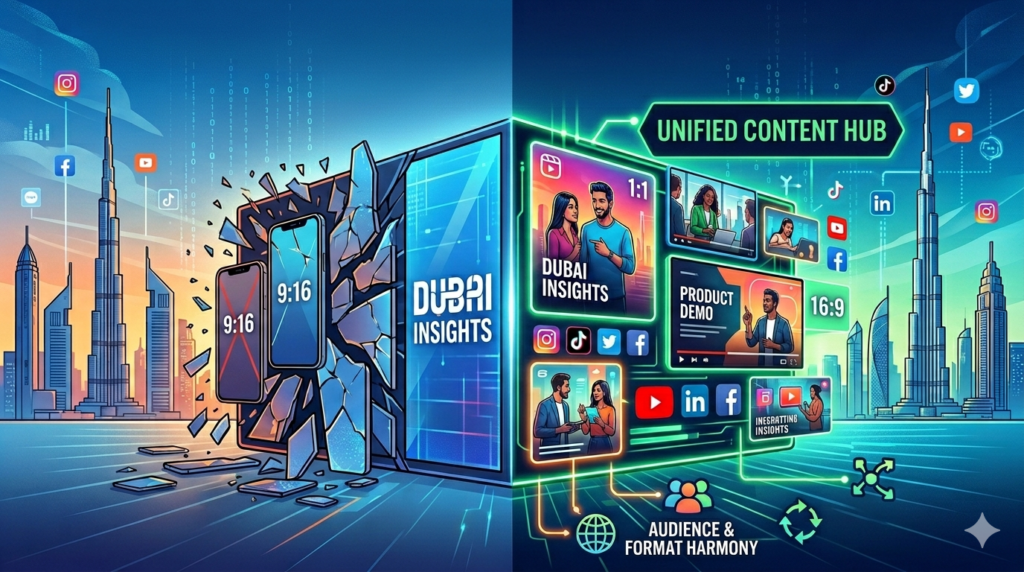
Vertical video was the standard for years. Instagram Stories, TikTok, and Reels trained an entire generation of marketers to think in 9:16. Businesses invested in vertical content because that’s what platforms prioritized. Then the algorithm shifted, user behavior changed, and suddenly vertical isn’t enough.
In 2026, the format dominating UAE social media isn’t vertical or horizontal. It’s hybrid, adaptive, and designed for multi-platform distribution from the start. Businesses still creating content in only one aspect ratio are losing reach, engagement, and the ability to compete across platforms. This shift isn’t coming. It’s already here.
Why Vertical Video Stopped Working
Vertical video didn’t die because it’s bad. It stopped working because platforms evolved and so did how people consume content.
Platform algorithms now prioritize engagement over format
For years, platforms like Instagram and TikTok gave preferential treatment to vertical content. Posting a horizontal video meant lower reach. But in late 2025, both platforms shifted their algorithms to prioritize watch time, saves, and shares over format compliance.
What this means is that a well-executed horizontal or square video that keeps people watching will now outperform a mediocre vertical video. Format alone no longer guarantees distribution.
Multi-platform distribution requires flexibility
Businesses don’t post on just one platform anymore. They need content that works on Instagram, TikTok, LinkedIn, YouTube, Facebook, and increasingly on AI-driven platforms where video previews appear in search results.
Vertical content works on Stories and Reels, but it’s cropped awkwardly on YouTube and LinkedIn. Horizontal works on YouTube but wastes space on mobile feeds. Square works everywhere but isn’t optimized for anything.
The solution is hybrid content designed with adaptability in mind from the first frame.
Users are consuming content in more contexts
People don’t just scroll vertically anymore. They watch videos in full-screen, they cast content to TVs, they share clips on WhatsApp where aspect ratio varies. A single rigid format doesn’t serve all these use cases.
Content that adapts to context performs better because it meets users where they are instead of forcing them into one viewing experience.
What Hybrid Content Actually Means
Hybrid content isn’t about posting the same video in different sizes. It’s about creating content with flexible framing, modular editing, and platform-specific optimization built in from the start.
Shoot for the edit, not the platform
The best creators in the UAE are now shooting in 4:3 or 1:1 because it gives them the flexibility to crop for any platform without losing key visual elements. The action stays centered, text overlays are placed in safe zones, and nothing critical sits in areas that get cut off when reformatted.
This approach means one shoot can produce multiple aspect ratios without reshooting or compromising quality.

Design for sound-off and sound-on
Not every platform prioritizes audio the same way. Instagram Reels and TikTok lean heavily on music and voiceover. LinkedIn and Facebook feeds often play videos muted by default. Hybrid content is structured to work both ways.
Use captions, on-screen text, and visual storytelling that makes sense without audio. Then layer in sound that enhances the experience for those who turn it on.
Think in story arcs, not single clips
The most effective content in 2026 is modular. A single concept is broken into hooks, value delivery, and calls to action that can be rearranged, shortened, or extended depending on the platform.
A 60-second TikTok becomes a 15-second Instagram Reel, a 3-minute YouTube short, and a series of carousel stills for LinkedIn. This isn’t repurposing. It’s designing content with distribution flexibility from the beginning.
For businesses that want to understand the mechanics behind content that spreads, what makes business content go viral on social media in 2025? explains the patterns that drive real engagement.
The New Formats That Are Actually Working
Here are the content structures and formats that are outperforming traditional vertical video across UAE social media in 2026.
1:1 square with dynamic cropping
Square video gives you maximum flexibility. It works on feed posts, Stories, Reels, and YouTube without major cropping issues. Platforms are increasingly auto-cropping square content to fit vertical or horizontal displays, which means you maintain quality across formats.
This is particularly effective for product demos, tutorials, and explainer content where you need consistent framing across platforms.
Carousel-style video with text overlays
Instead of one continuous video, break content into distinct sections with bold text transitions. Each section delivers one idea, making it easy to stop and scroll back or share specific parts.
This format works because it mirrors how people consume information on social media—in digestible chunks, not long narratives. It also makes content easier to repurpose. Each section can become a standalone post if needed.
Talking-head content with adaptive framing
Talking-head videos aren’t new, but how they’re shot has changed. Creators are framing subjects in the center third of the frame with generous headroom and side space. This allows the video to be cropped vertically for Stories or horizontally for YouTube without cutting off the speaker.
The key is intentional composition during filming, not trying to fix it in post-production.
Hybrid horizontal with vertical cutdowns
Some businesses are flipping the strategy entirely. They shoot horizontal first for YouTube and long-form content, then create vertical cutdowns optimized for short-form platforms. This works especially well for educational content, interviews, and behind-the-scenes material where the horizontal format feels more natural.
The vertical versions highlight key moments, drive curiosity, and send viewers to the full horizontal video for depth.
Why Most Businesses Are Still Getting This Wrong
Even businesses that understand the shift toward hybrid content struggle to execute it properly. Here’s where the mistakes happen.
They repurpose instead of redesigning
Taking a vertical video and cropping it into a square or horizontal format isn’t hybrid content. It’s lazy distribution. Real hybrid content is designed from the start to work across formats without losing quality or message clarity.
Repurposing leads to awkward framing, cut-off text, and visuals that don’t translate. Redesigning means shooting and editing with flexibility as the foundation.
They prioritize aesthetics over distribution
A beautifully shot vertical video that only works on Instagram is less valuable than a strategically framed square video that performs across five platforms. Aesthetic perfection doesn’t matter if your content isn’t reaching the right people.
Distribution flexibility should be the priority. Aesthetics should support that goal, not override it.
They don’t test platform-specific edits
Not every platform needs the same version of your content. A 60-second TikTok might need to be 30 seconds on Instagram and 90 seconds on YouTube to match platform-specific engagement patterns.
Businesses that post identical content everywhere are missing the nuance of how each platform’s audience consumes video. Small tweaks in length, pacing, and hooks can dramatically change performance.
For companies that want to create content designed to generate leads instead of just views, how to create viral short-form videos that generate leads? provides a tactical framework.
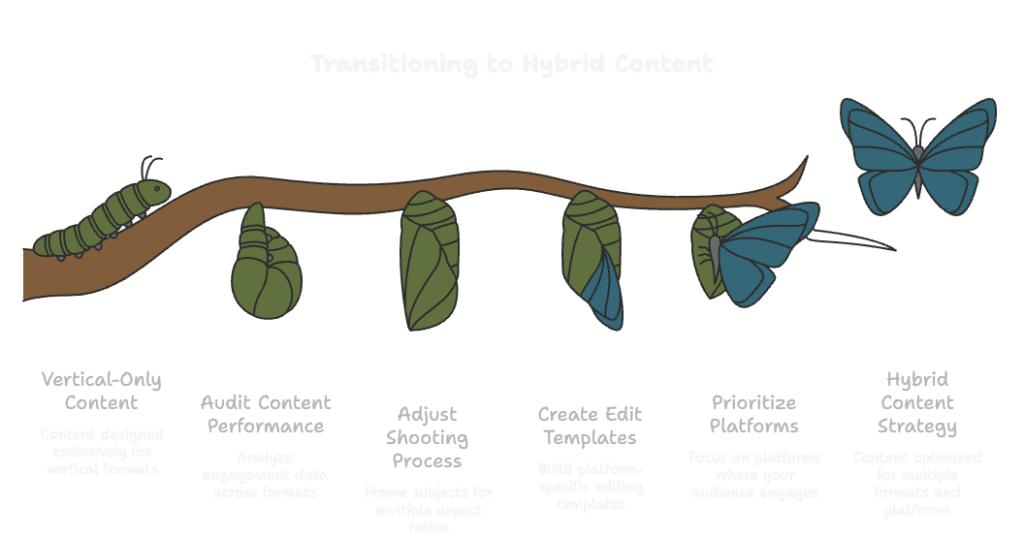
How to Transition Your Content Strategy
Shifting from vertical-only to hybrid content doesn’t require starting over. It requires adjusting how you shoot, edit, and distribute.
Audit your current content performance by format
Pull data from the last three months. Compare engagement rates, watch time, and shares across vertical, horizontal, and square content. Look for patterns. Are certain formats consistently underperforming? Are others getting better reach?
This gives you a baseline to understand what’s working and where the gaps are.
Adjust your shooting process
When planning your next content shoot, frame subjects and key visuals in the center of the shot. Leave space on all sides so you can crop without losing critical elements. Test how the shot looks in vertical, square, and horizontal before finalizing.
This doesn’t require expensive equipment. It’s a composition decision that costs nothing but saves hours in post-production.
Create platform-specific edit templates
Build templates for each platform that account for aspect ratio, text placement, and pacing. This speeds up distribution and ensures consistency across formats.
Templates also make it easier to delegate editing to team members or freelancers without sacrificing quality.
Prioritize platforms based on where your audience actually engages
Not every platform deserves equal attention. If your audience is primarily on Instagram and LinkedIn, focus your hybrid content strategy there. Don’t waste time optimizing for TikTok if your target market isn’t using it.
Distribution should be strategic, not scattershot.
What Platforms Are Prioritizing in 2026
Each platform has shifted its priorities in ways that impact how hybrid content performs.
Instagram values saves and shares over views
Instagram’s algorithm now weights saves and shares more heavily than raw view counts. This rewards content that people want to reference later or send to friends.
Hybrid content that’s educational, tactical, or highly relatable gets saved and shared more often than purely entertaining content.
TikTok is rewarding longer watch times
TikTok extended video length limits and started prioritizing content that keeps people watching beyond the first few seconds. Longer, value-driven content is outperforming quick trends.
This doesn’t mean abandoning short-form. It means structuring content to hold attention longer through pacing, storytelling, and payoff.
LinkedIn is pushing native video over links
LinkedIn’s feed now prioritizes native video uploads over external links. Posting a YouTube link gets less reach than uploading the video directly to LinkedIn.
For B2B businesses, this means creating LinkedIn-specific versions of content instead of relying on cross-posting.
YouTube Shorts is competing aggressively with TikTok
YouTube Shorts is investing heavily in distribution and monetization. Creators who post Shorts alongside long-form content are seeing significant traffic growth.
Hybrid content that works on TikTok can be easily adapted for Shorts, giving you two high-reach platforms with minimal extra effort.
The Role of AI in Adaptive Content Creation
AI tools are making hybrid content easier to produce at scale. From automated cropping to dynamic text overlays, technology is removing the technical barriers that used to make multi-format content time-intensive.
AI-powered editing tools handle aspect ratio adjustments
Tools like Descript, Kapwing, and Adobe’s Sensei can automatically reframe video for different aspect ratios while keeping subjects centered. This cuts editing time dramatically and ensures consistency across formats.
Text-to-video generators create modular content
AI can now generate short video clips based on text prompts, making it easier to create modular content designed for hybrid distribution. These tools are particularly useful for explainer content, product demos, and educational posts.
Analytics platforms track performance across formats
AI-driven analytics tools aggregate performance data across platforms, showing you which formats and edits drive the most engagement. This removes guesswork and helps you double down on what’s working.
Businesses working with a viral content agency in Dubai are increasingly using these tools to streamline production and maximize reach across platforms.
FAQ
Is vertical video completely dead, or does it still work in some contexts?
Vertical video still works on Stories, Reels, and TikTok, but it’s no longer the dominant format. Hybrid content designed for flexibility performs better across platforms and gives you more distribution options.
What’s the best aspect ratio for shooting content in 2026?
4:3 or 1:1 gives you the most flexibility. You can crop to vertical, horizontal, or square without losing key visual elements. Avoid shooting in 9:16 unless the content is exclusively for Stories or TikTok.
Do I need to reshoot all my old content?
No. Focus on creating new content with hybrid formats in mind. You can repurpose high-performing old content by cropping strategically, but don’t waste time redoing everything.
How do I know which platforms to prioritize?
Look at where your audience is most active and where your content performs best. For B2B, that’s often LinkedIn and YouTube. For consumer brands, Instagram and TikTok still dominate. Don’t spread resources across platforms that don’t drive results.
What’s the biggest mistake businesses make with hybrid content?
Treating it like repurposing instead of redesigning. Hybrid content should be planned and shot with multi-platform distribution in mind, not retrofitted after the fact.
How long does it take to see results from switching to hybrid content?
Most businesses see improved engagement within 30 to 60 days if they’re consistently posting optimized content. Results depend on content quality, posting frequency, and platform-specific strategy.
Adapt or Get Left Behind
The businesses winning on social media in 2026 aren’t the ones with the biggest budgets or the flashiest content. They’re the ones designing for distribution flexibility, testing platform-specific edits, and staying ahead of format shifts.
Vertical video served its purpose, but the landscape has moved on. Hybrid content is the standard now, and businesses that don’t adapt will watch their reach decline as competitors figure it out.
Shoot smarter. Edit strategically. Distribute everywhere that matters. That’s how you stay visible in a market that’s constantly evolving.