For years, SEO in the UAE meant finding the right keywords, placing them in the right locations on a page, and building links. That model is not broken, but it is significantly incomplete in 2026.
Google now understands meaning, not just words. It identifies entities, which are distinct, real-world things like businesses, people, places, and concepts, and it maps relationships between them. When someone searches for “best accountant in Dubai,” Google is not just matching keyword strings. It is identifying which entities in its knowledge base are classified as accountants, are associated with Dubai, and have the strongest trust and relevance signals.
If your business is not a well-defined entity in Google’s knowledge model, your keyword rankings will always be fragile, regardless of how well you have optimised individual pages.
This article explains what entity-based SEO is, why it matters for UAE service businesses in 2026, and exactly how to establish your business as a credible, well-understood entity.
What Is Entity-Based SEO?
Entity-based SEO is the practice of optimising your digital presence so that Google clearly understands who you are, what you do, where you operate, and how you relate to other entities in your industry, rather than just whether your website contains the right keywords.
An entity, in Google’s definition, is any distinct thing with a clear identity. This includes:
- Businesses and organisations
- People (authors, founders, experts)
- Locations (Dubai, the UAE, specific neighbourhoods)
- Concepts and topics (digital marketing, physiotherapy, real estate)
- Products and services
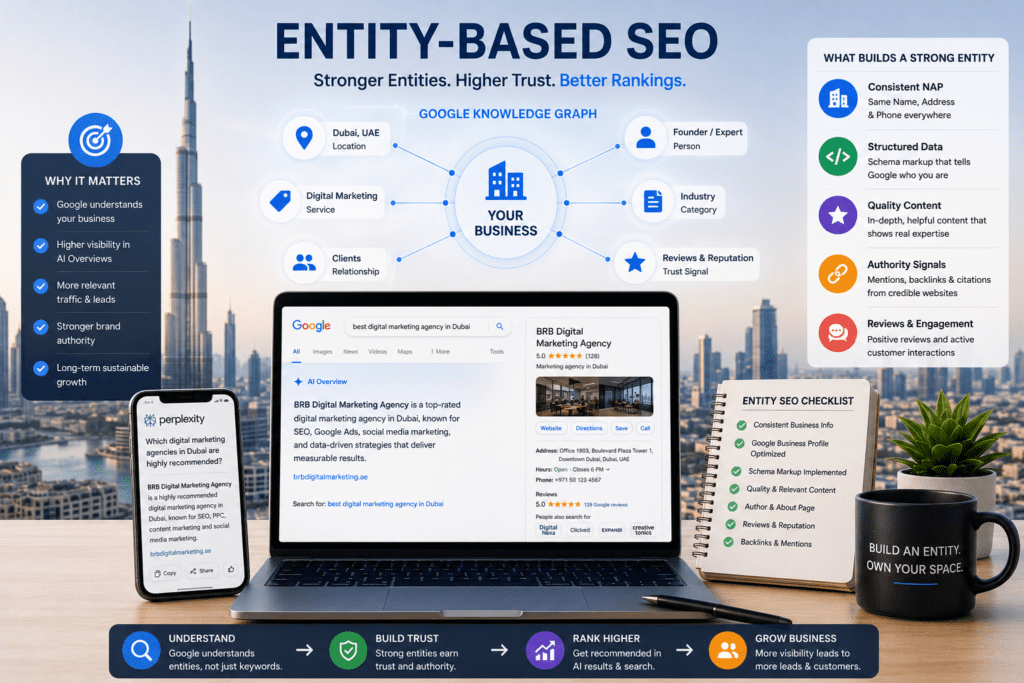
Google’s Knowledge Graph is the database where these entities and their relationships are stored. When your business is clearly defined in this graph, Google can confidently include you in recommendations, AI Overviews, and local results for relevant queries.
When your business is not clearly defined, or is confused with another entity, Google reduces the confidence with which it recommends you.
Why Google Moved Beyond Keywords
Google’s shift toward entity understanding was driven by the fundamental limitation of keyword-based search: the same words mean different things in different contexts.
“Jaguar” means the car brand, the animal, or a Jacksonville NFL team depending on context. “Mercury” is a planet, a chemical element, a Roman god, and a car brand. A keyword-based system cannot reliably distinguish these meanings.
Google addressed this through a sequence of algorithm updates:
- Hummingbird (2013): Began processing search queries as full questions rather than keyword strings
- RankBrain (2015): Applied machine learning to understand the intent behind queries
- BERT (2019): Enabled understanding of word context within a sentence
- MUM (2021) and beyond: Introduced multimodal understanding across topics, languages, and formats
By 2026, Google’s understanding of entities and their relationships is sophisticated enough that a search for “spine surgeon specialising in disc problems Dubai” will return results for entities that match that specific description, not just pages that contain all those words.
How the Google Knowledge Graph Affects UAE Businesses
The Google Knowledge Graph is Google’s structured database of facts about entities and their relationships. When your business has a strong Knowledge Graph presence, several things happen:
Visible benefits:
- A Knowledge Panel appears in search results when people search your brand name
- Your business is included in “best of” and comparison-type results more consistently
- Google AI Overviews and Gemini are more likely to reference your business by name
- Related entity connections increase your visibility in topically adjacent searches
Behind-the-scenes benefits:
- Google interprets your content with higher confidence because it knows the entity behind it
- Topic authority signals carry more weight when they are attached to a clearly defined entity
- Your pages are less likely to be deprioritised due to entity ambiguity
How UAE businesses can check their Knowledge Graph status: Search your business name on Google. If a Knowledge Panel appears on the right side of the results with your business information, you have Knowledge Graph presence. If no panel appears, your entity definition is incomplete or unestablished.
What Makes a Business an Entity in Google’s View? {#what-makes}
For Google to treat your business as a well-defined entity, it needs to find consistent, corroborating information about you from multiple sources.
Entity establishment signals:
Consistency signals:
- The same business name, address, and contact information across your website, GBP, and all directory listings
- A consistent business description across platforms using the same core language
Authority signals:
- Your business is mentioned by credible third-party sources (industry directories, news mentions, review platforms)
- Your website has been active for a meaningful period of time
- Other established entities (publications, businesses, organisations) reference you
Structured data signals:
- Your website uses Schema.org markup to explicitly declare what type of entity you are (LocalBusiness, Organisation, MedicalBusiness, etc.)
- Your content uses named entity references (mentions of Dubai, UAE, specific services by their accepted names)
People signals:
- Your business is associated with real, named individuals who have their own entity presence
- Author schema on articles and a clear About page with named team members strengthens the people-entity connections
How to Build Your Business as a Recognised Entity
Step 1: Create a complete, entity-rich About page This page should clearly state your business name, founding information, location, specific services, the team or founder, and your relationship to the Dubai/UAE market. It is your entity definition page.
Step 2: Implement comprehensive structured data Add LocalBusiness, Organization, Service, and Person schema to the relevant pages on your website. These are explicit declarations to Google about what type of entity you are and how you relate to other entities.
Step 3: Build consistent NAP citations NAP stands for Name, Address, Phone number. Ensure these three elements are identical across your website, GBP, and every directory your business appears in. Inconsistency creates entity confusion.
Step 4: Claim and optimise all relevant profiles This includes Google Business Profile, Bing Places, Apple Maps, LinkedIn company page, and any industry-specific directories. Each is a data point that confirms your entity to search engines.
Step 5: Earn editorial mentions A mention of your business in an established publication, a guest article in a relevant industry resource, or a citation in a news article contributes to entity authority in a way that self-published content cannot.
Step 6: Build author entities for key individuals If you or your team members produce content, create dedicated author bios with consistent information across all platforms where they publish. Author entities strengthen the overall entity graph of the business.
For UAE businesses wanting to understand how entity-based optimisation fits into the broader shift from traditional SEO to AI search visibility, the article on what is the difference between SEO and GEO for businesses is a useful companion read.
The Generative Engine Optimization Dubai services that BRB provides are built around entity establishment as a foundational element, because without it, all other GEO tactics operate on an unstable foundation.
Entity-Based SEO vs Traditional Keyword SEO: A Practical Comparison
Traditional keyword SEO approach:
- Research keywords with search volume
- Place keywords in title, H1, H2, meta description, and body
- Build links from external sites
- Repeat for new target keywords
Entity-based SEO approach:
- Establish what type of entity the business is and who it serves
- Build consistent identity signals across all digital touchpoints
- Create content that Google can associate with a specific entity and topic cluster
- Earn third-party mentions that corroborate the entity’s attributes
Key differences:
| Factor | Keyword SEO | Entity SEO |
| Primary focus | Individual page ranking | Overall entity authority |
| Core tactics | On-page keyword placement | Entity consistency, structured data, citations |
| Time to results | Weeks to months | Months to years (but more durable) |
| Impact on AI search | Limited | Direct and significant |
| Vulnerability | Algorithm updates targeting specific techniques | Lower (entity signals are harder to manipulate) |
| UAE relevance | Effective for immediate ranking needs | Essential for long-term visibility and AI recommendation |
The most effective approach for UAE service businesses in 2026 combines both: keyword optimisation for immediate relevance, entity building for durable authority.
FAQ
Is entity-based SEO replacing keyword SEO entirely? No. Keywords are still how search engines initially match queries to content. Entity-based SEO provides the authority layer that determines which matching content is ranked and recommended most prominently. Both are necessary.
How long does it take to establish entity presence in Google’s Knowledge Graph? Building Knowledge Graph presence for a new or small business typically takes 3 to 12 months of sustained effort. The timeline depends on the volume and quality of third-party mentions and the consistency of structured data signals.
Can a small UAE business with a new website build entity authority? Yes. Entity authority is built through consistency and corroboration, not just age or size. A new business that implements structured data correctly, maintains consistent NAP citations, and earns even a few relevant third-party mentions will build entity signals faster than a larger business with inconsistent or absent entity optimisation.
What is the easiest first step for entity-based SEO? Implementing LocalBusiness schema on your website’s homepage and Contact page. This is a 30-minute technical task for most websites and provides an immediate, explicit entity declaration to Google.
Does entity-based SEO help with Arabic search queries? Yes. Entity signals are language-independent. A business entity that is well-defined in Google’s Knowledge Graph will benefit from that definition, whether the query is in Arabic, English, or another language commonly used in UAE search.
Conclusion
Entity-based SEO is not a new tactic to layer on top of existing keyword strategies. It is a fundamental shift in how search engines understand and evaluate businesses, and it is already determining which UAE businesses appear in AI-generated recommendations.
The businesses in Dubai and across the UAE that will dominate search visibility over the next three to five years are not necessarily the ones with the highest keyword density or the most backlinks. They are the ones that Google most clearly understands as specific, authoritative entities in their field.
Start with structure and consistency. Define your entity explicitly through structured data, consistent citations, and an authoritative About page. Then build the content and third-party presence that corroborates what you have declared.
The keyword era is not over. But the entity era is already here.