
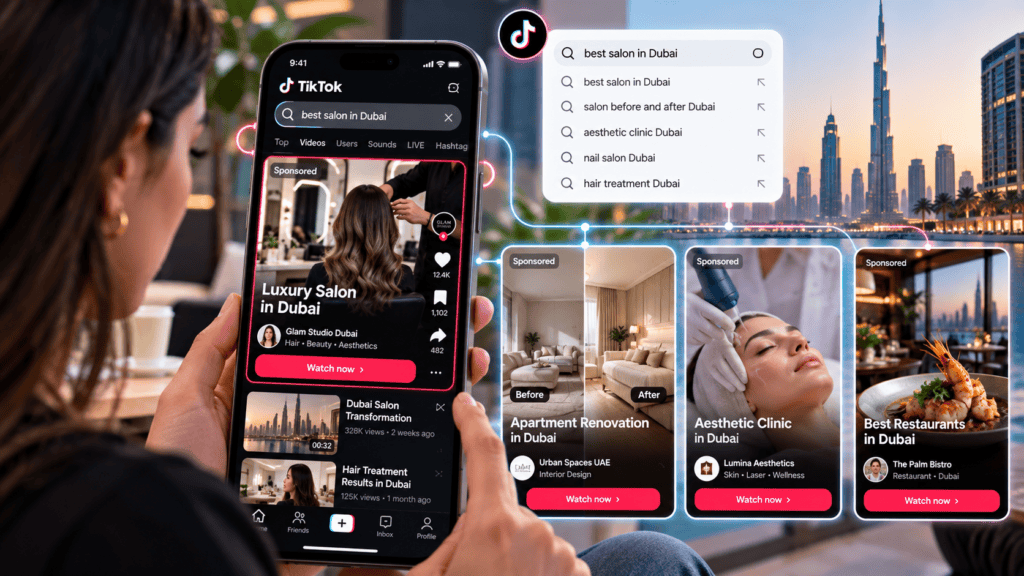
Most people think of TikTok as a feed. You open the app, the algorithm decides what you see, and you either stop scrolling or you do not. That model is still accurate for the majority of TikTok usage. But a growing share of TikTok activity looks different: users searching. Typing queries. Looking for something specific.
TikTok’s internal data consistently shows that a significant percentage of users use TikTok search to research products, find tutorials, and look for service recommendations. In the UAE, where TikTok has 15.5 million users and growing search adoption among the 18 to 34 demographic that dominates it, this behaviour is commercially meaningful.
TikTok Search Ads, now available to advertisers in the UAE market, let businesses appear at the top of those search results. This is not an extension of the feed ad product. It is a different placement, with different intent dynamics, that requires a different creative approach.
What the Placement Actually Looks Like
When a UAE user searches “best salon in Dubai” or “interior design before and after UAE,” TikTok returns a results page mixing organic videos with labelled sponsored placements. The Search Ads Toggle in TikTok Ads Manager activates this placement by connecting your existing video content to relevant keyword queries.
Unlike Google search ads, which use text to match intent, TikTok search ads reach users through video at the moment they have expressed intent. The combination is genuinely unusual: the precision of search-triggered delivery with the visual persuasion of video content. A user who searched for Dubai interior design ideas and immediately sees a before-and-after reveal from a real project is receiving highly targeted content in the format they trust most on the platform.
The intent quality is higher than feed advertising. The creative bar is lower than polished brand production. A UAE business that already produces content for TikTok has most of what it needs.
Which UAE Business Categories Have the Clearest Case
Not every business should run TikTok Search Ads. The format favours categories where seeing drives decision-making.
Strong fit: Interior design and home renovation, beauty salons and aesthetic clinics, restaurants and cafes, real estate project marketing, fitness and wellness, fashion and lifestyle retail. These are categories where a well-executed video is the most convincing proof available, and where TikTok’s audience has demonstrated genuine research intent.
Weaker fit: B2B professional services, legal and financial advisory, niche technical services. The search volume exists at a lower level, the content format suits the category less naturally, and the audience profile is less aligned with TikTok’s UAE demographics.
For visual-output categories, the investment case is strong simply because the creative already exists. A viral content agency in Dubai managing video production for a UAE interiors brand or aesthetic clinic can activate the search placement with content already being produced for the feed. The marginal cost of adding search is low when the content pipeline is already running.
The First-Two-Seconds Problem
Every TikTok ad format shares one constraint: you have about two seconds to earn the continued watch of someone scrolling past. Search ads differ slightly because the user has expressed intent, they are less likely to scroll away immediately, but the opening frames still set up or undermine everything that follows.
What the first two seconds should deliver in a search context: show the result. Not the process, not the brand, not a hook designed to create curiosity. Show what the user searched for. A user who searched “Dubai apartment renovation” wants to see the apartment. A user who searched “aesthetic clinic Dubai” wants to see the procedure environment or a before-and-after. Delivering the search answer in the first frame earns the continued watch that the ad’s commercial message then benefits from.
What the first two seconds should not be: a logo, an ambient brand shot, a slow reveal, or text that tells the viewer what they are about to see rather than simply showing it. What the first two seconds of a business reel should actually look like covers this in detail with the specific creative decisions that change watch-time outcomes at that moment.
Text overlays in the first frame serve a useful function in search ads specifically: confirming that the content matches the query. “Dubai apartment renovation, 62sqm” or “Before and after: Business Bay salon” gives the searching user immediate confirmation that they found relevant content.
How to Build Your Keyword List
TikTok search keywords behave differently from Google keywords. They are more conversational, more discovery-oriented, and more likely to be phrased as descriptors of content rather than direct commercial requests.
A user on Google might search “interior designer Dubai.” On TikTok they are more likely to search “Dubai apartment transformation” or “small bedroom makeover UAE.” The intent is similar, the phrasing is different, and a keyword list built by copying Google terms will miss the queries that TikTok users actually type.
TikTok Ads Manager includes a keyword research tool within the campaign setup. Use it. It shows actual TikTok search volume for relevant terms and is more accurate than manual estimation. A content strategy Dubai brief for search ads should start with TikTok’s own keyword data rather than assumptions from other platforms.
Comment Sections Are Part of the Ad
TikTok search ads generate public comments. This is not optional behaviour that can be disabled. Users who see your ad comment on it, and those comments are visible to every subsequent viewer of the same ad. This makes comment management a direct component of ad performance.
A UAE business running search ads without monitoring comments is publishing an ad whose trust impact is being decided by unmanaged public feedback. Positive comments from satisfied customers increase conversion. Unresponded complaints reduce it. Social media management Dubai for clients running TikTok campaigns should include comment monitoring as a standard deliverable, not an optional add-on.
Should Your UAE Business Test This Now?
The case for testing TikTok Search Ads now, before competition increases, is straightforward: UAE search results on TikTok are not crowded yet. The cost of reaching a searching user in your category is lower than it will be once more advertisers discover the placement. First-mover advantage in a relatively new ad format with genuine intent signals is a real commercial opportunity for UAE businesses in high-visual categories.
The case against is simple: if your content is not good enough for the feed, it will not work for search. The placement amplifies content quality rather than compensating for weak creative. If video production quality is the constraint, address that first.
A digital marketing for UAE service businesses approach that adds TikTok search alongside existing paid channels should be positioned as an early test with a defined budget and a 60-day evaluation window, not a full channel commitment. Test it on two or three campaign-ready pieces of existing content and let performance data inform the next decision.
For the broader context of how TikTok fits alongside other short-form video platforms for UAE businesses, YouTube Shorts vs Reels vs TikTok: which performs best for UAE businesses and how to create viral short-form videos for UAE audiences give the platform comparison and creative framework this article assumes as background.
And for the parallel development on YouTube’s shopping-and-search integration, YouTube Shopping for UAE business channels covers how a very different platform is building its own version of intent-plus-video commerce.