
Introduction
Most service business websites in Dubai have the same problem. They look professional, load quickly, and feature clean design. But they do not convert.
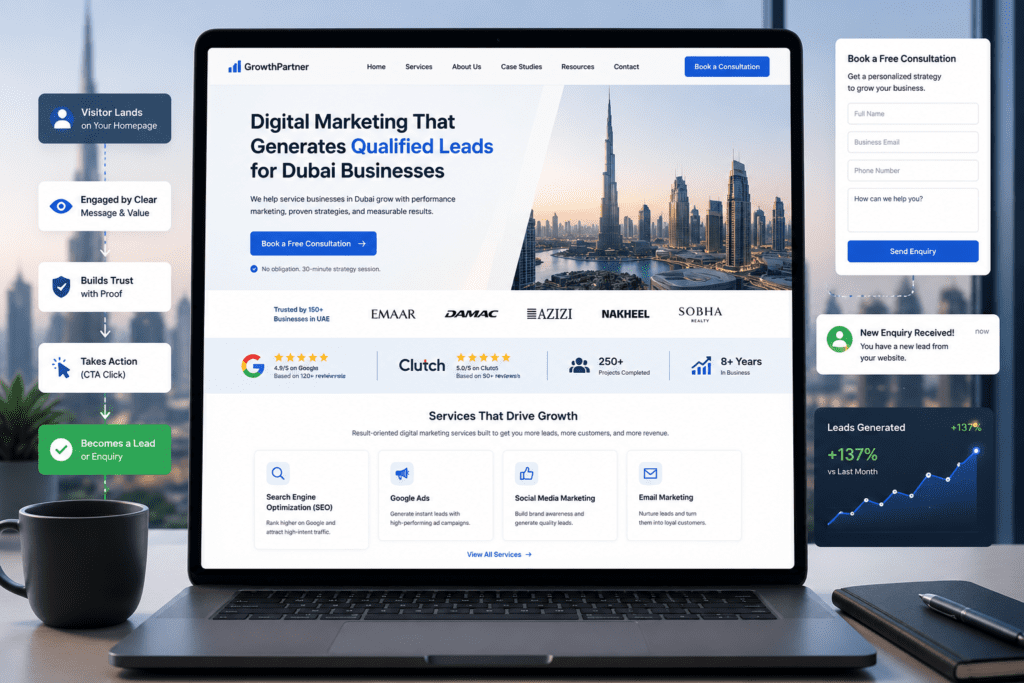
A visitor lands on the page, reads a few lines, and leaves. No enquiry. No call. No form submission. The business owner assumes the traffic is wrong or the niche is too competitive. In most cases, the real problem is the homepage copy.
Your homepage is not a brochure. It is a conversation. A visitor arrives with a problem, a question, or a specific need. Your homepage has roughly 8 seconds to make them feel they are in exactly the right place. If it fails to do that, they go back to Google and click the next result.
This article covers exactly what a Dubai service business homepage needs to say, in what order, and why every element matters.
Why Most Service Business Homepages Fail
Homepage failure almost always comes down to three things:
- Talking about the business instead of the customer. “We are a leading provider of premium solutions” tells the visitor nothing useful. “We help Dubai clinics fill their appointment books through targeted digital advertising” tells them everything they need to know in one line.
- Delaying the answer. Visitors do not scroll to find out what you do. If your homepage does not communicate your core offer in the first screen, most visitors will leave before they find it.
- Burying the call to action. Many homepages have one contact button at the very bottom. By the time a convinced visitor wants to act, they cannot find where to go.
These are not design problems. They are message problems. And they cost businesses real enquiries every week.
What Is the Job of a Homepage?
The homepage has one job: move a qualified visitor one step closer to contacting you.
It does not need to explain everything about your business. It does not need to showcase every service, every team member, or every award. It needs to answer three questions fast:
- What do you do?
- Who do you do it for?
- Why should I trust you over everyone else?
If a visitor can answer all three within the first 10 seconds of landing on your page, your homepage is doing its job. If they cannot, it is not.
Above the Fold: What Should Appear First?
Above the fold refers to everything visible before a visitor scrolls. On most screens, this is roughly 600 to 900 pixels of vertical space. It is the most valuable real estate on your entire website.
What must appear above the fold:
- A clear headline that states what you do and who it is for
- A supporting line that reinforces the benefit or outcome
- A primary call to action button (one only)
- A visual that reflects the service or the customer, not a generic stock image
What kills above-the-fold effectiveness:
- A headline that uses your company tagline instead of a customer-benefit statement
- An image slider or carousel (they reduce conversion on nearly every site)
- Multiple competing calls to action
- Navigation menus so large they consume the visible space
- Copy that is written for the business owner rather than the customer
Strong headline example for a Dubai clinic: “Physiotherapy and Rehabilitation in Dubai – Appointments Within 48 Hours”
Weak headline example: “Dedicated to Excellence in Healthcare”
The strong version answers the visitor’s question immediately. The weak version answers nothing.
The Trust Section: Why Visitors Need Proof Before They Enquire
Most visitors to a service business website do not know you. They found you through search, an ad, or a recommendation, and they need to quickly establish whether you are credible.
Trust signals placed strategically on the homepage do this work without the visitor having to dig for them.
Effective trust signals for Dubai service businesses:
- Client logos (if you serve other businesses)
- Review scores with platform attribution (Google, Trustpilot, Clutch)
- Number of clients served, projects completed, or years in operation
- Specific results achieved for clients (numbers and outcomes, not adjectives)
- Recognisable media mentions or industry certifications
- A short, specific “who we help” statement that names an audience type
What trust signals do not work:
- “Over 10 years of experience” without any supporting specificity
- Generic stock photos of handshakes or laptops
- Testimonials with no full name, company, or photo
- Awards from unknown or unverified organisations
Social proof is most persuasive when it is specific. “We helped a Dubai real estate agency generate 340 qualified leads in 90 days” is trusted. “We deliver results for our clients” is not.
How to Structure Your Services Section
The services section should do three things: confirm you offer what the visitor is looking for, communicate the outcome of each service, and guide the visitor to learn more or take action.
Structure for each service block:
- Service name (clear, not clever)
- One-line description of what it does for the customer
- 2 to 3 bullet outcomes or benefits
- A link to the full service page or a call to action
Avoid:
- Listing service features rather than customer outcomes
- Long paragraphs under each service
- Using internal jargon the visitor has to decode
- Cramming more than 4 to 5 services onto the homepage without a clear hierarchy
If your business offers many services, use the homepage to feature the 3 to 4 most in-demand options and let a services overview page carry the rest. Trying to present everything on the homepage overwhelms the visitor and dilutes the message.
For deeper guidance on the full website structure and what each page type should accomplish, the team at our web development agency in Dubai designs conversion-focused site architectures for service businesses across the UAE.
What a Call to Action on a Homepage Should Actually Say
The call to action (CTA) is the point where a convinced visitor takes the next step. Most homepages undermine themselves here by defaulting to weak, generic language.
CTAs that underperform:
- “Learn More” (not an action, it is a deferral)
- “Submit” (cold, robotic, impersonal)
- “Contact Us” (vague, no indication of what happens next)
- “Click Here” (meaningless without context)
CTAs that convert on Dubai service business sites:
- “Book a Free Consultation” (commitment level is low, benefit is clear)
- “Get a Quote in 24 Hours” (specific timeframe reduces uncertainty)
- “Speak to a Specialist” (human, direct, reduces perceived risk)
- “Start Your Project” (forward-looking, confident)
The best CTA language is specific about what happens next and low in perceived commitment. The visitor should know exactly what clicking will lead to.
Place the CTA at a minimum in three locations: above the fold, after the services section, and at the bottom of the page. On longer homepages, a floating or sticky CTA button can increase conversions significantly.
We have explored the detailed mechanics of conversion architecture in how to improve website conversion rate for service businesses, which covers the specific page elements that determine whether a visitor becomes a lead.
What Most Businesses Get Wrong About Homepage Copy
Beyond the structural issues, homepage copy frequently fails because of how it is written.
The most common copy mistakes:
- Writing for the business owner’s pride rather than the customer’s problem
- Using industry language or abbreviations the customer does not recognise
- Leading with history (“Founded in 2015…”) when the visitor wants help now
- Writing in the third person (“Our company provides…”) instead of directly addressing the reader
- Promising outcomes with no evidence to support them
The shift that fixes most homepage copy: Change every “we” statement to a “you” or “your” statement wherever possible.
“We provide professional accounting services to businesses across Dubai” becomes “Your business finances, managed accurately and filed on time, every time.”
The second version is about the customer’s outcome. The first is about the company’s capability. Customers buy outcomes, not capabilities.
Also avoid the word “solutions.” It says nothing and signals that the copy is templated rather than considered.
For businesses investing in a website alongside broader digital marketing activity, the digital marketing agencies in Dubai that consistently deliver results are the ones that treat the website as a conversion asset, not a design project.
FAQ
How long should a service business homepage be? Long enough to cover the key decision-making questions a visitor has, and no longer. For most single-service businesses, a well-structured homepage of 600 to 900 words with supporting visuals and social proof performs well. Multi-service businesses may need more content to guide different visitor types.
Should I put pricing on my homepage? For fixed-price services, showing pricing on the homepage reduces friction and qualifies leads more effectively. For bespoke or project-based services, a starting-from price or pricing guide link is better than leaving pricing entirely absent.
How many calls to action should a homepage have? One primary CTA (the main action you want visitors to take) repeated at multiple points down the page. Avoid using multiple different CTAs that compete with each other for the visitor’s attention.
Does homepage copy affect SEO? Yes, directly. The headline, supporting text, and page structure all influence how Google understands and ranks the page. A homepage with clear, keyword-relevant copy and proper heading structure will outperform one with generic marketing language.
What is the most important line on a homepage? The headline above the fold. It is the first and often the only line a large proportion of visitors will read. If it fails to communicate clearly what you do and for whom, everything that follows it is wasted.
How often should a Dubai business update its homepage? Review your homepage every 6 to 12 months, or whenever your core offer, target audience, or key results change. Stale copy that no longer reflects your current business is a quiet conversion killer.
Conclusion
A homepage that converts is not complicated. It is clear, customer-focused, structured around a specific outcome, and built with the visitor’s decision journey in mind.
The businesses in Dubai that generate consistent enquiries from their websites are not necessarily the ones with the most sophisticated design. They are the ones that give the right visitor the right message at the right moment.
Start with your headline. Make sure a first-time visitor can understand exactly what you do and who it is for within 5 seconds. Build every element of the page from that foundation.
If your current homepage is not doing this work, it is worth fixing before you spend another dirham on advertising traffic to it.