
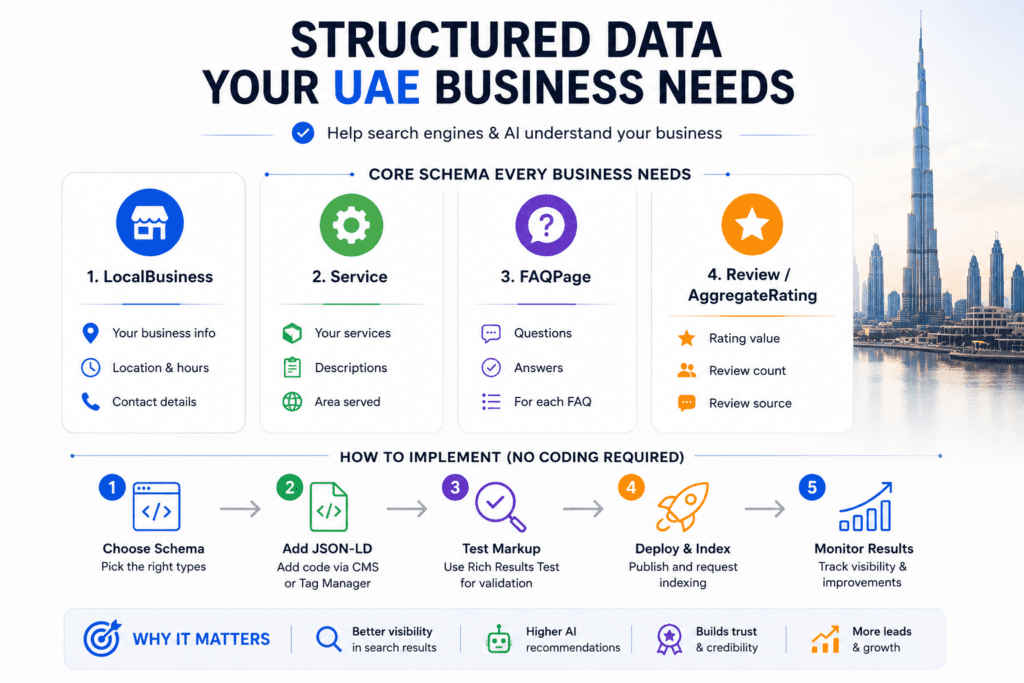
Most UAE business websites have no structured data at all. They are well-designed, professionally written, and optimised for keywords, but they are invisible to the part of Google’s systems that reads machine-readable signals about what a page is, who is behind it, and why it is authoritative.
Structured data is code added to a webpage that explicitly tells search engines and AI engines what the page contains, using a shared vocabulary called Schema.org. Instead of a search engine inferring that a page belongs to a Dubai-based marketing agency from reading the text, structured data states it directly in a format the algorithm reads instantly and reliably.
For UAE service businesses investing in AI search visibility in 2026, structured data is not optional. It is foundational. This article covers the specific schema types that matter, why they matter, and how to implement them without needing to be a developer.
What Is Structured Data and Why Does It Matter?
Structured data is code, typically written in a format called JSON-LD, that is added to the HTML of a webpage. It does not change how the page looks to visitors. It changes how search engine crawlers and AI systems interpret the page’s content and the entity behind it.
Why it matters:
Without structured data: A search engine crawler reads your text, infers what type of business you are, guesses your location from contextual clues, and estimates your authority from external signals. This process is imprecise and prone to error.
With structured data: The crawler reads an explicit, machine-formatted statement: “This is a LocalBusiness named BRB, located in Dubai, UAE, offering GEO and digital marketing services, operating Monday to Friday, with a rating of 4.8 based on 62 reviews.” No inference required.
The commercial implications: Structured data directly improves:
- Google local search pack appearance
- Google Knowledge Panel accuracy and completeness
- Google AI Overview citation probability
- Perplexity and ChatGPT entity recognition
- Rich Results appearance in Google search (FAQ accordions, review stars, service information)
How Structured Data Affects AI Search Recommendations
AI search engines face the same entity recognition challenge as traditional search engines, but at a higher level of complexity. They need to not just rank pages but understand entities well enough to recommend specific businesses to users by name.
Structured data is the clearest signal an AI engine can receive about what entity is behind a webpage and what it does.
Without structured data, an AI engine might:
- Confuse your business with another business of a similar name
- Attribute your services incorrectly to a different category
- Be uncertain enough about your entity that it excludes you from a recommendation where you should appear
- Describe your business inaccurately when generating a recommendation narrative
With structured data, an AI engine:
- Has an explicit, machine-readable entity declaration to reference
- Can match your entity to relevant queries with higher confidence
- Is more likely to include you in recommendations where the query matches your declared entity attributes
- Can describe your business accurately because the structured data provides the description
For UAE service businesses, this distinction is the difference between appearing and not appearing in AI-generated responses to “recommended [service category] in Dubai” queries.
The Core Schema Types Every UAE Service Business Needs
1. LocalBusiness (or subtype)
The LocalBusiness schema is the most important structured data type for UAE service businesses. It declares your business as a local entity with specific attributes.
Apply to: Homepage and About page
Key properties:
json
{
“@context”: “https://schema.org”,
“@type”: “LocalBusiness”,
“name”: “Your Business Name”,
“description”: “One to two sentence description of what you do and who you serve”,
“url”: “https://yourdomain.com”,
“telephone”: “+971-XX-XXX-XXXX”,
“email”: “contact@yourdomain.com”,
“address”: {
“@type”: “PostalAddress”,
“streetAddress”: “Your Street Address”,
“addressLocality”: “Dubai”,
“addressRegion”: “Dubai”,
“addressCountry”: “AE”
},
“geo”: {
“@type”: “GeoCoordinates”,
“latitude”: “YOUR_LATITUDE”,
“longitude”: “YOUR_LONGITUDE”
},
“openingHours”: “Mo-Fr 09:00-18:00”,
“areaServed”: “UAE”,
“sameAs”: [
“https://www.linkedin.com/company/your-company”,
“https://g.page/your-business-id”
]
}
Use a specific subtype where applicable:
- Marketing agency: ProfessionalService
- Medical clinic: MedicalClinic
- Legal firm: LegalService
- Restaurant: FoodEstablishment
- Real estate: RealEstateAgent
Specific subtypes carry more semantic precision than generic LocalBusiness and improve matching to specific query types.
2. Service
Apply Service schema to each individual service page to explicitly describe what the service is, what it includes, and who it is for.
Apply to: Each service page
Key properties:
json
{
“@context”: “https://schema.org”,
“@type”: “Service”,
“name”: “Generative Engine Optimization (GEO)”,
“description”: “AI search optimisation for UAE service businesses to appear in Perplexity, Google Gemini, and ChatGPT recommendations”,
“provider”: {
“@type”: “LocalBusiness”,
“name”: “BRB (Big Red Button)”
},
“areaServed”: “UAE”,
“serviceType”: “Digital Marketing”
}
3. FAQPage
Apply FAQPage schema to any page containing a FAQ section.
Apply to: Service pages, homepage FAQ section, dedicated FAQ pages, blog articles with FAQ sections
json
{
“@context”: “https://schema.org”,
“@type”: “FAQPage”,
“mainEntity”: [
{
“@type”: “Question”,
“name”: “How much does GEO cost in UAE?”,
“acceptedAnswer”: {
“@type”: “Answer”,
“text”: “GEO services for UAE businesses typically range from AED 3,000 to AED 12,000 per month.”
}
}
]
}
4. Article
Apply Article schema to every blog post and long-form content page on your website.
Apply to: All blog articles and resource pages
Key properties:
json
{
“@context”: “https://schema.org”,
“@type”: “Article”,
“headline”: “Article Title”,
“description”: “Meta description text”,
“author”: {
“@type”: “Organization”,
“name”: “BRB (Big Red Button)”
},
“publisher”: {
“@type”: “Organization”,
“name”: “BRB (Big Red Button)”,
“logo”: {
“@type”: “ImageObject”,
“url”: “https://yourdomain.com/logo.png”
}
},
“datePublished”: “2026-05-09”,
“dateModified”: “2026-05-09”
}
Additional Schema for Specific Business Types
For medical clinics and healthcare businesses:
- MedicalClinic schema
- Physician schema for named practitioners
- MedicalProcedure schema for specific treatments
For legal services:
- LegalService schema
- Attorney schema for named lawyers
For restaurants and food businesses:
- FoodEstablishment schema
- Menu schema
- Review and AggregateRating schema
For real estate businesses:
- RealEstateAgent schema
- RealEstateListing schema for specific properties
For e-commerce:
- Product schema
- Offer schema
- AggregateRating schema for product reviews
Universal additions for all business types:
- BreadcrumbList schema on all internal pages (helps AI understand site hierarchy)
- WebSite schema on the homepage (with sitelinks search box if relevant)
- SiteNavigationElement schema for main navigation items
How to Implement Structured Data on Your Website
Option 1: WordPress with Rank Math or Yoast (recommended for most UAE businesses) Both Rank Math and Yoast SEO plugins include structured data generation as a core feature. Rank Math has more granular control and is generally considered the stronger tool for structured data implementation.
Setup steps for Rank Math:
- Install Rank Math plugin
- Navigate to Rank Math > Schema
- Set your LocalBusiness schema with your business details
- Rank Math auto-generates Article schema for blog posts
- Add custom schema to service pages using the Schema Builder
Option 2: Google Tag Manager Structured data can be injected via Google Tag Manager without modifying website code. Useful for businesses that do not have direct CMS access.
Option 3: Manual JSON-LD implementation For custom-built websites, JSON-LD blocks can be added directly to page templates. Add the JSON-LD code in a <script type=”application/ld+json”> tag in the page’s <head> section.
Option 4: Dedicated schema generation tools Schema markup generators (TechnicalSEO.com/tools/schema-markup-generator) allow you to create the JSON-LD code without writing it from scratch, and the output can be pasted into your website.
The web development agency in Dubai services BRB provides include structured data implementation as a standard component of all website builds and migrations, ensuring that AI search signals are built into the site architecture from day one.
How to Test That Your Structured Data Is Working
Google Rich Results Test: Go to search.google.com/test/rich-results and enter your URL. The tool shows all structured data Google has detected on the page and flags any errors or warnings. Run this test on your homepage, main service pages, and one blog article.
Schema Markup Validator: Go to validator.schema.org and enter your URL or paste your JSON-LD code. This shows whether the schema is valid according to Schema.org specifications.
Google Search Console: Under Enhancements in Search Console, Google reports on specific rich result types detected on your site and highlights pages with errors.
What to check:
- Is structured data detected on your homepage?
- Is LocalBusiness or your specific business type schema present?
- Are FAQ schema entries valid and correctly formatted?
- Are there any critical errors flagged in the Rich Results Test?
FAQ
Does structured data directly improve my Google rankings? Structured data is not a direct ranking factor in the traditional sense. However, it improves entity clarity, which influences AI Overview citation, Rich Results eligibility, and local search pack visibility, all of which affect the commercial outcomes associated with ranking.
Is JSON-LD the only way to add structured data? No. Structured data can also be added via Microdata or RDFa formats embedded in the HTML. However, JSON-LD is the Google-recommended approach and is easiest to implement and maintain without affecting the visible HTML structure of the page.
What happens if my structured data has errors? Errors in structured data are common and range from minor (missing optional properties) to significant (invalid property values). Minor errors typically do not affect performance. Significant errors may result in rich results not appearing. Use the Google Rich Results Test regularly to identify and correct errors.
Do I need a developer to implement structured data? For WordPress websites with Rank Math or Yoast, no developer is required for standard schema types. For custom websites or more advanced schema implementations, developer involvement is recommended to ensure the code is correctly placed and does not conflict with existing page structure.
How often does structured data need to be updated? Update your LocalBusiness schema whenever your business information changes (address, phone, hours, services). Review Article schema on any updated blog content. FAQ schema should be updated whenever FAQ questions or answers change.
Conclusion
Structured data is the technical foundation that supports everything else in an AI search optimisation strategy. Without it, AI engines must guess at entity attributes and content type. With it, those attributes are explicitly declared and reliably readable.
The UAE service businesses that are appearing in AI-generated recommendations consistently are almost always businesses whose websites include the core schema types described in this article. The businesses that are invisible to AI search, despite ranking well on Google, are often technically capable websites that have never had structured data implemented.
The implementation is not complicated. Start with LocalBusiness schema on your homepage. Add Service schema to your service pages. Add FAQPage schema to any page with FAQ content. Test with the Rich Results Test. Expand from there.
This is one of the highest-leverage technical investments a UAE service business can make, and for most businesses it can be completed in a single afternoon.